
Here's something that should probably keep more orthopedic surgeons up at night than it currently does: when a clinic spins your blood in a centrifuge and reinjects the platelet-rich concentrate back into your creaky knee, does it matter which centrifuge they used? Because it turns out we've been collectively shrugging at that question for years, and a new pilot trial (NCT07491367) is finally demanding an answer.
The Platelet Problem Nobody Talks About
Platelet-rich plasma, or PRP, has become the darling of regenerative medicine over the past decade. The basic pitch is seductive in its simplicity: draw some of your own blood, spin it really fast, concentrate the platelets (which are packed with growth factors), and inject that golden concentrate back into your damaged joint. Your body essentially gets a pep talk from its own biology. No synthetic drugs, no foreign substances. Just you, helping you.
The trouble is that PRP is a bit like ordering a "salad" at different restaurants. One place gives you a bed of mixed greens with heirloom tomatoes and a balsamic reduction. Another hands you a bowl of iceberg lettuce with a crouton on top. Both technically qualify as salad. Both are wildly different experiences.
The PRP world has the same problem. Different preparation systems yield different platelet concentrations, different white blood cell counts, and different growth factor profiles. And yet, when patients Google "PRP for knee osteoarthritis," they encounter it as though it were a single, standardized treatment. It is not. Not even close.
Two Machines Enter, Your Knee Decides
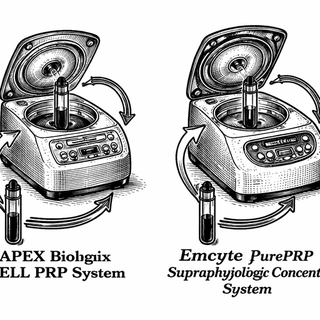
This new pilot study, registered on ClinicalTrials.gov, pits two FDA-approved, commercially available PRP preparation systems against each other: the APEX Biologix XCELL PRP System and the Emcyte PurePRP Supraphysiologic Concentrating System. Both are used in clinics across the country. Both promise to produce high-quality PRP. But "high-quality" is doing a lot of heavy lifting in that sentence.
The investigators are recruiting participants with knee osteoarthritis - the wear-and-tear variety where your cartilage has been slowly grinding itself into irrelevance - and comparing the PRP output from each machine. They're looking at platelet counts, platelet function, and (here's the part patients actually care about) whether participants feel any different after the injection depending on which system prepared their PRP.
This is, in research terms, a head-to-head comparison. And in a field that has spent years comparing PRP to hyaluronic acid, corticosteroids, and placebo, it's refreshing to see someone asking the more fundamental question: are we even comparing apples to apples when we talk about PRP?
Why This Matters More Than You Think
Knee osteoarthritis affects over 365 million people worldwide and is one of the leading causes of disability in adults over 50. Current treatment options range from physical therapy and anti-inflammatory medications to total knee replacement, which, while effective, involves someone literally sawing into your femur and replacing your joint with metal and plastic. There's a reason patients are interested in alternatives.
PRP has shown genuine promise. A systematic review and meta-analysis by Belk et al. found that PRP provided superior pain relief and functional improvement compared to hyaluronic acid injections for knee OA, with benefits lasting up to 12 months (doi: 10.1177/03635465211015010). Another comprehensive review by Kon et al. in Expert Opinion on Biological Therapy highlighted PRP's potential while simultaneously noting that the enormous variability in preparation methods makes it nearly impossible to draw universal conclusions (doi: 10.1080/14656566.2020.1798928).
And that variability problem is precisely what this trial targets. Magalon et al. demonstrated back in 2014 that five different commercial PRP preparation devices produced significantly different platelet concentrations and growth factor levels from the same donor's blood (doi: 10.1016/j.arthro.2014.04.067). Chahla et al. later issued what amounted to a polite but urgent plea for standardization in PRP preparation protocols, noting that the field's failure to agree on what PRP actually is was undermining the entire body of research (doi: 10.2106/JBJS.16.01374). Everts et al. echoed these concerns in a 2020 review that called for better classification systems and more rigorous characterization of PRP products (doi: 10.3390/ijms21207794).
So we've known about this problem for at least a decade. It's nice to see someone actually doing something about it.
The Bigger Picture
If this pilot study shows that the two systems produce meaningfully different PRP - different platelet concentrations, different functional characteristics, different clinical outcomes - the implications cascade quickly. It would mean that clinical trials comparing "PRP" to other treatments are potentially comparing different things every time, depending on what machine was used. It would mean that a patient getting PRP at Clinic A might be receiving a fundamentally different product than a patient at Clinic B. And it would mean that the entire PRP literature needs to be interpreted with a much larger asterisk than it already carries.
On the flip side, if both systems produce comparable PRP with similar outcomes, that's also valuable information. It would suggest a degree of robustness in the preparation process and give clinicians more confidence that their choice of system isn't inadvertently shortchanging their patients.
Either way, the data wins.
What to Watch For
This is a pilot study, so temper your expectations accordingly. Pilot studies are the "let's see if this question is even worth asking at scale" phase of research. The sample size will be small. The conclusions will be preliminary. But pilots are how big questions get their start, and this one asks a question that the regenerative medicine field has been tap-dancing around for too long.
For patients considering PRP for knee osteoarthritis, the practical takeaway is this: ask your provider which system they use and why. It's a reasonable question, and any clinician worth their white coat should be able to answer it without breaking a sweat.
For researchers, the takeaway is even simpler: it's 2026. We should probably know whether the machine matters.
Disclaimer: This blog post is for informational and educational purposes only and does not constitute medical advice. Clinical trial results are pending and have not been peer-reviewed. Always consult with a qualified healthcare provider before making decisions about your treatment.
Clinical Trial Reference: NCT07491367 - Pilot Exploration of Platelet Characterization of Platelet Rich Plasma Created by Two Different Systems | Table View
Citations:
1. Belk JW, et al. "Platelet-Rich Plasma Versus Hyaluronic Acid for Knee Osteoarthritis: A Systematic Review and Meta-Analysis." Am J Sports Med. 2021. doi: 10.1177/03635465211015010
2. Kon E, et al. "Platelet-rich plasma for the treatment of knee osteoarthritis: an expert opinion and proposal for a novel classification and coding system." Expert Opin Biol Ther. 2020. doi: 10.1080/14656566.2020.1798928
3. Magalon J, et al. "Characterization and Comparison of 5 Platelet-Rich Plasma Preparations in a Single-Donor Model." Arthroscopy. 2014. doi: 10.1016/j.arthro.2014.04.067
4. Chahla J, et al. "A Call for Standardization in Platelet-Rich Plasma Preparation Protocols and Composition Reporting." J Bone Joint Surg Am. 2017. doi: 10.2106/JBJS.16.01374
5. Everts P, et al. "Platelet-Rich Plasma: New Performance Understandings and Therapeutic Considerations in 2020." Int J Mol Sci. 2020. doi: 10.3390/ijms21207794