
The crowd is on its feet, the clock is running down, and monkeypox diagnostics just sent in a very specialized closer from the bullpen. On one side: an emerging infectious disease that public health systems would prefer not to chase with slow, clunky detection tools. On the other: a new electrochemical biosensor that combines CRISPR/Cas12a, a hybridization chain reaction, and a DNA tetrahedron sensing interface. It is the kind of lineup only a molecular biologist and an overcaffeinated procurement office could love. But if this technology holds up, it could make detecting monkeypox virus faster, more sensitive, and a lot more useful when outbreaks start behaving like policy stress tests.
That is what makes this paper interesting. It is not simply “another test.” It is a test designed around amplification at multiple steps, with the clear goal of spotting tiny amounts of monkeypox viral DNA that might otherwise slip through the cracks. In public health, those cracks are where outbreaks go to become budget hearings.
Why monkeypox detection still matters
Monkeypox virus, now more commonly referred to in many public health settings as mpox, became globally familiar the hard way. Once an infection moves beyond a geographically limited problem and starts showing up across multiple health systems, diagnostics stop being a niche lab concern and start becoming infrastructure. You need tools that are accurate, fast, practical, and ideally capable of detecting infection before case counts start making epidemiologists sigh into their spreadsheets.
Traditional laboratory methods can work very well, but they often depend on specialized equipment, trained personnel, and workflows that are not exactly famous for their breezy simplicity. That is fine when capacity is abundant. Capacity, however, is one of those things governments are convinced exists right up until it does not.
This study tackles a plain but consequential problem: how do you detect monkeypox virus with very high sensitivity using a biosensor platform that can translate a molecular event into a measurable electrical signal?
The short version of how this test works
The system described in the paper is an electrochemical biosensor. That means the readout comes from changes in electrical behavior at a sensing surface. Think of it as a microscopic checkpoint where the chemistry either triggers a signal or it does not.
Here is the chain of events.
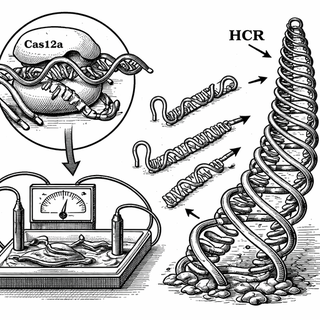
First, if monkeypox viral DNA is present, it activates CRISPR/Cas12a. Cas12a is a CRISPR-associated enzyme that can be programmed to recognize a specific DNA target. Once it finds that target, it becomes enzymatically active and starts cutting nearby nucleic acid sequences in a broader way. This is one reason CRISPR has become such a tempting tool for diagnostics. It does not just recognize. It reacts.
Second, that CRISPR activity is linked to a hybridization chain reaction, or HCR. HCR is a signal amplification method where DNA components assemble into longer structures once the trigger is present. Bureaucratically speaking, it is a document routing process that somehow improves efficiency instead of destroying it.
Third, the whole affair happens on a DNA tetrahedron-mediated sensing interface. DNA tetrahedrons are nanoscale three-dimensional structures made from DNA strands arranged into a defined shape. On a sensor surface, they can help organize molecular interactions more neatly and predictably than a messier flat attachment scheme. In regulatory language, this is standardization with ambition.
Finally, the HCR product carries horseradish peroxidase, an enzyme label that catalyzes a reaction involving TMB and hydrogen peroxide. That reaction generates the electrochemical signal the device measures. So the presence of monkeypox DNA gets translated into an amplified, trackable electrical output.
In plain English, the authors built a very elaborate molecular mousetrap, and that is a compliment.
Why the layering matters
The notable feature here is not just CRISPR. It is the stacking of amplification strategies.
CRISPR/Cas12a gives specific target recognition and enzymatic cleavage activity.
HCR multiplies the downstream signal.
The DNA tetrahedron interface improves organization and potentially boosts sensing performance at the surface.
The enzyme label adds another strong readout layer.
Each element by itself has value. Together, they aim to create an ultrasensitive detection platform. That matters because low viral loads can be hard to detect, especially early in infection or in samples where target material is scarce. A more sensitive system could reduce false negatives and improve confidence in testing.
And from a health policy perspective, sensitivity is not a boring technical footnote. It is often the difference between containing a problem and writing a memo about why containment was “operationally challenging.”
What this could mean in the real world
If follow-up development goes well, this kind of biosensor could be useful in outbreak settings where rapid, accurate detection matters for isolation decisions, contact tracing, and surveillance. Public health agencies do not just need tests that work in ideal conditions. They need tests that can help manage uncertainty when time, staffing, and logistics are all in short supply.
A highly sensitive monkeypox test could support:
- Earlier case identification
- Better outbreak monitoring
- Faster triage of suspected infections
- More confidence when infection levels are low but still epidemiologically meaningful
It also points to a broader systems issue. We tend to treat diagnostics as supporting actors, when in reality they are policy engines. The speed and quality of detection shape everything that comes after: reporting, clinical management, public communication, and resource allocation. A diagnostic bottleneck can turn a manageable event into an institutional scavenger hunt.
The usual fine print, because science is not a victory parade
This is promising research, but it is still research. A clever biosensor design is not the same thing as a fully deployed public health tool.
Several questions still matter. How does the test perform across real-world sample types? How reproducible is it outside carefully controlled lab conditions? Can it be scaled, standardized, and packaged into something clinics or public health labs can actually use without requiring a minor moon landing? What are the costs, turnaround times, and robustness under routine handling?
Those are not trivial details. They are the details that decide whether a strong paper becomes a practical diagnostic platform or a very elegant PDF.
There is also the broader challenge of adoption. Health systems do not absorb new technology simply because it is scientifically impressive. They absorb technology when it fits workflows, reimbursement structures, supply chains, validation frameworks, and regulatory expectations. In other words, the molecule still has to meet the meeting.
Why this paper deserves attention
What I like about this study is that it reflects a more mature view of diagnostics. It is not only asking whether a target can be detected. It is asking how to engineer the interface, the amplification logic, and the signal output so the whole system performs better. That is the kind of thinking that turns molecular cleverness into something with public health potential.
For mpox and other emerging infections, that matters. Outbreak response is often discussed like a grand strategy problem, full of geopolitics, emergency declarations, and supply-chain charts. But sometimes it comes down to whether a sensor can reliably notice a few strands of viral DNA before the rest of the system is forced to improvise.
This paper is a reminder that preparedness is not just stockpiles and dashboards. Sometimes preparedness is a DNA tetrahedron quietly doing excellent administrative work at the nanoscale.
This blog post discusses research findings and should not be taken as medical advice. If you have concerns about monkeypox or mpox, please consult a healthcare provider. Research discussed here represents ongoing scientific investigation and clinical validation is still in progress.
All images used in this post are decorative illustrations only and do not represent or reflect the accuracy, reality, or correctness of the referenced research.
Primary Source: Ultrasensitive detection of monkeypox virus: harnessing synergistic CRISPR-driven signal amplification on a DNA tetrahedron-mediated sensing interface. PubMed Record 41592354. https://pubmed.ncbi.nlm.nih.gov/41592354/