
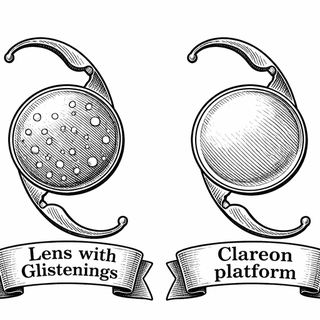
Here's a riddle that keeps cataract surgeons up at night: you perform a flawless operation, implant a perfectly engineered artificial lens, and your patient walks out seeing 20/20. Five years later, the same patient is back in your office squinting at the eye chart like it personally wronged them. The lens hasn't moved. It hasn't cracked. But something inside it has gone subtly, maddeningly wrong. Tiny water-filled vacuoles - called "glistenings" - have bloomed through the optic like condensation on a bathroom mirror. The surgery was a success, but the lens material had other plans.
This, in a nutshell, is why the Clareon TruPlus Single-Arm Study (NCT07502456) matters.
Wait, 30 Million Surgeries a Year and We're Still Tweaking the Lens?
Cataract surgery is, by volume, the most commonly performed surgical procedure on planet Earth. Roughly 30 million people per year have their clouded natural lens scooped out and replaced with an intraocular lens (IOL) - a tiny, folded piece of optical-grade polymer that unfurls inside the eye like the world's most consequential origami. The procedure takes about 15 minutes. Recovery is measured in days. Patient satisfaction rates hover above 95%. By any reasonable standard, it's a solved problem.
Except it isn't. Not quite.
The dirty little secret of IOL technology is that the lens you implant today needs to perform flawlessly for the next 30 to 40 years. That's an absurd engineering challenge. Imagine buying a car and being told it needs to run perfectly until 2066 with no oil changes, no tire rotations, and no scheduled maintenance - while being continuously bathed in a warm saline solution. Welcome to the life of an intraocular lens.
Enter the Clareon Platform
Alcon's Clareon platform represents the company's answer to the glistening problem. The traditional hydrophobic acrylic material used in earlier-generation IOLs (including Alcon's own wildly successful AcrySof line) was prone to developing those pesky micro-vacuoles over time. Were they clinically significant? Ophthalmologists have argued about this for decades with the intensity normally reserved for parking disputes. Some studies suggested glistenings degraded contrast sensitivity and visual quality; others shrugged and called them cosmetically annoying but functionally irrelevant.
Alcon, wisely, decided to sidestep the debate entirely by engineering a material that simply doesn't do it. The Clareon platform uses a reformulated hydrophobic acrylic with a higher water content equilibrium, designed to dramatically reduce glistening formation. Early published data has been encouraging - the material shows significantly fewer glistenings compared to its predecessors, with optical clarity that appears durable over multi-year follow-up.
So What Exactly Is the TruPlus?
The Clareon TruPlus is a monofocal IOL, meaning it's designed to provide clear vision at a single focal point - typically distance. "But wait," you might say, "don't we already have monofocal IOLs that work just fine?" We do. Millions of them. But the word "TruPlus" in the name is doing some heavy lifting here.
The current trend in IOL design is the "enhanced monofocal" - a lens that's technically classified as monofocal but uses subtle optical modifications to extend the functional range of vision beyond what a standard single-focus lens provides. Think of it as a monofocal lens that went to night school. You still get your excellent distance vision, but the optical design nudges your depth of focus just enough to provide some functional intermediate vision - the kind you need for dashboard gauges, computer screens, and reading the check at dinner without reaching for your readers.
This is a sweet spot that a lot of patients (and surgeons) have been looking for. Multifocal and trifocal IOLs can provide vision at multiple distances, but they split light between focal points, which can reduce contrast sensitivity and produce halos around lights at night. Extended depth of focus (EDOF) lenses stretch the focal range more aggressively but come with their own trade-offs. The enhanced monofocal concept aims to give patients a meaningful visual bonus over a standard monofocal without the optical compromises of more complex designs.
The Trial Itself
The Clareon TruPlus study is a single-arm study, meaning every enrolled participant receives the TruPlus lens - there's no control group getting a different IOL for comparison. This design is typical for generating initial safety and performance data on a new device, essentially answering the question: "Does this lens do what it's supposed to do, and does it do so without hurting anyone?"
The study will collect data on visual acuity outcomes, adverse events, and device performance in patients undergoing standard cataract surgery. Because the IOL is intended to remain in the eye for the patient's lifetime, long-term follow-up data is particularly valuable.
Why Should You Care?
If you're under 50 and reading this, cataracts probably feel like somebody else's problem. They're not. By age 75, roughly half of all Americans either have a cataract or have already had cataract surgery. By 80, that number climbs above 70%. This is not a question of if but when.
And when your turn comes, you'll want the lens that your surgeon implants to be the product of decades of iterative improvement - material science that resists degradation, optical designs that maximize your visual range, and clinical data from trials exactly like this one proving that the thing actually works as advertised.
The Clareon TruPlus represents the convergence of two important trends: materials that stay optically clear for decades and optical designs that squeeze more functional vision out of a monofocal platform. If the trial data bears out, it could offer cataract patients a compelling option that delivers enhanced visual range without the halos, glare, and adaptation issues that sometimes accompany more complex multifocal designs.
In the world of IOL technology, the sexiest innovation isn't always the flashiest. Sometimes it's the lens that just quietly does its job - for the next 40 years - without you ever having to think about it again.
And honestly? That's about the most you can ask of anything you put inside your body.
Disclaimer: This blog post is for informational and educational purposes only and does not constitute medical advice. Treatment decisions should be made in consultation with a qualified healthcare provider. Clinical trial results are pending and may differ from expectations.
Citation:
- ClinicalTrials.gov. Clareon TruPlus Single-Arm Study. Identifier: NCT07502456. Available at: https://clinicaltrials.gov/study/NCT07502456