
Let's be real - selenium supplementation kind of sucks. Here's why.
You've got a trace element that your body absolutely needs for antioxidant defense, thyroid function, and immune health. But take too much in its raw chemical forms - selenite, selenate, the stuff crammed into supplement capsules - and you're flirting with toxicity faster than a resident flirts with the coffee machine at 3 AM. The therapeutic window between "helpful" and "your liver would like a word" is uncomfortably narrow. It's like trying to thread a needle while riding a mechanical bull.
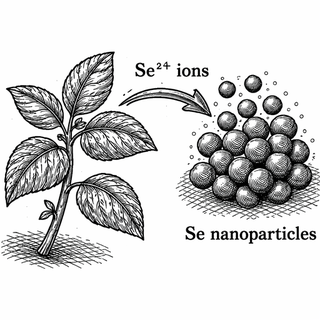
So what if plants could do the manufacturing for us, wrapping selenium into tiny, biocompatible packages that your body actually knows what to do with? That's exactly what a new study on PAF-SeNPs (selenium nanoparticles synthesized through plant-driven interfacial redox transformation) set out to prove - and the results are worth paying attention to.
Nano-Sized Selenium, Plant-Assembled
The concept behind this research is elegant in its simplicity: instead of synthesizing selenium nanoparticles using harsh industrial chemicals (sodium borohydride, hydrazine, the kind of stuff that makes your safety officer weep), the researchers used plant phytochemicals to do the heavy lifting.
Here's how it works. When you introduce selenium ions into a solution rich in plant-derived compounds - polyphenols, flavonoids, terpenoids, the whole botanical pharmacy - something beautiful happens at the interface. The phytochemicals donate electrons to the selenium ions, reducing them from their oxidized ionic form down to elemental selenium. This is the "interfacial redox transformation" part of the title, and it's basically chemistry doing what chemistry does best: shuffling electrons around until something useful falls out.
But the phytochemicals don't just build the nanoparticles and clock out. They stick around as a "cap" - a molecular coating that stabilizes the particles, prevents them from clumping together into useless chunks, and (here's the kicker) contributes their own biological activity to the final product. It's a two-for-one deal. The selenium brings antioxidant firepower, and the plant coating brings additional protective compounds along for the ride.
Why Size Matters (In Nanoparticles, At Least)
For anyone who hasn't spent quality time in a nanotechnology lab, let me break down why making selenium really, really small is such a big deal.
Bulk selenium and ionic selenium compounds have well-documented toxicity issues. They're like that colleague who's great in small doses but absolutely unbearable in large quantities. Selenium nanoparticles, by contrast, offer dramatically lower toxicity while maintaining - and in some cases enhancing - biological activity. The nano-sized particles have greater surface area relative to their volume, which means better cellular uptake and more efficient interaction with biological targets.
Think of it like the difference between swallowing a marble and dissolving a powder. Same material, radically different bioavailability.
The PAF-SeNPs in this study take it a step further. Because the phytochemical capping agents are biocompatible molecules that cells already recognize and tolerate, these nanoparticles essentially come with a biological passport. They're less likely to trigger inflammatory responses or accumulate in tissues where they're not wanted.
The Protective Bioefficacy - What It Actually Does
The study investigated the "protective bioefficacy" of these plant-capped selenium nanoparticles, and this is where things get clinically interesting.
Selenium's role as a cofactor for glutathione peroxidase - one of your body's most important antioxidant enzymes - is well established. When oxidative stress starts hammering your cells (and in the ER, I see the downstream consequences of this every shift: liver damage, cardiovascular events, inflammatory cascades that spiral out of control), having adequate selenium-dependent antioxidant capacity is the difference between cells that recover and cells that wave a white flag.
The PAF-SeNPs demonstrated enhanced protective effects compared to what you'd expect from selenium alone. The phytochemical coating appears to contribute synergistic antioxidant and cytoprotective activity. In plain English: the plant wrapper makes the selenium work better.
This dual-action approach - nanoparticle core providing selenium bioactivity plus a phytochemical shell providing additional protection - is genuinely clever. It's the nanomedicine equivalent of wearing both a belt and suspenders, except in this case, both the belt and the suspenders are actively fighting oxidative damage.
Green Synthesis: Better for the Planet, Better for the Patient
There's a broader trend here worth noting. The field of "green nanotechnology" has been gaining serious momentum over the past decade, and for good reason.
Traditional nanoparticle synthesis involves toxic reducing agents, organic solvents, and energy-intensive processes. Green synthesis using plant extracts eliminates most of those headaches. The reactions happen at or near room temperature. The reagents are biodegradable. The waste products won't make an environmental scientist cry into their lab notebook.
And from a translational medicine perspective, nanoparticles synthesized with biological reducing agents tend to be more biocompatible out of the gate. You're not spending months trying to wash industrial contaminants off your particles before you can even think about putting them into a biological system.
What This Means Going Forward
Let me temper the enthusiasm with a dose of clinical reality. This is still early-stage research. We're not prescribing plant-capped selenium nanoparticles in the ER anytime soon. The jump from "demonstrates protective bioefficacy in a controlled study" to "FDA-approved therapeutic" is roughly the distance from Earth to Jupiter, and about as pleasant to traverse.
But the foundation being laid here is solid. Understanding exactly how phytochemical capping agents drive nanoparticle formation - and how they contribute to biological activity - is the kind of mechanistic insight that moves a field forward. It's not just "we mixed plants with selenium and something good happened." It's "here's the redox chemistry, here's the capping mechanism, here's the biological outcome, and here's why they're connected."
For a trace element with a notoriously slim margin between therapeutic and toxic, finding ways to deliver it more safely and effectively isn't just academically interesting. It's the kind of research that, five or ten years down the road, could change how we think about micronutrient supplementation, oxidative stress management, and biocompatible drug delivery.
And honestly? If we can get plants to build our nanomedicines for us while we focus on other things, that sounds like the best kind of delegation.
This blog post discusses research findings and should not be taken as medical advice. If you have concerns about selenium supplementation or oxidative stress-related conditions, please consult a healthcare provider. Research discussed here represents ongoing scientific investigation and clinical validation is still in progress.
All images used in this post are decorative illustrations only and do not represent or reflect the accuracy, reality, or correctness of the referenced research.
Primary Source: Interfacial redox transformation and phytochemical capping drive the formation and protective bioefficacy of selenium nanoparticles. PubMed. 2026. PMID: 41943625