
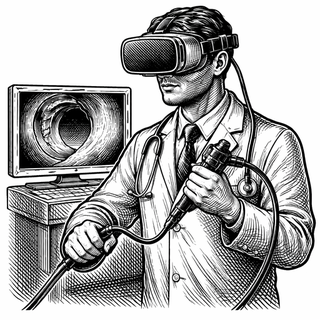
Here's a sentence I genuinely never expected to write: somebody is running a clinical trial where gastroenterologists perform endoscopies while wearing an Apple Vision Pro. Not as a dare. Not on a bet. As actual registered medical research (NCT07493863).
And honestly? It might be one of the most practical uses anyone has found for the thing.
The Problem Nobody Talks About at Dinner Parties
Endoscopy is, mechanically speaking, the culinary equivalent of trying to julienne vegetables while looking at a TV mounted six feet to your left, holding a four-foot flexible knife, and standing in the same position for 45 minutes straight. Now do that eight to twelve times a day, five days a week, for a 30-year career.
The result is predictable. Endoscopists are getting wrecked. Studies have consistently shown that somewhere between 37% and 89% of endoscopists report musculoskeletal pain related to their work, depending on which survey you read and how generous the researchers were with the word "pain." A landmark survey by Shergill and colleagues found that endoscopist injuries most commonly affect the neck, back, shoulders, and thumbs - essentially every body part involved in the awkward ergonomic pretzel that modern endoscopy demands (Shergill et al., Gastrointestinal Endoscopy, 2009; DOI: 10.1016/j.gie.2008.10.052).
The core issue is monitor placement. During a standard endoscopy, the physician holds the scope with both hands while watching a screen that's positioned somewhere in the room - usually off to one side, sometimes above, occasionally in a location that seems chosen by someone who has never actually performed the procedure. This forces sustained neck rotation and extension that, over years, does to cervical vertebrae what repeatedly bending a paperclip does to metal.
Enter the Face Computer
The clinical trial, which plans to enroll approximately 140 endoscopic procedures, is testing whether the Apple Vision Pro virtual reality headset can be worn during endoscopy to improve ergonomics. The concept is surprisingly straightforward: instead of craning your neck to look at a wall-mounted monitor, the endoscopy feed appears in a virtual display that follows your natural line of sight. You look wherever is comfortable, and the screen is just... there.
Think of it like the difference between reading a cookbook propped open on the counter versus one taped to your ceiling. Same recipe, wildly different neck outcomes.
This isn't the first time someone has tried head-mounted displays in endoscopy. Earlier attempts using Google Glass and various HMDs showed mixed results - the resolution was often too low, the displays too small, or the devices too uncomfortable for extended wear. A systematic review by Ong and colleagues examining wearable technology in surgical settings found that while the concept was promising, early devices were limited by display quality and field of view (Ong et al., Surgical Endoscopy, 2023; DOI: 10.1007/s00464-023-10044-3).
The Apple Vision Pro changes the recipe somewhat. Its dual micro-OLED displays deliver roughly 23 million pixels of resolution - more than enough to spot the subtle mucosal changes that make or break an endoscopic diagnosis. The passthrough cameras mean the physician isn't completely sealed off from the room. And the eye-tracking interface means they don't need to touch anything with their scope-holding hands.
Why This Actually Makes Ergonomic Sense
A study published in Endoscopy International Open found that monitor height and angle significantly affected cervical spine loading during simulated endoscopy, with non-optimal positions increasing muscle activation by 30-60% (Won et al., Endoscopy International Open, 2020; DOI: 10.1055/a-1216-1939). The problem is that "optimal" monitor placement varies by physician height, procedure type, and room layout - and most endoscopy suites aren't exactly swimming in adjustable mounting options.
A head-mounted display sidesteps this entirely. The "monitor" is always at the perfect angle because it's always wherever the physician is looking. It's like having a personal chef who rearranges the kitchen around you while you cook, except the kitchen is a GI suite and the cooking involves a lot more sedation.
Riedle and colleagues further demonstrated that endoscopist posture during procedures routinely exceeds recommended ergonomic thresholds, with many physicians spending more than 50% of procedure time in positions classified as "high risk" by occupational health standards (Riedle et al., Gastrointestinal Endoscopy, 2023; DOI: 10.1016/j.gie.2023.04.007).
The Skeptic's Corner
Now, I wouldn't be doing my job if I didn't point out some potential wrinkles in this soufflé.
First, the Apple Vision Pro weighs about 650 grams. Strapping 650 grams to your face for a 45-minute colonoscopy might solve your neck angle problem while creating an entirely new neck loading problem. That's like fixing a leaky faucet by redirecting the water to a different sink.
Second, there's the question of depth perception and spatial awareness. Endoscopy occasionally requires the physician to interact with the physical world - adjusting patient position, communicating with nursing staff, handling biopsy forceps. The Vision Pro's passthrough is good, but "good" and "good enough for medical procedures" are different categories entirely.
Third, and I say this with love: the Apple Vision Pro looks absolutely ridiculous. Patient confidence is a real thing, and there's a conversation to be had about whether your gastroenterologist suiting up like they're about to enter the Metaverse before examining your colon inspires the kind of trust you're looking for in that moment.
Why It Matters Anyway
Skepticism aside, this trial matters because it's attacking a genuinely underserved problem. Endoscopist burnout and injury are contributing to workforce shortages in gastroenterology at a time when demand for screening colonoscopies is increasing. The American Society for Gastrointestinal Endoscopy has published guidelines on ergonomics, but the fundamental hardware setup of the endoscopy suite hasn't changed much in decades. The monitor is still on the wall. The doctor is still twisting to look at it.
If this feasibility study shows that the VR headset is practical - that physicians can perform procedures safely, that image quality is sufficient for clinical decisions, that the device doesn't fog up or cause headaches after procedure number seven - it opens a door to rethinking how endoscopy suites are designed. Not necessarily with Apple Vision Pros specifically, but with the general concept that the display should adapt to the physician rather than the other way around.
It's worth noting that similar head-mounted display approaches have shown ergonomic benefits in laparoscopic surgery, where the same neck-craning-at-a-monitor problem exists. A randomized crossover study by Weidner and colleagues found significant reductions in neck and shoulder strain when surgeons used head-mounted displays versus conventional monitors during laparoscopic tasks (Weidner et al., Surgical Endoscopy, 2024; DOI: 10.1007/s00464-024-10735-1).
The Bottom Line
Is strapping an Apple Vision Pro to an endoscopist's face going to revolutionize gastroenterology? Probably not tomorrow. But this trial is asking exactly the right question: can we use existing consumer technology to solve a chronic occupational health problem that's been quietly grinding down an essential medical workforce?
Sometimes the most interesting clinical trials aren't testing a new drug or a novel surgical technique. Sometimes they're just testing whether we can stop hurting the people who are trying to help us.
And if it means your gastroenterologist looks like a ski goggle enthusiast during your next colonoscopy, well - you'll be sedated anyway.
Clinical Trial Reference: NCT07493863 - Feasibility and Ergonomic Impact of A Virtual Reality Headset in Endoscopic Procedures | Table View
Disclaimer: This blog post is for educational and informational purposes only and does not constitute medical advice. The clinical trial discussed is ongoing, and no conclusions about efficacy or safety should be drawn from this summary. Always consult with qualified healthcare professionals regarding medical conditions and treatments. The author has no financial relationship with Apple Inc. or any entity involved in this trial.
is a contributor to Biomedical Observer covering medical device innovation and clinical technology. He has strong opinions about monitor placement.