
Spoiler alert: researchers built a 3D-printed titanium scaffold laced with zinc and immune-signaling cytokines that boosted bone growth by nearly 20% in animal models while simultaneously telling inflammation to sit down and be quiet. If that sentence sounds like it was written by someone who plays too many RPGs, stick around, because the actual science is even cooler than the loot description.
The Problem With Holes in Bones
During my paramedic days, I saw plenty of fractures. Most of them healed fine because human bone is remarkably good at fixing itself - up to a point. But when you're dealing with large bone defects (think tumor removal, severe trauma, or degenerative disease), the body throws up its hands and says, "This is above my pay grade." The gap is just too big for natural repair mechanisms to bridge.
Traditional solutions include bone grafts - harvesting bone from somewhere else in the patient's body or using donor tissue. Both come with downsides. Autografts mean a second surgical site (congratulations, now you have two problems), and allografts carry infection and rejection risks. It's like trying to fix a pothole by digging up your own driveway.
This is where bone tissue engineering enters the chat. The idea is to build a scaffold - basically construction scaffolding for your skeleton - that gives cells something to grab onto and grow. Titanium has been the material of choice for decades because it's biocompatible, strong, and your immune system mostly tolerates it. But plain titanium scaffolds are like building a house frame with no insulation, no wiring, and no plumbing. Structurally sound, functionally incomplete.
Enter the Overachieving Scaffold
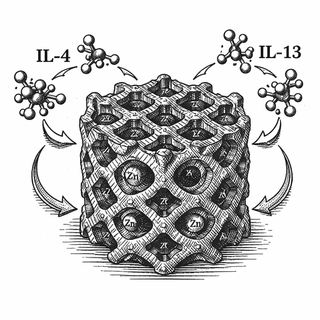
A research team recently developed what I can only describe as the Swiss Army knife of bone implants. Their creation - designated IL4/IL13@SM@pTi-Zn, which sounds like a wifi password but is actually quite elegant - takes a 3D-printed porous titanium scaffold and upgrades it in two major ways.
First, they incorporated zinc into the titanium structure. Zinc isn't just for cold lozenges and sunscreen. At the cellular level, it promotes osteogenesis (bone formation) and has antimicrobial properties. Think of it as giving the scaffold a built-in vitamin regimen.
Second, and this is the clever part, they coated the scaffold with interleukin-4 (IL-4) and interleukin-13 (IL-13). These are cytokines - molecular messengers that tell your immune system what to do. Specifically, IL-4 and IL-13 are anti-inflammatory signals. They encourage macrophages (the immune cells that show up first to any injury) to switch from their angry, tissue-destroying M1 mode into their calm, tissue-repairing M2 mode.
It's like having a bouncer at a club who not only keeps troublemakers out but also hands everyone inside a cup of chamomile tea.
The Numbers Don't Lie (And They're Pretty Impressive)
The research team published their findings showing results at both the cellular and whole-animal level (PubMed: 41964693).
In lab dishes, mouse bone marrow stem cells grown on the scaffold showed dramatic increases in key bone-building gene expression compared to plain titanium:
- Alkaline phosphatase (early bone formation marker): up 148%
- COL1A1 (collagen, the structural protein of bone): up 198%
- Runx2 (the master switch for bone cell differentiation): up 250%
- OPN/osteopontin (bone remodeling signal): up 245%
For context, a 250% increase in Runx2 expression is like your construction crew suddenly working two-and-a-half times faster. That's not a marginal improvement - that's the difference between a project finishing on schedule and finishing a whole season early.
On the immune side, the scaffold reduced pro-inflammatory markers and lowered reactive oxygen species (ROS) accumulation inside cells. ROS are those free radicals your supplement-pushing uncle keeps warning you about, except in this case the concern is legitimate - excessive ROS at an injury site creates a hostile environment that sabotages healing.
From Lab Bench to Rabbit Legs
The team then tested the scaffold in a rabbit femoral condyle defect model - essentially a standardized bone hole drilled into the thigh bone near the knee. At four weeks, micro-CT imaging showed that the fancy scaffold group had a 14.8% higher bone volume fraction (BV/TV) than controls. By eight weeks, that gap widened to 18.3%.
Trabecular thickness - the actual thickness of the tiny bone struts that make up spongy bone - increased by 21.3% at four weeks and 22.2% at eight weeks. If bone quality were a batting average, this scaffold just moved from the minor leagues to the All-Star game.
Why This Matters Beyond the Lab
The real innovation here isn't any single component. Zinc-enhanced scaffolds exist. Cytokine-loaded implants exist. 3D-printed titanium is practically old news. What's noteworthy is the combination - a single implant that simultaneously provides structural support, promotes bone cell activity, calms inflammation, and reduces oxidative stress.
Current orthopedic implants often require patients to take separate anti-inflammatory medications, undergo multiple procedures, or accept that healing will be slow and incomplete. A scaffold that handles multiple jobs from day one could simplify treatment protocols and improve outcomes for patients with large bone defects from trauma, tumor surgery, or degenerative conditions.
The Obligatory Reality Check
This is still preclinical research. Rabbits are not humans (despite what some of my former patients behaved like on Saturday nights). The jump from animal models to human clinical trials involves years of safety testing, regulatory review, and manufacturing scale-up. The 3D printing aspect actually helps with that last part - custom implants matched to a patient's specific defect geometry are theoretically printable right now.
There are also questions about long-term cytokine release kinetics. How long do the IL-4 and IL-13 remain active? Does the zinc release at a safe, steady rate or does it spike? These are the kinds of details that separate a promising lab result from an actual product in an operating room.
Still, the dual-action approach - building bone while managing inflammation - represents exactly the kind of multifunctional thinking that bone tissue engineering has been moving toward. It's not enough to just fill the hole anymore. You've got to manage the whole neighborhood.
This blog post discusses research findings and should not be taken as medical advice. If you have concerns about bone health or orthopedic conditions, please consult a healthcare provider. Research discussed here represents ongoing scientific investigation and clinical validation is still in progress.
All images used in this post are decorative illustrations only and do not represent or reflect the accuracy, reality, or correctness of the referenced research.
Primary Source: Multifunctional 3D-Printed Titanium Alloy Composite-Coated Scaffold for Modulating the Immune Microenvironment and Promoting Osteogenesis. PubMed. 2026. PMID: 41964693