
There's a quiet revolution happening in nerve repair, and most people have no idea. It lives at the microscopic scale, where surgeons, biomaterials, and immune systems are all negotiating over the aftermath of injury. The latest wrinkle is almost comically small: leftover donor cell nuclei inside biologic nerve wraps. Tiny specks, big consequences. It is a bit like buying a “cleaned” apartment and then discovering the previous tenant still has socks in every drawer.
Peripheral nerve injuries are a serious problem. They can leave people with chronic pain, numbness, weakness, and reduced function that can linger long after the original injury. In surgical repair, one common strategy is to use biologically derived nerve wraps. These wraps are designed to reduce scar formation, limit adhesions, and create a friendlier environment for nerve healing. Conceptually, they are the surgical equivalent of giving a recovering nerve some personal space and a decent working environment.
That sounds straightforward enough, but the materials themselves are not all made the same way.
What This Study Asked
The study behind this paper looked at commercially available extracellular matrix, or ECM-based, nerve wraps and asked a very practical question: how much donor nuclear material is still left behind after processing?
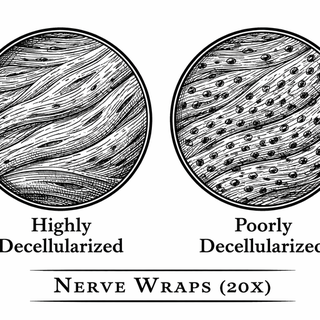
That matters because decellularization is supposed to remove donor cells while preserving the structural scaffold of the tissue. The scaffold is the useful part. The donor cellular leftovers are more like uninvited guests. Residual nuclei and other cell fragments have been linked to immune reactions, chronic inflammation, and fibrotic encapsulation. None of those outcomes are exactly on a surgeon’s wish list.
So the researchers focused on two measurable endpoints using standard histology with hematoxylin and eosin staining at 20X magnification:
- The number of visible nuclei per three representative microscopic fields
- The percentage of cell-free fields per sample
This is the kind of study I appreciate because it asks the numbers to do the talking. No hand-waving. No mystical claims about “biocompatibility” floating free of evidence. Just: how many nuclei are actually there?
What the Numbers Actually Say
The main finding is variability. A lot of it.
Some products showed what looks like highly effective decellularization. One reconstituted xenograft and one porcine placental product had more than 90 percent cell-free fields and fewer than 10 nuclei per field. That is a very clean result by the standards of this comparison.
Other products landed at the opposite end of the spectrum. A native porcine small intestinal submucosa product and a human amnion/chorion membrane showed more than 50 nuclei per field and zero percent cell-free fields.
Zero percent.
That is not a subtle difference. That is not “more research needed” in the vague, shrugging sense. That is a visible, countable gap between products that appear thoroughly decellularized and products that retain a substantial amount of donor nuclear material.
When you see a spread that wide, the pattern practically waves at you from across the room.
Why That Matters Beyond the Microscope
The point here is not that all nerve wraps are bad or that one histology slide decides clinical destiny. The point is that products marketed for similar surgical purposes may arrive with very different biological baggage.
If retained donor nuclei can contribute to inflammatory responses, then decellularization quality is not just a manufacturing footnote. It may shape how the body reacts after implantation. And in nerve repair, where scar tissue, fibrosis, and adhesion can interfere with regeneration, that reaction is not trivial.
Biomaterials often get discussed as though they are passive. They are not. The body notices things. The immune system, in particular, has the personality of an overachieving auditor. If there is residual cellular material where it should not be, it tends to ask questions.
This study suggests that one useful way to compare these materials is not by branding language or broad category labels, but by direct histological quantification. Count the nuclei. Measure the cell-free fields. See what is still there.
A Useful Reminder About “Biologic” Products
There is a tendency, especially outside the lab, to treat “biologic” or “extracellular matrix-based” as if those labels automatically imply harmony with the body. But biology is not automatically gentle. Plenty of biologic materials work beautifully, and plenty require careful processing to avoid triggering exactly the reactions they are meant to reduce.
That is what makes decellularization such a big deal. The ideal ECM scaffold preserves structural and biochemical cues that support healing while removing the donor components most likely to provoke trouble. It is a narrow target. Too little processing leaves behind cellular remnants. Too much processing can damage the scaffold itself. Manufacturing, as usual, is where elegant theory goes to wrestle with reality.
This paper does not solve every downstream clinical question, but it does sharpen one key issue: “ECM-based” is not a synonym for “uniform.”
Why This Research Is Interesting
I find this study interesting because it turns a fuzzy concept into something countable. “Biocompatibility” often gets used as a broad umbrella term, but here the authors push toward reproducible histological metrics that could help standardize how these products are evaluated.
That matters for surgeons choosing materials. It matters for manufacturers defending their processing methods. And it matters for patients, even if they never hear the phrase “cell-free field” in their lives, which is probably for the best.
If follow-up work connects these histological differences to meaningful clinical outcomes, such as reduced inflammation, better nerve gliding, less fibrosis, or improved recovery, then this kind of assessment could become more than a lab exercise. It could become part of how better biomaterials are designed, selected, and regulated.
In plain English: if you can measure what is being left behind, you have a better shot at understanding which products are more likely to play nicely with healing tissue.
The Bigger Picture
The broader challenge in regenerative medicine is that “processed tissue” is never just one thing. Source tissue, species, preparation method, sterilization, and manufacturing choices all change the final product. This study highlights that even within one category of nerve wraps, the endpoint can vary dramatically.
That should push the field toward more transparent quality metrics. Not glossy claims. Not broad equivalence. Metrics.
Because when one product shows more than 90 percent cell-free fields and another shows none, we are not dealing with a rounding error. We are looking at fundamentally different residual biological profiles.
And honestly, that is the kind of result that deserves attention. Nerves already have enough problems without dragging leftover donor nuclei into the conversation.
This blog post discusses research findings and should not be taken as medical advice. If you have concerns about peripheral nerve injuries, chronic pain, sensory loss, or motor dysfunction, please consult a healthcare provider. Research discussed here represents ongoing scientific investigation and clinical validation is still in progress.
All images used in this post are decorative illustrations only and do not represent or reflect the accuracy, reality, or correctness of the referenced research.
Primary Source: Quantification of Retained Donor Nuclei in ECM-Based Nerve Wraps: A Histological Assessment of Decellularization and Biocompatibility. PubMed Record 42013899. https://pubmed.ncbi.nlm.nih.gov/42013899/