
How much healing is just biology doing its thing, and how much is physics quietly running the room like an underappreciated stage manager? When it comes to wounds, the answer appears to be: quite a lot. Skin repair is not only about cells dividing and collagen organizing itself into something useful. It is also about moisture, fluid flow, structural support, and the small logistical miracle of keeping the wound environment wet enough to heal but not so wet that it turns into a swamp.
That balancing act is exactly what makes this new wound dressing study interesting. Researchers developed a bilayer "Janus" dressing made from acetylated curdlan, a modified polysaccharide, with one side designed to love water and the other designed to resist it. The result is a material that moves wound fluid in one direction, fast, while blocking it from flowing back. In other words, it behaves less like a passive bandage and more like a tiny traffic control system for exudate.
Why wound fluid is such a big deal
Wound exudate is one of those biological details that rarely gets top billing, but the numbers say it matters. Too little moisture and tissues dry out, cells struggle, and healing slows. Too much and the wound bed becomes overly soggy, surrounding skin can break down, and infection risk rises. Chronic wounds live in this messy middle ground. They need fluid management that is precise, not just absorbent.
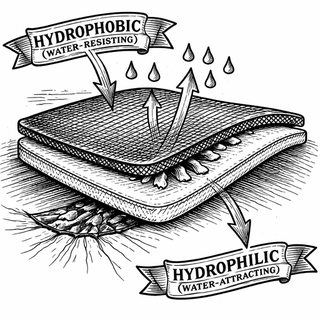
Most dressings can soak things up. Fewer can direct fluid movement with intention. That is the clever part here. The dressing has two layers with different surface properties. The outer layer is more hydrophilic, meaning it attracts water. The inner layer is more hydrophobic, meaning it resists water. Together, they create unidirectional transport, a sort of fluid diode. Engineers love a diode because it enforces order. Wound fluid apparently does too.
The material science trick
The dressing was built using electrospinning, a fabrication method that creates very fine fibrous membranes. The researchers used acetylated curdlan with carefully tuned degrees of substitution. That phrase sounds intimidating, but the underlying idea is straightforward: they chemically modified the same base material to different extents, which changed how each layer interacts with water.
One layer used low-substitution acetylated curdlan and became the hydrophobic inner side. The other used high-substitution acetylated curdlan and became the hydrophilic outer side. Same family of material, different personalities. Think identical twins where one organizes spreadsheets for fun and the other owns three raincoats but never remembers an umbrella.
This pairing produced rapid fluid uptake in under 3 seconds through the hydrophilic side, while the hydrophobic side prevented backflow. That is the kind of metric I appreciate. "Works well" is nice. "Less than 3 seconds" is better. Biology gets a lot more convincing when it shows up with timestamps.
The performance numbers are not subtle
Here is what the numbers actually say.
The dressing showed a swelling capacity greater than 400% under physiological conditions. That means it can take in a lot of fluid relative to its original state, which is exactly what you want if wound exudate is part of the problem.
Mechanically, it also held up well in the wet state, which is where dressings actually have to perform instead of just looking impressive in a dry lab demo. The reported wet-state tensile strength was 5.7 MPa, and elongation at break was 55%. Translation: it was strong enough and flexible enough to stay intact during the very non-theoretical business of wound healing, where movement, moisture, and friction are all trying to make your material fail at the worst possible time.
This matters because many promising biomaterials have a bad habit of being excellent right up until they encounter the real world.
Cells seemed happy, which is non-negotiable
The researchers also tested biocompatibility in vitro using NIH-3T3 fibroblasts and human umbilical vein endothelial cells. They reported no cytotoxicity. That is not flashy, but it is essential. A dressing can have brilliant fluid dynamics, but if it annoys or harms the cells needed for repair, that is like designing a luxury hotel with no oxygen.
Fibroblasts are central to building new tissue and collagen. Endothelial cells are key players in blood vessel formation. If both cell types tolerate the material well, that is a strong early signal that the dressing is not just mechanically clever but biologically compatible too.
The rat wound model is where things get more interesting
In a full-thickness rat wound model, the bilayer dressing accelerated wound closure compared with other membrane-treated groups. It also enhanced collagen deposition, suggesting that repair was not merely faster but potentially more structurally organized.
The study further reported a five-fold increase in CD31-associated staining, pointing toward substantially improved angiogenesis. CD31 is commonly used as a marker related to blood vessel formation. More vascularization generally means better nutrient and oxygen delivery to healing tissue, which is the wound-care equivalent of improving both the supply chain and the road network at the same time.
That combination matters. Exudate control addresses the physical environment. Collagen deposition reflects tissue rebuilding. Increased CD31 signal suggests support for vascular regeneration. The dressing is not just mopping up fluid. It may be shaping a more favorable healing ecosystem.
Why this is intriguing beyond one paper
What I like about this study is that it solves multiple problems with one material architecture. Chronic wounds are difficult because they are not one-variable systems. They involve moisture imbalance, tissue damage, inflammation, impaired vascularization, and often mechanical stress. A dressing that only absorbs fluid is helpful, but limited. A dressing that absorbs fluid, prevents backflow, maintains integrity, and supports regenerative processes starts to look more like a platform technology.
The phrase "Janus dressing" is fitting. Janus was the Roman god of duality and transitions, and this material really does have two faces with two jobs. One pulls fluid away. The other blocks the return trip. It is a simple concept, but simplicity is often what wins when translated into real medical products.
Of course, one animal study is not the same as clinical adoption. There are still questions about manufacturing scale, cost, long-term storage stability, infection performance in more complex wound settings, and how it compares against current advanced dressings in humans. The distance between "promising biomaterial" and "something your wound clinic stocks routinely" is longer than most abstracts make it seem.
Still, the logic here is solid. The design is targeted. The material properties are quantified. The biological readouts move in the right direction. For a field that often wrestles with tradeoffs, this study suggests you may be able to engineer a dressing that is both physically smart and biologically supportive.
And honestly, I am always a little charmed when a medical advance comes down to giving fluid fewer bad options.
This blog post discusses research findings and should not be taken as medical advice. If you have concerns about wound healing or chronic wounds, please consult a healthcare provider. Research discussed here represents ongoing scientific investigation and clinical validation is still in progress.
All images used in this post are decorative illustrations only and do not represent or reflect the accuracy, reality, or correctness of the referenced research.
Primary Source: PubMed Record 41679850. Substitution-degree-engineered acetylated curdlan Janus dressing: Unidirectional self-pumping for efficient wound exudate management and accelerated healing. Available at: https://pubmed.ncbi.nlm.nih.gov/41679850/