
Let's play two truths and a lie. One: iron is the most abundant metal in your body. Two: cancer cells hoard hydrogen peroxide like my kids hoard Halloween candy. Three: scientists are combining those two facts to blow up tumors from the inside. If you guessed number one is the lie (it's actually calcium), congratulations - you're already smarter than me before I read this paper. But here's what matters: truths two and three? Those are the real deal, and they might change how we fight cancer.
Wait, We're Fighting Cancer with Rust Now?
Okay, not literal rust. But chemically? Pretty close. A recent review published in 2025 digs into the rapidly advancing field of iron-based chemodynamic therapy, or CDT for short (DOI: 10.1016/j.pmatsci.2025.101479). As a parent who reads way too many research papers at 2 a.m. wondering "could this help someone's kid someday?" - this one genuinely got my attention.
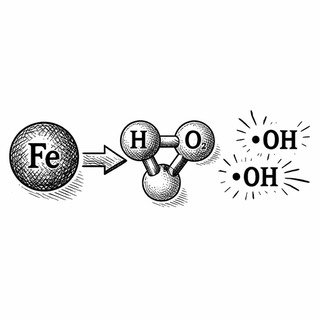
Here's the elevator pitch: tumor cells are weirdly full of hydrogen peroxide (H₂O₂). Normal cells? Not so much. Iron-based CDT exploits this difference by delivering iron into the tumor, where it reacts with all that stockpiled H₂O₂ through something called the Fenton reaction. The result? Highly toxic hydroxyl radicals that shred cancer cells from the inside out. It's like the tumor built its own destruction toolkit and just needed someone to hand it the instruction manual.
The Fenton Reaction: High School Chemistry Goes Hardcore
If you remember anything from chemistry class (and I barely do), you might recall that iron can exist in different oxidation states - Fe²⁺ and Fe³⁺ being the headliners. When Fe²⁺ meets hydrogen peroxide, it kicks off the Fenton reaction, generating hydroxyl radicals (·OH). These radicals are among the most reactive oxygen species known to science. They don't negotiate. They don't file paperwork. They just destroy whatever biological molecules they bump into - lipids, proteins, DNA. In a cancer cell swimming in H₂O₂, this is spectacularly bad news for the tumor.
The beauty of this approach is its selectivity. Normal, healthy tissue has relatively low levels of H₂O₂ and maintains tight control over its iron. Tumors, on the other hand, live in what researchers describe as a mildly acidic, oxidatively stressed microenvironment - basically a chemical disaster zone that happens to be the perfect operating theater for Fenton chemistry. It's one of those rare situations where the disease's own dysfunction becomes its Achilles' heel.
Why Parents Should Care About Nanoparticle Delivery
Now, you can't just hand someone an iron supplement and call it cancer therapy (please don't try this at home). The real advances covered in this review involve engineered nanoparticles - tiny iron-based carriers designed to accumulate specifically in tumor tissue. These include iron oxide nanoparticles, iron-organic frameworks, and iron-doped nanomaterials that researchers have been tuning like a Formula 1 engine.
The nanoparticle approach solves several problems at once. First, it gets iron where it needs to go - into the tumor, not just floating around your bloodstream. Second, many of these nanocarriers are designed to release their iron payload only under the acidic conditions found inside tumors. Third - and this is where it gets really exciting for anyone with a kid who's terrified of chemotherapy side effects - CDT doesn't rely on external energy sources like radiation or light. It's powered entirely by the tumor's own screwed-up chemistry.
For comparison, photodynamic therapy needs a laser. Radiation therapy needs, well, radiation. CDT just needs the tumor to keep being a tumor. That's a meaningfully lower burden on the patient, especially a young one.
The Combo Platter: CDT Plays Well with Others
One of the most promising threads in this review is how iron-based CDT combines with other therapies. Researchers are pairing it with photothermal therapy, immunotherapy, and even traditional chemotherapy to create synergistic effects. Some nanoplatforms are designed to simultaneously deliver chemotherapy drugs AND catalyze the Fenton reaction, hitting cancer from multiple angles at once.
There's also fascinating work on how CDT can trigger immunogenic cell death - essentially making the dying tumor cells "visible" to the immune system in a way that trains the body to hunt down remaining cancer cells. If that pans out in clinical settings, we're talking about a treatment that doesn't just kill the tumor you can see, but helps your body find the ones you can't.
The Reality Check (Because I'm a Realist)
Before anyone gets too excited - and I say this as someone who desperately wants to get excited - most of this work is still preclinical. We're talking cell studies and animal models, not Phase III clinical trials. The jump from "works in mice" to "works in your kid" is enormous, littered with the wreckage of therapies that looked incredible in the lab and fizzled in humans.
There are also legitimate challenges around controlling the Fenton reaction rate, ensuring nanoparticle safety long-term, and scaling up manufacturing. Hydrogen peroxide levels vary between tumors and even within different regions of the same tumor, which means the therapy's effectiveness could be inconsistent.
But here's why I'm cautiously optimistic: the fundamental science is sound, the materials are relatively biocompatible, and the field is moving fast. The sheer volume of research being published on iron-based CDT in the last three years suggests this isn't a flash in the pan.
So, Will This Help My Kid?
Not tomorrow. Probably not next year. But the trajectory is pointing somewhere genuinely hopeful. A cancer treatment that weaponizes the tumor's own biochemistry, spares healthy tissue, doesn't require external energy, and can be combined with immunotherapy to train the body's own defenses? That's worth watching closely.
I'll be keeping this paper bookmarked next to my coffee maker, right where I do my best worrying and hoping in equal measure.
This blog post discusses research findings and should not be taken as medical advice. If you have concerns about cancer treatment options, please consult a healthcare provider. Research discussed here represents ongoing scientific investigation and clinical validation is still in progress.
All images used in this post are decorative illustrations only and do not represent or reflect the accuracy, reality, or correctness of the referenced research.
Primary Source: Advances in iron-based chemodynamic anti-cancer therapy. 2025. PubMed: 41962808