
For decades, regenerative medicine promised us lab-grown organs would be just around the corner. The plot twist? Researchers got really, really good at describing lungs down to the single-cell level - and then realized that describing a lung and actually building one that works are two spectacularly different problems. It's a bit like having a perfect blueprint of a Ferrari but no engine, no transmission, and honestly no idea how to make the tires grip the road. A new review brings together the scientists who are finally tackling the "make it actually work" part, and as a parent who spends way too much time thinking about whether emerging research might someday help my kids, this one has my attention.
Why Lungs Are the Final Boss of Organ Engineering
If you've ever wondered why we can grow skin grafts and even coax stem cells into mini-brains in a dish, but nobody's handing out lab-grown lungs yet, the answer is humbling. Your lungs are absurdly complex. We're talking about an organ that has to simultaneously handle gas exchange across around 300 million tiny air sacs (alveoli), pump blood through a capillary network that could stretch across a tennis court, fend off every germ you inhale, and do all of this while being mechanically squished and expanded roughly 20,000 times a day by your breathing.
That's not one engineering problem. That's like five PhD theses wearing a trenchcoat pretending to be one organ.
Recent advances in single-cell profiling and spatial mapping have given us an incredibly detailed parts list - every cell type, every developmental pathway, every molecular signal. But as this review points out, knowing all the ingredients doesn't mean you can bake the cake. The field hit a bottleneck: plenty of tools to describe lung biology, not enough platforms to test whether engineered tissue can actually do the job under real physiological conditions (Fang et al., 2026).
Crystal Ribcages and Other Things That Sound Made Up But Aren't
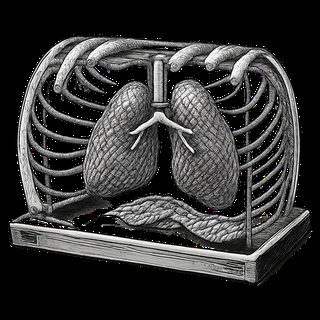
One of the most exciting developments covered in this review is what researchers call the "crystal ribcage" approach. Before you picture some kind of fantasy armor, it's actually a transparent imaging platform that lets scientists watch lung function in real time - alveoli expanding and contracting, blood flowing through capillaries, immune cells patrolling for trouble, and the extracellular matrix remodeling itself. All of it, live, under conditions that mimic actual breathing.
This is a game-changer. Previously, testing engineered lung tissue meant growing something in a dish and then basically squinting at it under a microscope, hoping the cells looked right. Now scientists can ask the question that matters most: does this tissue actually breathe? Does blood flow through it correctly? Do the immune cells know what to do?
As a parent, I think of it this way: it's the difference between checking if your kid's science project looks nice on the poster board versus testing whether the volcano actually erupts. Function over appearance. Performance over promise.
From Replacement Parts to Smart Repairs
Here's where the research gets particularly interesting for anyone whose child might need lung-related medical care someday. The traditional approach to regenerative medicine has been "grow a whole new organ and swap it in." This review suggests the field is pivoting toward something potentially more practical: targeted functional augmentation.
Instead of trying to build an entire lung from scratch (see above re: five PhD theses in a trenchcoat), researchers are exploring interventions that could repair or boost specific damaged regions. Think of it less like replacing your car's engine and more like a mechanic who identifies exactly which valve is sticking and fixes just that.
The review covers cell-based therapies, molecular interventions, and even subcellular approaches - all designed around the specific constraints of different lung regions. Because the airways near your throat face different challenges than the delicate gas-exchange surfaces deep in your lungs, a one-size-fits-all repair strategy was never going to cut it. Region-specific design is the name of the game now.
What Medical Devices Can Teach Lung Builders
One of my favorite sections of this review draws lessons from the medical device industry, and honestly, it's the part that makes me trust this research direction the most. The authors argue that engineered lung tissues need to meet the same non-negotiable benchmarks that medical devices face: durability, infection resistance, and mechanical integrity.
This is incredibly practical thinking. It's not enough for a regenerative construct to work on day one. It needs to survive the relentless mechanical stress of breathing, resist colonization by bacteria, and hold its structural integrity over time. Anyone who's ever watched a toddler treat their belongings like crash-test dummies understands the value of durability testing.
By borrowing the translation framework from device development - where you don't get to market without proving your gadget survives real-world abuse - lung regeneration researchers are setting themselves a higher, more honest bar for success.
So When Can My Kid Actually Benefit?
Let's be real: nobody is getting a lab-grown lung next year. Or probably in the next five years. But what this review represents is a fundamental shift in how the field measures progress. Instead of celebrating because cells look right under a microscope, researchers are now demanding proof of function. Does it breathe? Does it perfuse? Does it defend itself?
That shift - from descriptive biology to functional biodesign - is exactly the kind of progress that eventually leads to clinical therapies. For conditions like bronchopulmonary dysplasia in premature infants, cystic fibrosis, or lung damage from severe infections, the targeted repair strategies outlined here could someday offer options beyond lung transplant wait lists.
For now, I'm cautiously optimistic. The tools are getting better, the questions are getting sharper, and the standards are getting higher. As a parent, that's exactly the kind of scientific progress I want to see - not flashy promises, but honest, function-first engineering that might actually help real kids with real lung problems someday.
And if they need to build a crystal ribcage to get there? Honestly, that's just cool.
This blog post discusses research findings and should not be taken as medical advice. If you have concerns about lung conditions or regenerative therapies, please consult a healthcare provider. Research discussed here represents ongoing scientific investigation and clinical validation is still in progress.
All images used in this post are decorative illustrations only and do not represent or reflect the accuracy, reality, or correctness of the referenced research.
Primary Source: Fang et al. Engineering Function in Lung Biology: Integrating Imaging, Regenerative Constructs, and Functional Biodesign. PubMed. 2026. DOI: 42030197