
Less than one-tenth of a degree Celsius. That's the thermal sensitivity of a temperature sensor small enough to ride piggyback on a fiber-optic probe already threading its way into a mouse brain. To put that in perspective, your kitchen meat thermometer is about ten times less precise, and it doesn't have to fit inside a living organ the size of a walnut.
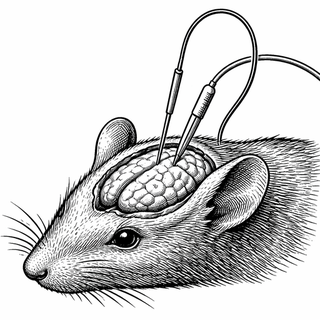
Welcome to the quietly bonkers world of neural interface engineering, where the question isn't just "can we control brain cells with light?" but "are we accidentally cooking them while we do it?"
The Optogenetics Heating Problem Nobody Loves Talking About
Optogenetics has been the darling of neuroscience for over a decade now. The pitch is elegant: genetically modify neurons to express light-sensitive proteins, implant a tiny fiber optic, shine a light, and watch specific brain circuits flip on or off like a molecular light switch. It's given us extraordinary insights into everything from addiction pathways to motor control.
Here's the awkward footnote, though. Light carries energy. Energy becomes heat. And brain tissue is, to use a technical term, exquisitely fussy about temperature. Even a fraction of a degree can alter neural firing rates, change synaptic transmission, and confound your beautiful optogenetic experiment with plain old thermal artifacts. You think you're watching a neuron respond to your precisely targeted light pulse, but you might just be watching it complain about getting warm.
Previous studies have shown that high-power optogenetic stimulation can raise local brain temperature by several degrees Celsius - enough to cause tissue damage in extreme cases, and more than enough to muddy your data in routine ones. The problem is that measuring this temperature change right where the light hits has been, well, a logistical nightmare.
The "Why Can't We Just Stick a Thermometer Next to It?" Problem
Traditional approaches to monitoring brain temperature during optogenetics involve placing a separate thermal sensor alongside the optical fiber. This sounds reasonable until you remember that we're talking about a mouse brain. Every additional probe you jam in there increases tissue damage, displaces neural tissue, and - here's the real kicker - creates a spatial mismatch. Your temperature reading comes from a spot that's near the illumination zone, not in it. It's like trying to measure the temperature of your oven by holding a thermometer near the door handle. You'll get a number, sure, but it won't be the number you actually need.
Coaxial designs (wrapping one probe around another) and side-by-side configurations have tried to solve this, but they inevitably bulk up the implant cross-section, which means more tissue displacement and more damage. The neuroscience community has been stuck in an engineering catch-22: measure temperature accurately, or minimize brain damage. Pick one.
Enter the Two-Photon-Printed Micro-Thermometer
A research team has now published what amounts to an elegant hack for this problem. They've built a microscale resistance temperature detector - dubbed a µRTD - directly onto the curved surface of a tapered optical fiber. Same fiber that delivers the light. Same probe. One implant, two functions, minimal footprint.
The manufacturing process is where things get genuinely clever. Patterning a functional sensor onto a curved, tapered surface isn't exactly something you can do with a stencil and a steady hand. The team used two-photon polymerization (TPP), a type of ultra-precise 3D printing that uses focused laser pulses to build structures at the microscale. If regular 3D printing is building with LEGO bricks, TPP is building with individual atoms of LEGO, on a surface that's shaped like a sharpened pencil tip.
The result? A temperature sensor with sub-0.1°C sensitivity, low self-heating (so it doesn't create the very problem it's designed to detect), and - critically - co-localized with the light delivery point. The thermometer is exactly where the action is.
What They Actually Found (The Part That Matters)
With their integrated probe in hand, the researchers ran a series of experiments using standard optogenetic stimulation and inhibition protocols in mouse brain tissue. The findings carry a reassuring-with-caveats quality that will be familiar to anyone who's spent time in biomedical research.
Short pulses at typical intensities? Minimal temperature rise. The kind of brief, targeted stimulation that forms the backbone of most optogenetic experiments appears to be thermally benign. Your data is probably fine. Exhale.
However - and there's always a however - longer illumination periods (hundreds of milliseconds to several seconds) at high intensities produced significant thermal accumulation. This is particularly relevant for optogenetic inhibition protocols, which often require sustained light exposure. The neurons you're trying to silence might be getting an unwanted thermal nudge at the same time. It's the neurophysiological equivalent of trying to quiet a room by turning on a space heater.
Why This Matters Beyond Mouse Brains
The implications ripple outward in several directions. For the optogenetics community, this probe provides a way to establish thermal safety boundaries for stimulation protocols with actual local measurements, not estimates or extrapolations from distant sensors. That's a significant upgrade for experimental rigor.
But the TPP fabrication approach is arguably the bigger story. The modular nature of the platform means additional functionalities - electrophysiological recording electrodes, thermoplasmonic elements - can be layered onto the same fiber using the same manufacturing technique. It's a Swiss Army knife approach to neural interfaces, where each new tool gets added without making the whole thing bigger.
As optogenetic techniques inch closer to clinical applications (there are already human trials for retinal conditions), the ability to monitor thermal safety in real-time, at the precise point of light delivery, transitions from "nice to have" to "absolutely non-negotiable." Nobody wants to be the research group that accidentally poached a patient's neurons because they didn't think to check the temperature.
The Takeaway
Sometimes the most impactful advances in neuroscience aren't flashy new discoveries about consciousness or memory. Sometimes they're a really, really small thermometer, built in a really, really clever way, answering a question that nobody could measure properly before. It's not glamorous work. But it's the kind of engineering that keeps the glamorous work honest.
And in science, honest data is the only kind worth having - even if it occasionally tells you that your favorite stimulation protocol runs a little hot.
This blog post discusses research findings and should not be taken as medical advice. If you have concerns about neurological conditions or neurostimulation therapies, please consult a healthcare provider. Research discussed here represents ongoing scientific investigation and clinical validation is still in progress.
All images used in this post are decorative illustrations only and do not represent or reflect the accuracy, reality, or correctness of the referenced research.
Primary Source: Localized Temperature Monitoring in Mouse Brain during Light Delivery via a Non-Planar Tapered Fiber-Integrated µRTD Sensor. PubMed. 2026. PMID: 41924887