
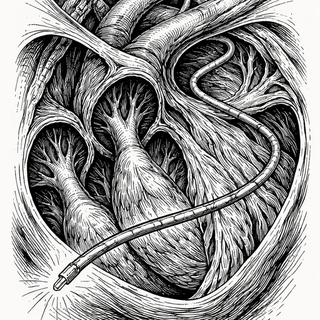
Let me save you a trip to medical school: some abnormal heart rhythms are hard to treat not because we do not know what the heart is doing, but because the heart insists on doing it while wriggling around in three dimensions like a goldfish being examined during an earthquake. That is the basic appeal of clinical trial NCT07541092, which looks at whether the Optrell mapping catheter can do a better job identifying ventricular arrhythmias that arise from the papillary muscles.
Why papillary muscle arrhythmias are such a nuisance
Papillary muscles are small muscular structures inside the ventricles. Their day job is helping the mitral and tricuspid valves behave themselves. Occasionally, though, they moonlight as troublemakers by giving rise to ventricular arrhythmias, which are abnormal electrical rhythms coming from the lower chambers of the heart.
The challenge is not just that these rhythms exist. It is that papillary muscles are awkward terrain. They move with every heartbeat, they sit inside a chamber full of blood, and they can make precise electrical mapping surprisingly difficult. If you are trying to ablate an arrhythmia, meaning burn or freeze the tiny patch of tissue causing the problem, you first have to know exactly where that problem lives. "Close enough" is not a phrase anyone wants to hear in cardiac electrophysiology.
What this trial is actually studying
According to the trial summary, this study explores the potential utility and superiority of the Optrell mapping catheter with TRUEref technology for ventricular arrhythmias arising from the papillary muscles. The idea is straightforward, at least by electrophysiology standards, which is to say straightforward with a few wires attached.
The hypothesis is that the catheter's design may allow faster and more accurate mapping for a few reasons:
- It has narrow electrode spacing, which may improve spatial resolution.
- It may achieve simultaneous contact of multiple bipoles with the papillary muscle surface.
- That simultaneous contact could help clinicians detect small activation-time differences between neighboring sites.
- Because the catheter can move with the papillary muscle, it may assign activation timing to the correct spot more accurately.
- Intracardiac echocardiography may help with optimal positioning.
That last point is worth pausing on. Imaging plus better mapping is often where progress happens in electrophysiology. A better catheter alone is useful. A better catheter placed well, while being guided by intracardiac echo, is where things get interesting.
Why this is more than gadget enthusiasm
Medicine does have a weakness for shiny devices. We are not immune. Put a sleek catheter in front of a room full of electrophysiologists and watch everyone suddenly speak in voltage maps. But this study is interesting for a real clinical reason.
Papillary muscle ventricular arrhythmias can be stubborn. Mapping them can be imprecise because the target is moving, the geometry is tricky, and activation patterns may differ only subtly from one nearby site to another. If the Optrell catheter really can sample multiple nearby points at once while maintaining better tissue contact, that could reduce the amount of educated guesswork. Less hunting, more finding. A noble goal in any field, but especially when the field involves catheters inside the left ventricle.
The practical problem this trial is trying to solve
In plain language, this is a location problem.
When a patient has a ventricular arrhythmia coming from a papillary muscle, the treating team needs to pinpoint where the electrical signal starts. Traditional mapping can be limited by motion, unstable contact, or the difficulty of appreciating tiny timing differences between adjacent sites. If the catheter is not truly where you think it is, or if it shifts as the papillary muscle moves, the map may be less reliable than it looks. And a beautiful map that is wrong is mostly decorative.
The trial's central claim is that the Optrell design may handle this moving-target problem better. Simultaneous contact across multiple bipoles could make the electrical picture sharper. Moving with the papillary muscle instead of fighting it could make the readings truer to the underlying anatomy. There is a certain irony here: after years of trying to hold everything still, the better strategy may be a tool that dances with the tissue instead.
What success could mean in the real world
If the study bears out its hypothesis, the impact could be practical and immediate.
More accurate mapping could mean:
- Shorter procedures
- Faster localization of the arrhythmia source
- More effective ablation
- Fewer repeat procedures
- Better confidence when dealing with anatomically difficult cases
That matters for patients because ventricular arrhythmias are not an abstract nuisance. They can cause palpitations, dizziness, fainting, reduced quality of life, and in some settings more serious risk. Even when a papillary muscle arrhythmia is not life-threatening, it can still be disruptive enough to make daily life feel like a negotiation with one's own ventricles.
For clinicians, a tool that improves mapping accuracy in this niche could also lower cognitive strain during procedures. Not every advance in medicine has to be a moon landing. Sometimes it is enough to make a hard case less maddening.
A few healthy caveats
This is still a clinical trial, not a coronation.
The summary provided makes a compelling technical argument, but technical plausibility is not the same thing as demonstrated clinical superiority. A catheter may generate prettier maps without necessarily improving durable patient outcomes. It may help in some anatomies more than others. It may perform best in expert hands, which is not nothing, but also not the same as broad real-world generalizability.
There is also the classic device-study question: are we seeing the benefit of the tool itself, the operator's experience, the imaging support, or all three tangled together like holiday lights in an EP lab drawer? Trials like this are how we sort that out, ideally before marketing departments write poetry about electrode geometry.
Why I am paying attention
I like research that targets a specific, annoying clinical problem with a plausible mechanical solution. This trial does exactly that. It is not promising to reinvent cardiology. It is asking whether a better-designed mapping catheter can make one difficult type of ventricular arrhythmia easier to map accurately. That is modest, focused, and potentially useful, which in medical research is often a better sign than grandiosity.
If the Optrell catheter proves superior in this setting, it could improve how electrophysiologists approach papillary muscle arrhythmias and spare some patients the misery of prolonged procedures or repeat attempts. And if it does not, that is useful too. Negative trials are still data, even if they get invited to fewer cocktail parties.
Trial record: ClinicalTrials.gov NCT07541092
Table view: ClinicalTrials.gov NCT07541092 Table View
Disclaimer: This post is for educational purposes only and is based solely on the clinical trial summary information provided here. It is not medical advice. For current study details, including sponsor, eligibility, status, and outcome measures, consult the full ClinicalTrials.gov record.
Citation: ClinicalTrials.gov. "The Comparative Advantage of the Optrell Mapping Catheter in Ventricular Arrhythmias From the Papillary Muscles." Record ID NCT07541092. Available at: https://clinicaltrials.gov/study/NCT07541092