
Quick - name the last time you thought about what happens to a drug delivery device after it delivers the drug. If you're like most people, the answer is somewhere between "never" and "does the vending machine in the break room count?" But a team of researchers just published work that makes this question surprisingly exciting, because they've 3D-printed a dental device that not only releases medication on two different schedules but also dissolves on its own when it's done. It's basically the Mission Impossible tape of dental care - "this device will self-destruct" - except it's real, biodegradable, and headed for your mouth.
Wait, You Can 3D Print Dental Devices Now?
You absolutely can, and the method these researchers used is called direct powder extrusion, or DPE. Think of it as the difference between buying pre-made pasta from a store versus feeding raw flour directly into a pasta machine. Traditional 3D printing in the medical field often requires you to first manufacture a filament (that's the "store-bought pasta"), which adds time, cost, and complexity. DPE skips that step entirely. You dump in raw material - powder, pellets, or granules - and the printer extrudes it directly into whatever shape you need.
If you've ever watched The Great British Bake Off and marveled at someone piping intricate royal icing designs, you've got the general idea. Except instead of icing, it's a biopolymer heated to about 160 degrees Celsius, and instead of a cake, it's a precision medical device.
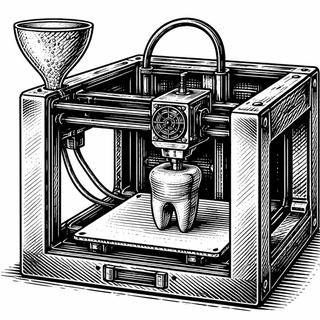
The material in question is polyhydroxybutyrate, or PHB. It's a polyester produced naturally by microorganisms, making it both biocompatible (your body tolerates it well) and biodegradable (it breaks down over time without leaving behind anything nasty). PHB has been on the biomedical radar for years, but processing it for 3D printing has always been a bit finicky. This study tackled that challenge head-on by testing three physical forms of PHB - powder, pellets, and granules - across two different DPE printers to figure out which combination actually works best (Armillotta et al., 2025).
The Dual-Release Magic Trick
Here's where the research gets particularly clever. The team didn't just 3D-print a lump of drug-loaded plastic and call it a day. They engineered a device with two distinct release mechanisms working simultaneously, like a DJ running two turntables at once.
The fast drop: A built-in reservoir filled with a hydrophilic gel provides an immediate burst release. The moment the device contacts moisture in your mouth, this gel rapidly delivers a dose of medication. Think of it like the opening scene of an action movie - you want to grab attention (or in this case, inflammation) right away.
The slow burn: The PHB matrix itself releases the drug gradually over an extended period. This is the long game, the slow-cooked BBQ of drug delivery, providing sustained therapeutic levels while the polymer biodegrades.
The drug they loaded into this system is benzydamine hydrochloride (Bz HCl), a non-steroidal anti-inflammatory drug that also happens to have antimicrobial properties. It's commonly used in oral healthcare already, and - here's a practical detail that matters a lot in manufacturing - it stays stable at the 160 degrees Celsius temperatures needed to process PHB. Not every drug can survive a hot tub that intense, so compatibility was key.
Why Your Dentist Should Care
Dental drug delivery is one of those problems that sounds simple until you actually think about it. Mouthwashes rinse away in seconds. Gels get diluted by saliva faster than you can say "therapeutic window." And asking a patient to apply medication to a specific spot in their mouth on a rigid schedule is about as reliable as asking a cat to follow a training regimen.
A custom-printed, biodegradable device that sits in place, releases medication on its own timeline, and then quietly disappears? That's genuinely solving a real problem. Imagine recovering from a dental procedure and having a tiny, tailored device handling your anti-inflammatory and antimicrobial needs without you having to remember a single dose. It's like having Jarvis manage your dental recovery - you just sit back and heal.
The in vitro release studies confirmed that the dual-release profile actually works as designed: an initial burst followed by sustained delivery. Antimicrobial testing showed the released benzydamine retained its biological activity, meaning the printing process didn't cook the effectiveness out of the drug. That's not a given - thermal processing can degrade active pharmaceutical ingredients, so demonstrating preserved activity is a significant validation.
The Bigger Picture: Why DPE Changes the Game
Beyond this specific dental application, the study makes a broader case for DPE as a manufacturing platform. Traditional pharmaceutical 3D printing methods often require extensive material pre-processing. You need to make a filament first, which demands specific mechanical properties (too brittle and it snaps, too flexible and it jams). DPE sidesteps this entirely.
The researchers compared two different DPE printers under identical conditions, giving the field a much-needed apples-to-apples comparison. They characterized the thermal, chemical, and morphological properties of the printed scaffolds, essentially building a playbook for anyone else who wants to work with PHB in additive manufacturing.
The implications extend well beyond dentistry. PHB-based DPE printing could enable customizable, biodegradable drug delivery systems for wound healing, orthopedic implants, or localized cancer therapy. Each device could be tailored to a patient's specific anatomy and therapeutic needs - true personalized medicine, printed on demand like ordering a custom phone case, except the stakes are considerably higher.
What's Next?
This is still early-stage work. In vitro studies (that's lab bench, not living patients) are a necessary first step, but there's a long road of biocompatibility studies, clinical trials, and regulatory approvals before you'll see one of these at your next dental appointment. The researchers themselves frame this as proof of concept, demonstrating feasibility rather than declaring victory.
But the foundation is solid. PHB works in DPE printers. The dual-release geometry performs as designed. The drug survives processing. The antimicrobial activity is preserved. Each of those could have been a dealbreaker, and none of them were. That's the kind of result that makes the next round of research worth funding and following.
For now, you'll have to keep using mouthwash like the rest of us. But somewhere in a lab, a printer is laying down layers of biodegradable polymer, one pass at a time, building something that might just make "take your medicine" a whole lot easier - and a whole lot more elegant.
This blog post discusses research findings and should not be taken as medical advice. If you have concerns about dental health or drug delivery therapies, please consult a healthcare provider. Research discussed here represents ongoing scientific investigation and clinical validation is still in progress.
All images used in this post are decorative illustrations only and do not represent or reflect the accuracy, reality, or correctness of the referenced research.
Primary Source: Armillotta F. et al. Direct powder extrusion 3D printing of a polyhydroxybutyrate-based dual-release drug delivery device for dental therapy. International Journal of Pharmaceutics. 2025. DOI: 10.1016/j.ijpharm.2025.125574