
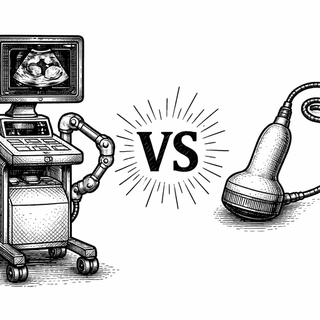
Here's a sentence I never thought I'd write: we're now at the point in medical technology where researchers are genuinely asking whether a machine can squish an ultrasound wand against your breast as effectively as a trained human being.
Welcome to the AUDIBLE trial, which - and I genuinely applaud whoever came up with this acronym - stands for "ATUSA Ultrasound Diagnostic Imaging for Breast Lesions Evaluation." Yes, they really worked backward from a hearing-related word to name a breast imaging study. Points for creativity, folks.
What's Actually Happening Here?
The AUDIBLE trial is a multi-site study across the United States that's collecting data on something called the iSono Health ATUSA system. Think of it as the self-driving car of breast ultrasound - an automated 3D imaging platform designed to take the human operator out of the equation.
Now, before you picture a Terminator-style robot approaching patients in exam rooms, let me pump the brakes a bit. This isn't about replacing radiologists with AI overlords. The ATUSA system is meant to standardize and potentially improve the ultrasound imaging process itself - the actual picture-taking part - while still leaving interpretation to skilled human professionals.
The study is enrolling up to 800 women who've already received suspicious findings (classified as BI-RADS 4 or 5) from standard diagnostic imaging and have been referred for biopsy. Essentially, researchers are comparing what the automated system sees against what traditional hand-held ultrasound and mammography found, then checking everyone's homework against the ultimate answer key: biopsy results.
Why Should You Care About Operator-Independent Ultrasound?
Here's the thing about traditional ultrasound that doesn't get discussed at dinner parties (shocking, I know): it's incredibly operator-dependent. The quality of your scan depends heavily on who's holding the wand, how they're angling it, how much pressure they apply, and whether they've had enough coffee that morning.
I'm being slightly facetious, but the variability issue is real. Two different technicians scanning the same patient can get meaningfully different images. This creates problems for comparison over time, for second opinions, and for detecting subtle changes that might indicate something concerning.
An automated system theoretically eliminates this variability. Every scan follows the same protocol, applies consistent pressure, and captures standardized 3D volumes. It's like the difference between someone's handwritten directions to their house and GPS coordinates - both might get you there, but one is considerably more reproducible.
The Radiation-Free Angle
The study description makes a point of emphasizing that ATUSA is "radiation-free," which is absolutely true of all ultrasound technology. Sound waves, not ionizing radiation. This isn't revolutionary for ultrasound in general, but it's worth noting in the broader context of breast imaging.
Mammography, the current gold standard for breast cancer screening, does use small amounts of radiation. For most women, the benefits of screening far outweigh the minimal radiation exposure. But for women who need frequent imaging - say, those being monitored during cancer treatment - having effective radiation-free options becomes more relevant.
Speaking of which, AUDIBLE includes a particularly interesting subset: participants receiving neoadjuvant therapy (that's chemotherapy given before surgery to shrink tumors) will be followed over time to see how well ATUSA tracks treatment response and changes in tumor size. This is where 3D automated imaging could really flex its muscles - providing consistent volumetric measurements that aren't subject to operator variation between visits.
Let's Talk Limitations
Now, as a card-carrying skeptic, I have to point out what this study isn't. It's not a randomized controlled trial comparing screening outcomes. It's not proving that automated ultrasound catches more cancers or saves more lives. It's a registry study - essentially a big data collection effort to validate that the ATUSA system produces quality images that correlate with other established methods.
This is important foundational work, but it's foundational. The study is asking "does this technology produce good images that match what we already trust?" rather than "does this technology improve patient outcomes?" Those are different questions, and the latter requires much larger, longer, and more expensive trials.
Also worth noting: the participants already have suspicious findings. This tells us nothing about how ATUSA performs as a screening tool in the general population, where the challenge is finding needles in haystacks rather than characterizing needles someone already spotted.
The Bigger Picture
Breast cancer remains the most commonly diagnosed cancer among women worldwide, and early detection genuinely saves lives. Any technology that could make screening more accessible, more consistent, or more comfortable deserves serious investigation.
Automated breast ultrasound systems have been around for a while, but adoption has been slow. The barriers include cost, workflow integration, and the fundamental question of whether they actually improve upon existing methods enough to justify the investment. Studies like AUDIBLE are attempting to build the evidence base that answers these questions.
What makes this particular trial interesting is the combination of real-world applicability (using patients who are already in the diagnostic pipeline) with longitudinal follow-up in the treatment monitoring subset. If automated 3D ultrasound can reliably track tumor response to therapy, that's a meaningful clinical application even if screening questions remain open.
The Patient Experience Factor
One aspect that deserves mention: patient comfort and accessibility. Traditional hand-held ultrasound requires a trained operator to be physically present throughout the exam, which creates scheduling constraints and staffing challenges. An automated system could potentially be operated by less specialized personnel, expanding access in underserved areas.
The "patient-friendly" claim in the study description is doing some heavy lifting, but it's not unreasonable. Standardized, reproducible exams that don't depend on finding an available trained sonographer could genuinely improve access to breast imaging.
Final Thoughts
The AUDIBLE trial represents exactly the kind of methodical, evidence-building research that medical technology needs. It's not flashy, it's not promising miracle cures, and it's not going to generate breathless headlines. What it might do is establish whether automated 3D breast ultrasound produces reliable, reproducible images that correlate with established diagnostic standards.
That's not nothing. In fact, that's how responsible medical device development is supposed to work - boring, careful, step-by-step validation before anyone claims the technology is ready for prime time.
Will automated breast ultrasound eventually replace hand-held imaging? Probably not entirely - the human element in medicine has value beyond technical image acquisition. But having reliable, standardized imaging tools in the diagnostic arsenal seems like an unambiguously good thing to pursue.
I'll be watching for results from this one. With 800 participants across multiple sites, we should get a reasonably robust picture of whether ATUSA delivers on its technical promises. The bigger questions about clinical utility will have to wait for future trials, but you have to learn to walk before you can run - even if you're a robot ultrasound machine.
Disclaimer: This blog post is for educational and informational purposes only and does not constitute medical advice. Clinical trials are ongoing research, and outcomes are not guaranteed. Always consult with qualified healthcare professionals regarding medical decisions.
Primary Source: ClinicalTrials.gov, NCT07505797 - ATUSA Ultrasound Diagnostic Imaging for Breast Lesions Evaluation (AUDIBLE)