
Most people assume that when an alarm goes off in an intensive care unit, a nurse immediately rushes to the patient's bedside, heart pounding, ready to save a life. But here's what actually happens: that same nurse has already heard 847 alarms today, roughly 90% of which meant absolutely nothing, and their brain has started treating the constant beeping as background noise - like elevator music, but with higher stakes.
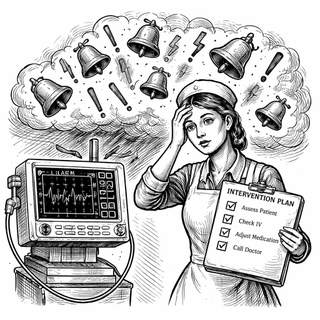
This phenomenon has a name: alarm fatigue. And it's not a character flaw or a sign of lazy healthcare workers. It's a predictable human response to being bombarded with so many false alerts that distinguishing the real emergencies becomes nearly impossible. Think of it as the medical equivalent of your email inbox - when everything is marked urgent, nothing is.
The Numbers Are Honestly Absurd
A recent mixed-methods study from an anaesthesiology and intensive care unit decided to actually count the alarms and figure out what was going on. The researchers recorded 119,158 alarms during their pre-intervention phase. Let that sink in for a moment. That's not annually - that's during a single study period in one ICU. The cardiac monitors alone were generating a symphony of beeps, boops, and warning tones that would make a car alarm jealous.
What they found through participant observation was pretty much what you'd expect when humans are subjected to sensory overload: selective responsiveness. Staff members had unconsciously trained themselves to filter alarms, responding to some and tuning out others. It's survival mode, but it comes with obvious risks when a genuine emergency gets lost in the noise.
Why This Matters for Health Equity
Here's where my public health heart starts beating a little faster. Alarm fatigue doesn't affect all patients equally. Under-resourced hospitals often have older equipment with less sophisticated alarm systems, higher patient-to-nurse ratios, and fewer resources for staff training. When your hospital is already stretched thin, alarm fatigue hits harder.
Patients in community hospitals serving lower-income populations may face a double whammy: more alarms per nurse and less institutional support for fixing the problem. Meanwhile, well-funded academic medical centers can afford biomedical engineering teams dedicated to optimizing alarm parameters. The gap between "best practices" and "what actually happens in most hospitals" is a canyon, and vulnerable patients fall into it.
The Intervention: Education Plus Technical Tweaks
The researchers didn't just document the problem and call it a day. They implemented an intervention combining educational initiatives with technical adjustments to the monitoring systems. This action research approach meant they weren't just observing from the sidelines - they were actively trying to make things better.
Here's where things get interesting. After the intervention, total alarm volume actually increased by 27.4%, jumping to 151,840 alarms. At first glance, that seems like a spectacular failure. More alarms? How is that helping?
But the quality of those alarms improved dramatically. Red technical alarms - the highest priority alerts that demand immediate attention - dropped by 61.1%. Short yellow alarms decreased by 2.3%. The system was generating more alarms overall, but it was crying wolf less often about the stuff that really mattered.
Root Cause Analysis: Where the Bodies Are Buried (Metaphorically)
One of the most valuable parts of this study was the root cause analysis, which dug into why the alarm situation was so chaotic in the first place. They discovered there was no comfort profile for palliative patients - meaning someone receiving end-of-life care was triggering the same aggressive alarms as a post-surgical patient expected to recover. The monitors were essentially treating a peaceful transition and an acute emergency with the same level of panic.
Device configuration issues and technical artifacts were also culprits. Equipment wasn't properly calibrated, and sometimes the alarms were responding to sensor problems rather than patient problems. It's like your smoke detector going off every time you make toast - eventually you just remove the battery, and then your house burns down.
The Staff Perspective: They Know It's a Problem
Through questionnaire surveys, staff confirmed what the observation data suggested: alarms were burdensome, caused fatigue, and negatively impacted patient care. This wasn't news to anyone working in the ICU. Healthcare workers have been complaining about alarm fatigue for years. The value of this study is that it quantified the problem, identified specific causes, and demonstrated that targeted interventions can actually improve alarm quality even if they don't reduce overall volume.
The absence of standardized alarm management protocols emerged as a significant finding. Different nurses might set different thresholds for the same type of patient. One shift's "normal" could be another shift's "emergency." This inconsistency makes it harder for staff to trust the alarms and easier for important signals to get lost.
What Needs to Happen Next
The researchers concluded that threshold standardization and clear protocols are essential. This isn't rocket science - it's just organizational best practices applied to alarm management. But implementing it requires resources, training, and institutional commitment.
For hospitals serving underserved communities, this might seem like a luxury they can't afford. But alarm fatigue directly affects patient safety. A missed alarm can mean a missed code. And the patients most likely to experience adverse events from alarm fatigue are often the ones who can least afford additional complications.
The good news? Many of the fixes don't require expensive new equipment. Education costs time but not necessarily money. Adjusting alarm parameters is a software problem, not a hardware problem. Creating comfort profiles for palliative patients is a policy decision that costs nothing but attention.
The Optimistic Take
This study gives me hope precisely because it shows that improvement is possible without waiting for some magical technological solution. A 61% reduction in red technical alarms is significant. It means fewer heart-stopping moments that turn out to be nothing. It means nurses can start trusting the alarms again, which means patients get faster responses when something actually goes wrong.
The path forward involves ongoing monitoring, continued education, and institutional commitment to treating alarm management as a patient safety priority rather than an annoying background issue. It's not glamorous work. Nobody's getting a Nobel Prize for optimizing alarm thresholds. But for the patients in beds throughout ICUs everywhere - especially those in hospitals that have historically been under-resourced and overlooked - this kind of systematic improvement work could be the difference between being heard and being lost in the noise.
This blog post discusses research findings and should not be taken as medical advice. If you have concerns about alarm management or patient safety in critical care settings, please consult healthcare professionals and institutional safety officers. Research discussed here represents ongoing scientific investigation and clinical validation is still in progress.
All images used in this post are decorative illustrations only and do not represent or reflect the accuracy, reality, or correctness of the referenced research.
Primary Source: Improving alarm management to reduce alarm fatigue in critical care: a mixed-methods study. PubMed. 2025. PMID: 41102103