
The surprising part is not that cotton can be made to repel water. We have been teaching old fabrics new tricks for years. The surprise is that this one does it without a catalyst, in one pot, while still leaving the surface chemically useful for later modifications. That is a bit like teaching an old umbrella to play chess while it is still keeping you dry.
I have spent enough decades around coatings, polymers, and laboratory optimism to know that simple methods are often the hardest won. Researchers love a heroic process with multiple steps, exotic reagents, and a flow chart that looks like a subway map designed by an insomniac. So a report describing a green, catalyst-free route to a durable, reactive, superhydrophobic coating on cotton catches my eye at once. It suggests not just a clever material, but a better way of making clever materials.
Why Cotton Is Such a Stubborn Customer
Cotton is beloved for good reasons. It is soft, breathable, familiar, and made from a natural fiber that humans have trusted for centuries. The difficulty is that cotton also loves water. At the molecular level, its cellulose-rich surface is covered with groups that happily interact with moisture. That makes cotton comfortable in many settings, but not ideal when one wants fabrics that stay dry, resist fouling, separate oil from water, or survive rough handling without losing their special surface behavior.
Many previous attempts to solve this have worked, at least on paper. But the usual tradeoff appears sooner or later. One treatment is effective but chemically harsh. Another is water-repellent but fragile. A third performs nicely until it is washed, bent, abraded, or asked to do anything rude, such as function outside a figure in a journal article.
That is the background against which this new work becomes interesting.
The Coating Trick
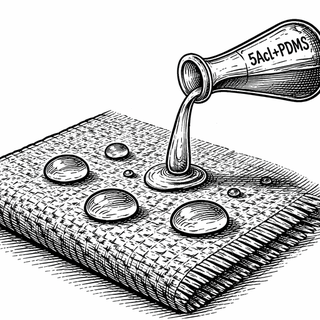
The paper reports a one-pot reaction between dipentaerythritol pentaacrylate, abbreviated as 5Acl, and aminopropyl-terminated polydimethylsiloxane, or PDMS. PDMS is a silicone-based material that chemists have used for years when they want flexibility, low surface energy, and general water-avoiding behavior. It is something of a veteran performer in this business, the polymer equivalent of an actor who knows exactly where the light is.
Here, the authors use a 1,4-conjugate addition to build a coating directly onto cotton without a catalyst. That matters for both practical and environmental reasons. Catalysts can add cost, complexity, toxicity concerns, and cleanup problems. Remove them from the process, and suddenly the route looks more attractive for scale-up and less like a laboratory balancing act.
The resulting coating does more than sit politely on the textile. It gives the cotton a superhydrophobic surface, meaning water beads up rather than soaking in. But the coating also remains chemically reactive, which is one of the paper's more elegant features. In plain English, the fabric is not locked into one destiny. It can be further customized afterward.
That secondary reactivity may turn out to be the quiet star of the whole affair.
Not Just Waterproof, But Resourceful
A fabric that repels water is useful. A fabric that repels water, heals damage, separates oil from water, and still offers handles for later chemical tuning is far more interesting.
The self-healing aspect is especially appealing. Surface damage is the usual villain in coatings research. A material may look splendid on day one, then lose performance after abrasion, compression, or repeated use. Self-healing behavior suggests that the hydrophobic character can recover after disruption, which is exactly the sort of practical detail that separates a laboratory novelty from a serious candidate for real-world use.
Then there is oil-water separation. That phrase can sound a little dry if handled poorly, but it points to applications with real consequence. Textiles or porous materials that selectively interact with oil and repel water can be useful in environmental cleanup, filtration, and industrial separations. When one can create that behavior with a relatively straightforward coating on cotton, a cheap and familiar substrate, ears ought to perk up.
And because the coating retains chemical reactivity, the fabric could in principle be outfitted with additional functions later. One can imagine antimicrobial surfaces, sensing capabilities, selective adsorption, or other smart-textile features being grafted onto the same basic platform. Materials scientists cannot resist a modular system. Give us one reactive surface and we begin decorating it like a holiday tree.
Why the Green Angle Matters
The word "green" is sometimes waved about so enthusiastically that it begins to resemble a campaign slogan. Here, though, it has a concrete meaning. A catalyst-free process with fewer chemical complications speaks directly to waste reduction, safer handling, and easier production. Those are not decorative benefits. They are often the difference between a nice paper and a usable technology.
The authors also frame the work around minimizing chemical resource use while advancing sustainable smart fabrics. That is a sensible target. We do not need more high-performance materials that achieve their brilliance by demanding a small opera of solvents, additives, and post-treatment steps. Industry is full of examples where a material performs beautifully and behaves economically only if one agrees not to ask too many follow-up questions.
This study, by contrast, seems to be asking the right ones from the start.
What Could This Lead To?
If follow-up development goes well, coatings like this could matter in protective clothing, filtration textiles, reusable separation materials, and smart fabrics designed for harsh or variable environments. Cotton is already widely used, so improving its performance without abandoning the substrate is often wiser than inventing an entirely new fabric from scratch.
There is also something appealingly democratic about the platform. Cotton is not an exotic nanostructured marvel available only in tiny batches and grand promises. It is ordinary, and ordinary materials are where scalable innovation often earns its keep.
Of course, the road from promising paper to practical product is never short. Durability under repeated washing, large-scale manufacturing consistency, long-term environmental behavior, cost comparisons, and compatibility with existing textile finishing lines all need careful study. Superhydrophobic surfaces, in particular, have a habit of looking immortal until one introduces friction, detergent, or a user with no patience at all.
Still, the paper addresses exactly the sort of challenge that deserves attention: how to build multifunctionality into common materials without an extravagant chemical bill.
A Quietly Clever Advance
What I like most here is the temperament of the work. It is ambitious without being theatrical. The researchers aim for robustness, reactivity, sustainability, and multiple useful functions, but they do so through a method that tries to simplify rather than complicate. After many years in research, I have become deeply suspicious of solutions that arrive wearing too much jewelry.
This cotton coating may not make headlines in the manner of a flashy biomedical gadget or a robot with excellent posture. But it represents something science badly needs more often: a cleaner route to a more capable material, built on familiar chemistry and aimed at practical use.
That, in my experience, is how progress usually looks before the press office gets hold of it.
This blog post discusses research findings and should not be taken as medical or product-use advice. If you have concerns about textile safety, environmental exposure, or industrial applications, please consult an appropriate qualified professional. Research discussed here represents ongoing scientific investigation and practical validation is still in progress.
All images used in this post are decorative illustrations only and do not represent or reflect the accuracy, reality, or correctness of the referenced research.
Primary Source: A facile, catalyst-free reactive polydimethylsiloxane coating toward multifunctional cotton textiles with superhydrophobicity, self-healing, oil-water separation, and secondary reactivity. PubMed. https://pubmed.ncbi.nlm.nih.gov/42019844/