
Every good recipe starts with a living culture. Sourdough bakers nurture their starters. Yogurt makers coddle their lactobacilli. But what if your microbial culture, instead of making bread rise or milk thicken, could whip up a little electricity - and then stop making it the moment someone dumped toxins into the mixing bowl? That's essentially the recipe behind a microbial fuel cell biosensor, and a recent study has put this peculiar kitchen to the test against some genuinely nasty water contaminants.
The Setup: Bacteria as Tiny Power Plants (and Tattletales)
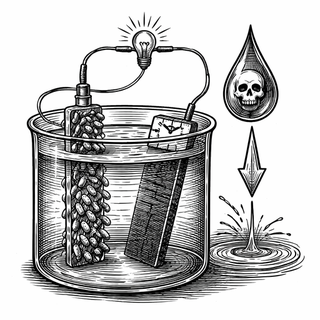
A microbial fuel cell (MFC) is one of those technologies that sounds like it was invented on a dare. You take a community of electroactive bacteria, give them a cozy electrode to cling to (carbon fiber, in this case), feed them organic matter, and they thank you by shuffling electrons to the anode. Wire it up and you've got yourself a biological battery. It's not going to charge your phone, but the voltage it produces is remarkably consistent - and that consistency is where the detective work begins.
The idea here is straightforward: healthy bacteria, happy voltage. Poison the bacteria, voltage drops. Measure how much it drops and you've got yourself a toxicity readout. The researchers in this study built a dual-chamber MFC - 200 mL, nothing extravagant - and cultivated a mixed-culture biofilm on the anode. Then they started spiking the water with heavy metals (copper, lead, cadmium, nickel, zinc, chromium) and BTEX compounds (benzene, toluene, ethylbenzene, xylene) to see how the little electricity factories would react.
What They Found: The Bacteria Noticed
The biosensor did, in fact, respond to contamination. The team quantified toxicity using something called an inhibition ratio (IR), derived from how much the voltage dropped after contaminant exposure. When copper showed up in the water, the bacteria's electrical output took a hit. Same story with lead, cadmium, and the rest of the heavy metal lineup. BTEX compounds also registered, though these volatile organic pollutants interact with microbial metabolism a bit differently than metal ions do.
This is genuinely interesting. Traditional water quality testing often involves collecting samples, shipping them to a lab, running chromatography or spectrometry, and waiting. Meanwhile, whatever's in the water keeps flowing. An MFC biosensor, in theory, could sit in a water stream and flag contamination in something closer to real time. That's appealing. Very appealing, actually.
Let's Pump the Brakes, Though
Before we crown bacteria as the new water quality inspectors and dismantle every analytical chemistry lab in the country, let's talk about what this study is and isn't.
First, this is a proof-of-concept with a 200 mL laboratory reactor. The gap between "it works on a bench" and "it works in a municipal water treatment plant" is roughly the size of the Grand Canyon, and just as difficult to cross. Real-world water doesn't come in neatly prepared single-contaminant doses. It's a messy soup of minerals, organics, pH fluctuations, temperature swings, and biological competitors. How does the MFC biosensor perform when copper AND toluene AND a dozen other things are present simultaneously? That's a harder question.
Second, the inhibition ratio approach tells you something is wrong - it's a toxicity alarm, not a specific chemical identifier. If the voltage drops, you know the microbes are unhappy, but you don't necessarily know if it's the lead, the benzene, or something else entirely that's ruining their day. For regulatory purposes, you generally need to know what is in the water and how much, not just "the bacteria seem stressed."
Third, mixed-culture biofilms are living systems, and living systems are... complicated. They shift community composition over time. They age. They get moody (scientifically speaking). Long-term stability and reproducibility are legitimate concerns that bench-scale studies can only partially address.
Why It Still Matters
None of that criticism is meant to dismiss the work. The methodology here - using voltage suppression as a real-time proxy for water toxicity - is sound and well-established in the MFC biosensor literature. Several research groups have been exploring similar approaches, and the body of evidence supporting MFC-based toxicity monitoring has been growing steadily (Kim et al., 2007; Stein et al., 2012).
The real value proposition isn't replacing laboratory analysis - it's complementing it. Imagine a network of cheap, low-maintenance MFC sensors deployed along a river or in a water distribution system, continuously monitoring for sudden toxicity spikes. They wouldn't tell you exactly what's wrong, but they'd tell you something is wrong, right now, go investigate. That early warning capability could be genuinely useful for environmental monitoring, particularly in resource-limited settings where regular lab testing isn't feasible.
The Bigger Picture
MFC biosensors sit at a fun intersection of microbiology, electrochemistry, and environmental engineering. They're inherently renewable (the bacteria replicate themselves), potentially very cheap (carbon fiber electrodes aren't exactly exotic materials), and they operate continuously without reagent consumption. These are real advantages.
But the field needs to move beyond demonstrating that voltage drops when you add toxins - we know that. The harder and more interesting questions are about selectivity (can you distinguish between contaminants?), sensitivity thresholds (what's the lowest concentration you can reliably detect?), long-term operational stability (does this still work after six months in a real water body?), and field validation (does this work outside the lab?).
This study contributes a useful data point to the MFC biosensor literature. It demonstrates detection of multiple contaminant classes in a single platform. That's a nice checkbox. But it's one checkpoint on a long road toward practical deployment, and anyone suggesting these devices are ready for prime time is getting ahead of the data.
The bacteria are talented. Let's just make sure we're not asking them to do more than they've actually proven they can.
This blog post discusses research findings and should not be taken as medical or environmental safety advice. If you have concerns about water contamination, please contact your local environmental protection agency or water utility. Research discussed here represents ongoing scientific investigation and practical deployment is still in development.
All images used in this post are decorative illustrations only and do not represent or reflect the accuracy, reality, or correctness of the referenced research.
Primary Source: Microbial fuel cell (MFC)-based biosensor for real-time detection of heavy metals and BTEX contaminants in water. PubMed. 2026. PMID: 41962434