
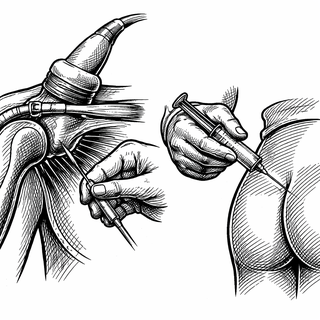
Let me paint you a picture. Your shoulder is angry. Maybe it's frozen shoulder (adhesive capsulitis, if you want to sound fancy at parties), maybe it's arthritis, maybe you just slept weird for three months and now raising your arm above your head feels like a personal attack from your own body.
You go to the doctor. They recommend a steroid injection. Simple enough, right? But here's where it gets interesting - and where clinical trial NCT06725420 comes in. Should that steroid go directly into the offending joint with ultrasound guidance, or should they just stab it into your buttock and let your bloodstream distribute it everywhere?
This is the surprisingly complex question of local versus systemic corticosteroid delivery, and the answer matters more than you might think.
The Case for Precision: Ultrasound-Guided Local Injections
Ultrasound-guided injections are basically GPS for needles. The doctor uses a real-time ultrasound image to watch exactly where the needle goes, ensuring the medication lands precisely where it's needed - in the joint space, around a specific tendon, wherever the inflammation is throwing its tantrum.
The accuracy difference is significant. Studies comparing landmark-guided (the old-school "feel for the bone and hope for the best" approach) versus ultrasound-guided shoulder injections found accuracy rates of 72.5% vs 92.5% respectively. That's a 20-percentage-point jump just from being able to see what you're doing.
It's like the difference between throwing darts blindfolded versus with your eyes open. Sure, you might hit the bullseye either way, but one approach is considerably less stressful for everyone involved.
The theoretical advantages of putting the drug exactly where it needs to go include:
Higher Local Concentration: The inflamed tissue gets a concentrated dose of anti-inflammatory medication, potentially providing faster and more complete relief.
Lower Systemic Exposure: Less medication circulating throughout your body means fewer systemic side effects - the mood changes, blood sugar spikes, and hormonal disruptions that can accompany steroid use.
Targeted Treatment: Different shoulder conditions (rotator cuff problems vs. joint arthritis vs. frozen shoulder) may respond better to injections in different specific locations.
The Case for the Shotgun: Intramuscular Systemic Injection
But wait - there's a counterargument, and it's not stupid.
When you inject a steroid into the gluteal muscle (the classic "shot in the butt"), it gets absorbed into the bloodstream and distributed throughout the body. This means every inflamed joint, tendon, and tissue gets some benefit. If you have polyarticular disease (inflammation in multiple joints, common in rheumatoid arthritis), one shot might help everywhere.
Research has actually found some surprising results here. One study on patients with shoulder impingement showed that gluteal corticosteroid injection was almost as effective as ultrasound-guided subacromial injection. Almost. Not quite as good, but close enough to raise eyebrows.
The intramuscular approach also has practical advantages:
Simpler Procedure: No ultrasound machine needed, no specialized training required, shorter appointment time.
Lower Cost: Ultrasound equipment isn't cheap, and neither is the expertise to use it properly.
No Joint Entry: Anytime you stick a needle into a joint, there's a small risk of introducing infection. Intramuscular injection avoids this entirely.
Broader Effect: For patients with systemic inflammatory conditions, treating just one joint might be missing the forest for the trees.
What the Trial Is Actually Testing
The NCT06725420 trial is comparing ultrasound-guided local steroid injection to intramuscular administration in what appears to be patients with inflammatory or painful joint conditions. This head-to-head comparison will help clinicians understand when each approach makes more sense.
The likely outcome measures include:
- Pain reduction (the thing patients care about most)
- Functional improvement (can you actually use the affected joint better?)
- Duration of benefit (how long before the pain comes back?)
- Side effects (local and systemic)
- Patient satisfaction (underrated but relevant)
The beauty of a randomized trial is that it should control for all the confounding factors that make real-world comparisons tricky. Similar patients, same condition, randomly assigned to different treatments - let's see what actually works better.
The Steroid Chemistry Matters Too
Here's a detail that gets overlooked: not all steroid formulations are created equal.
Triamcinolone hexacetonide has low solubility, meaning it stays in the joint longer and provides extended local action. Triamcinolone acetonide is more soluble and absorbs more quickly. Methylprednisolone acetate is somewhere in between.
When injected into a joint, the lower-solubility formulations theoretically provide longer-lasting relief because the drug hangs around locally instead of getting absorbed into the bloodstream. This is great for a single painful joint but less relevant if you're doing intramuscular injection anyway.
The choice of steroid might actually interact with the route of administration in ways that this trial could help clarify.
The Evidence So Far: It's Complicated
If you're hoping for a clear answer on which approach is better, I have bad news: the existing evidence is mixed.
A 2015 meta-analysis showed that ultrasound-guided glenohumeral and biceps tendon injections were not only more accurate but also more efficacious in providing relief. But a 2012 Cochrane Review stated there wasn't enough evidence to recommend ultrasound-guided injections over landmark-guided injections at the shoulder.
Seven of eight studies using image-guided injections found range-of-motion improvements within 12 weeks. But the clinical significance of the accuracy difference isn't always clear - if both approaches provide pain relief, does the difference matter?
Part of the confusion is that "steroid injection" covers a lot of ground. Different conditions (frozen shoulder vs. osteoarthritis vs. rotator cuff tendinopathy), different joints (shoulder vs. hip vs. knee), different patient populations (inflammatory arthritis vs. mechanical problems), and different outcome measures all make direct comparisons difficult.
The Systemic Effects You Might Not Know About
Even local joint injections aren't truly "local." Research has consistently shown that intra-articular corticosteroids get absorbed into the bloodstream and can affect the hypothalamic-pituitary-adrenal (HPA) axis - the hormonal system that regulates your body's stress response.
After a joint injection, serum cortisol typically drops within hours, hitting a low point at 24-48 hours after injection. Recovery to baseline takes 1-4 weeks, sometimes longer depending on the steroid type and dose.
This matters because it means even "local" treatment isn't without systemic effects. Patients who get frequent joint injections may experience cumulative suppression of their natural cortisol production. This is part of why rheumatologists generally limit how many injections a patient receives per year.
Who Wins? Context Matters
Here's my prediction for what this trial might show: both approaches work, and the best choice depends on the specific situation.
Ultrasound-guided local injection probably wins when:
- You have a single problematic joint
- Accuracy really matters (small joint spaces, anatomic variations)
- You want to minimize systemic exposure
- The patient is diabetic (local injection causes less blood sugar disruption)
- You need to inject a specific structure (a particular tendon sheath, bursa, etc.)
Intramuscular injection probably wins when:
- Multiple joints are affected
- The patient has a systemic inflammatory condition
- Access to ultrasound is limited
- The condition is likely to respond to systemic anti-inflammatory effects
- Cost and convenience are major factors
The trial might also reveal something unexpected - maybe one approach works better for certain subgroups, or maybe the difference is smaller than we thought, or maybe duration of effect differs even when initial relief is similar.
The Bigger Picture
This trial reflects a broader trend in medicine toward precision and personalization. The question isn't just "does this treatment work?" but "who does it work for, under what circumstances, and what's the best way to deliver it?"
Steroid injections have been around for decades. They clearly work. But optimizing how we deliver them - maximizing benefit while minimizing side effects - is the kind of incremental improvement that adds up across millions of patients.
Whether you end up getting your steroids delivered with GPS-like precision or through the time-honored tradition of the gluteal jab, the goal is the same: less pain, more function, and getting back to the life your angry shoulder has been keeping you from.
Just don't expect the answer to be simple. In medicine, it rarely is.
References:
- Comparing accuracy and efficacy of ultrasound-guided versus blind injections in adhesive capsulitis
- Ultrasound-Guided Steroid Injections for Shoulder Pain - AAFP
- Glenohumeral corticosteroid injections in adhesive capsulitis: systematic review
- Systemic effects of intra-articular corticosteroids
- Polyarticular corticosteroid injection versus systemic administration in RA patients
Disclaimer: This blog post is for informational purposes only and does not constitute medical advice. Clinical trials are ongoing research studies, and their results are not yet finalized. Always consult with qualified healthcare providers regarding treatment options. Images and graphics are for illustrative purposes only and do not depict actual medical devices, procedures, mechanisms, or research findings from the referenced studies.