
When penicillin showed up, medicine got one of those rare cheat-code moments. Suddenly, infections that used to be terrifying became a lot more manageable. No, this new hydrogel is not penicillin 2.0, and nobody should be spiking the Gatorade yet. But a new PubMed-indexed study on a modified chitosan hydrogel does hint at the kind of material scientists dream about: something tough, biocompatible, antibacterial, and helpful for tissue repair all at once. In medical research, that is a bit like finding a rookie who can defend, pass, score, and somehow also remember where the team bus is parked.
What are we even talking about?
The study, titled A Mechanical Robust Tunable Terepthaloyl Modified Chitosan Hydrogel Matrix for Modulating Biological Response, focuses on chitosan. Chitosan is a material derived from chitin, which is found in shellfish shells and other natural sources. Researchers have been interested in it for years because it tends to play nicely with the body and has antibacterial properties. Those are two very attractive traits if you're trying to build materials for wound care or tissue engineering.
Hydrogels, meanwhile, are water-rich, jelly-like materials that can mimic some features of living tissue. If you've ever seen a wound dressing that looks a little like clear gel, you're in the right neighborhood. The challenge is that many hydrogels are biologically friendly but mechanically wimpy. They can be too soft, too unstable, or not quite sturdy enough for serious tissue repair jobs.
This study tried to fix that.
The tweak that changed the game
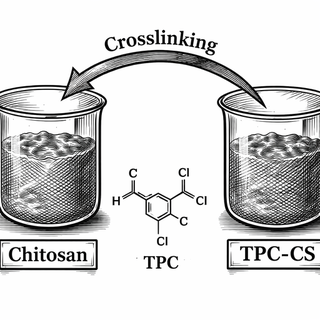
The researchers crosslinked chitosan using terepthaloyl chloride at different concentrations: 0.25, 0.5, 0.75, and 1 mmol. That chemical crosslinking basically helps tie the material's internal structure together more tightly. Think of it like reinforcing a camping tent with better poles and extra guy lines so it does not collapse the minute the weather gets rude.
Compared with plain chitosan, the terepthaloyl chloride crosslinked version, called TPC-CS, performed better in several ways. It showed stronger antibacterial activity against Escherichia coli and Staphylococcus aureus, two bacterial names that tend to show up whenever wounds, infection risk, or biomaterials enter the chat.
That matters because one of the biggest problems in wound healing and implanted materials is infection. A material can look fantastic in a lab dish, but if bacteria can move in like bad tenants, the whole project starts falling apart fast.
Why the 1 mmol version stood out
Among the different formulations, TPC-CS4, made with 1 mmol terepthaloyl chloride, seemed to be the star player.
According to the study summary, this version did three especially interesting things:
- It promoted epithelial cell proliferation.
- It stimulated expression of vascular endothelial growth factor, or VEGF.
- It showed good biocompatibility in fibroblast cytotoxicity testing.
That is a solid trio. Epithelial cells are a big part of surface tissues, including skin. Fibroblasts are the body's hardworking construction crew, helping build connective tissue and repair damaged areas. VEGF is involved in angiogenesis, meaning the formation of new blood vessels. And blood vessels are not some minor detail in healing. Tissue can only regenerate so far on good intentions alone. It needs oxygen, nutrients, and circulation.
So, in plain English, the best version of this hydrogel was not just sitting there looking inert. It seemed to support the kind of biological activity you'd want if you're trying to help damaged tissue recover.
Why this is interesting outside the lab
This is where my former paramedic brain perks up.
In the field, and later watching hospital care up close, you learn quickly that wounds and tissue damage are rarely simple. The body is trying to rebuild. Bacteria are trying to crash the party. Fluids, inflammation, and fragile new tissue are all part of the mess. You want a material that can protect the area, resist infection, and support healing without irritating the tissue or falling apart. That is a big ask.
A hydrogel that is stronger than standard chitosan, more antibacterial, and still friendly to cells starts to sound genuinely useful. If later studies back this up, materials like this could potentially help in wound dressings, tissue scaffolds, and regenerative medicine applications where structure and biological support both matter.
That "if" is doing some heavy lifting, of course. Research hype has a long and glorious history of running the 40-yard dash before anyone checks whether the shoes fit.
The real challenge this research is trying to solve
A lot of biomaterials force a tradeoff.
Some are mechanically strong but biologically bland, like building a healing scaffold out of something that feels more at home in a hardware store than a body. Others are biologically appealing but too weak or unstable to be practical. Getting both strength and cell-friendly behavior in the same material is the challenge.
This study suggests that chemically crosslinking chitosan with terepthaloyl chloride may move the needle on both fronts. The material became more structurally robust while also improving antibacterial action and supporting cell behavior linked to tissue repair.
That combination is what makes the paper interesting. It is not just "we made a gel." The message is closer to "we made a gel that may be better equipped for the rough-and-tumble environment of real healing."
And healing is rough-and-tumble. Bodies are not quiet little test tubes. They are more like busy construction sites run by committees, with occasional power outages and at least one guy yelling contradictory instructions.
What this does not mean yet
This does not mean doctors will be using this hydrogel in clinics next month. The findings described here come from material characterization and cell-based testing, not human trials. That distinction matters.
Biocompatibility in fibroblast experiments is encouraging, but it is an early step. Increased epithelial proliferation and VEGF expression are promising signals, but they do not automatically guarantee better healing in living patients. Real tissues are more complicated. Immune responses are more complicated. Manufacturing and stability are more complicated. Regulation is, naturally, extremely complicated.
So the smart takeaway is optimism with the parking brake still on.
Where this could go next
If follow-up research holds up, this kind of hydrogel could become a platform material for regenerative medicine. Possible future uses might include wound dressings for hard-to-heal injuries, scaffolds for tissue repair, or biomaterial coatings where infection resistance and tissue integration both matter.
The tuning aspect is also worth watching. Because the researchers tested several crosslinking concentrations, this approach may allow future teams to adjust the material depending on the tissue target or clinical use. In biotech terms, tunable is often code for "we might actually be able to adapt this instead of starting from scratch every time."
That flexibility could make a difference. Different tissues need different levels of stiffness, moisture retention, and biological signaling. A one-size-fits-all biomaterial usually fits like a bargain-bin knee brace.
The bottom line
This paper adds to a very practical corner of regenerative medicine: making materials that can survive the real world of healing while helping the body do what it already wants to do. The terepthaloyl-modified chitosan hydrogel, especially the TPC-CS4 formulation, looks promising because it combines better structural integrity with stronger antibacterial effects and encouraging cell response data.
That is not a miracle. It is not a cure. But it is the kind of smart, incremental materials research that sometimes turns into something genuinely useful down the line. And honestly, medicine runs on a lot more of that than on dramatic movie scenes with monitors beeping in perfect rhythm.
This blog post discusses research findings and should not be taken as medical advice. If you have concerns about wound healing, tissue repair, or infection risk, please consult a healthcare provider. Research discussed here represents ongoing scientific investigation and clinical validation is still in progress.
All images used in this post are decorative illustrations only and do not represent or reflect the accuracy, reality, or correctness of the referenced research.
Primary Source: A Mechanical Robust Tunable Terepthaloyl Modified Chitosan Hydrogel Matrix for Modulating Biological Response. PubMed record 42003771. https://pubmed.ncbi.nlm.nih.gov/42003771/