
Hot take: we've been treating all implantable device leads like they behave the same way inside an MRI, and that assumption could literally be cooking some patients more than others. Not in a fun sous-vide way, either.
If you've ever had a loved one with a pacemaker told they can't get an MRI - or worse, told they can but with a vague hand-wave about "conditional safety" - you've bumped into one of modern medicine's most frustrating Venn diagrams. On one circle: MRI, the gold standard of soft-tissue imaging. On the other: millions of people walking around with Active Implantable Medical Devices (AIMDs) that contain long metal leads threading through their bodies. Where those circles overlap? A whole lot of physics anxiety.
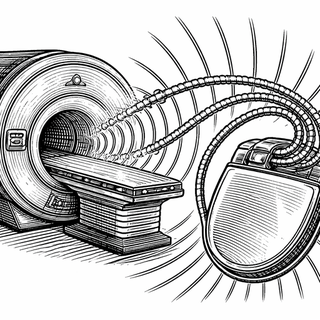
Wait, Why Would an MRI Heat Up My Implant?
Great question. MRI machines use powerful radiofrequency (RF) fields to generate their gorgeously detailed images. Those RF fields are fantastic at making hydrogen atoms do their little dance for the camera. Unfortunately, they're also fantastic at inducing electrical currents in any conductive material inside the body - like, say, the metal leads running from your implantable pulse generator (IPG) to your heart, spine, or brain.
That induced current can cause localized heating at the lead tip, right where it contacts sensitive tissue. We're talking about temperature increases that can potentially damage the very organs these devices are designed to help. It's the medical equivalent of plugging your phone charger into a nuclear reactor. A bit of an overreaction from the physics department.
The Wound-Up Question
Here's where it gets interesting - and where a new study published in 2025 really shakes things up. When surgeons implant these devices, there's often excess lead length. That extra wire doesn't just dangle around like forgotten earbuds in your pocket. It gets wound into loops near the IPG - the little generator box typically sitting under the skin in the chest or abdomen.
You might think those extra loops are just a tidy surgical afterthought. Turns out, how that wire is wound can dramatically change how much heating occurs during an MRI scan. And not in a one-size-fits-all kind of way.
Three Devices, Three Very Different Stories
The researchers examined three types of AIMD systems at 1.5 Tesla MRI (the most common clinical strength):
- Cardiac Rhythm Management (CRM) devices - your classic pacemakers and defibrillators
- Spinal Cord Stimulators (SCS) - used for chronic pain management
- Deep Brain Stimulators (DBS) - the remarkable devices treating Parkinson's disease, essential tremor, and other neurological conditions
They built transfer function (TF) models for various winding configurations and validated them according to ISO/TS 10974, the international standard for evaluating MRI safety in active implants. Then they tested their predictions against three different anatomical human body models because, spoiler alert, not all humans are shaped the same. Revolutionary concept, I know.
The Plot Twist Nobody Saw Coming
Here's the part that made me sit up straighter in my chair: winding the excess lead actually reduced RF-induced heating for CRM and DBS systems. The loops seemed to act almost like a buffer, dissipating or redistributing the induced energy in a way that kept tip temperatures lower. The CRM system showed the most robust and predictable behavior across different winding patterns.
But the SCS system? It went completely rogue.
For spinal cord stimulators, different winding patterns actually increased RF-induced heating. The same physical intervention that helped cardiac and brain devices made spinal devices potentially more dangerous. If that doesn't make you want to understand why, I don't know what will.
The researchers point to lead insulation thickness as a likely culprit. SCS leads tend to have thinner insulation compared to CRM leads, which changes how the electromagnetic fields interact with the conductor. It's a reminder that in biomedical engineering, the devil isn't just in the details - the devil has set up a permanent residence there and is paying rent.
Why Should You Care?
Right now, roughly 500,000 pacemakers are implanted annually in the United States alone. Add spinal cord stimulators, deep brain stimulators, and other AIMDs, and you're looking at a massive population of patients who may need MRI scans during their lifetime. Some estimates suggest that 50-75% of AIMD patients will have a clinical need for MRI within the life of their device.
The current approach to MRI safety labeling often treats lead winding configurations as a secondary consideration - if it's considered at all. This study argues convincingly that a "one protocol fits all" mentality isn't just insufficient; it's potentially dangerous for certain device types.
What Needs to Change?
The study's implications are clear: MRI safety assessments for AIMDs need to become more specific. We can't assume that what works for a cardiac lead will work for a spinal cord stimulator lead. The differences in lead construction, insulation properties, and winding geometry create fundamentally different electromagnetic scenarios inside the body.
For clinicians, this means paying closer attention to how excess lead is managed during implantation and factoring those specifics into MRI safety decisions. For device manufacturers, it means providing more detailed guidance about winding configurations and their impact on MRI compatibility. And for regulators and standards bodies, it means the frameworks we use to evaluate safety need to account for this variability.
The Bigger Picture
This research sits at a fascinating intersection of electrical engineering, radiology, and patient safety. It's the kind of work that doesn't make headlines but quietly makes millions of future MRI scans safer. Every patient with an implanted device who needs a brain scan, a spinal image, or a cardiac workup benefits when we understand the physics a little better.
So the next time someone tells you that the way a wire is coiled doesn't matter, remind them: in the world of MRI and implantable devices, a few extra loops could be the difference between a safe scan and an unsafe one. And which direction that goes depends entirely on which device you're talking about.
Isn't it reassuring to know that even at the cutting edge of medical technology, sometimes the most important variable is how neatly someone wound up the spare cable?
This blog post discusses research findings and should not be taken as medical advice. If you have concerns about MRI safety with an implanted medical device, please consult a healthcare provider. Research discussed here represents ongoing scientific investigation and clinical validation is still in progress.
All images used in this post are decorative illustrations only and do not represent or reflect the accuracy, reality, or correctness of the referenced research.
Primary Source: Impact of Excess AIMD Lead Winding Near the Implantable Pulse Generator on MRI RF-Induced Heating. PubMed. 2025. PMID: 41240361