
Once upon a time in a lab not so far away, scientists looked at a pile of crustacean waste and thought, "You know what? We could save the world with this." And here we are, folks. Twenty-plus years in emergency medicine, and I'm telling you about shrimp shells. But stick with me, because chitosan - the stuff hiding inside those discarded exoskeletons - might be one of the most versatile materials we've stumbled upon since someone figured out penicillin was more than moldy bread.
What the Shell Is Chitosan?
Chitosan is what you get when you take chitin - the second most abundant natural polymer on Earth after cellulose - and remove some acetyl groups through a process called deacetylation. Chitin is everywhere: shrimp shells, crab legs, mushroom cell walls, insect exoskeletons. Basically, if it crunches when you step on it, there's probably chitin involved.
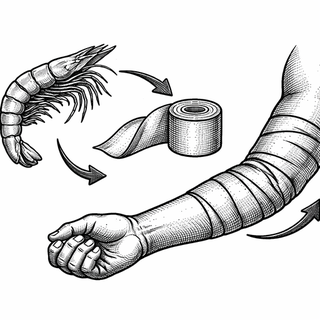
The magic happens when chitosan hits your body. It's biocompatible (your immune system doesn't freak out), biodegradable (it breaks down without leaving microplastic nightmares), and polycationic (it carries a positive charge that lets it stick to negatively charged surfaces like cell membranes and bacteria). It's like nature's velcro with a medical degree.
The Numbers Don't Lie
A massive new review examining a decade's worth of research - 2,616 publications from 2015 to late 2025 - reveals that chitosan research is exploding at roughly 15.7% annual growth. China, India, Iran, and Egypt are leading the charge, and three major research clusters have emerged: biomedical engineering, food science, and materials processing.
That's not a niche material quietly sitting in someone's doctoral thesis. That's a global movement.
From ER to Everywhere: Medical Applications
Here's where things get interesting for someone who's spent decades watching bleeding stop (or not stop, as the case may be). Chitosan has antimicrobial properties - it literally punches holes in bacterial cell membranes. It promotes wound healing by encouraging cell growth and reducing inflammation. Some formulations show antioxidant activity. Others are being investigated for anticancer properties.
I've seen every hemostatic agent on the market cycle through our trauma bays. The idea that shellfish waste could become the next generation of wound dressings? That's not science fiction anymore. The molecular weight, degree of deacetylation, and polymorphic form all influence how chitosan performs, which means researchers can essentially tune this stuff like a guitar string for different applications.
Need it to kill bacteria? Adjust the parameters. Want it to release drugs slowly? Different configuration. Hoping it'll help regenerate tissue? There's a formulation for that too.
Your Leftovers, Reimagined
Food science has grabbed onto chitosan with both hands. Active food packaging - the kind that doesn't just sit there but actually extends shelf life and fights pathogens - is a major research frontier. Imagine a wrapper that keeps your chicken fresh longer while simultaneously telling bacteria to take a hike.
In sustainable agriculture, chitosan coatings protect seeds and plants from fungal infections without the environmental baggage of synthetic pesticides. For a planet trying desperately to feed eight billion people without poisoning the groundwater, that's not trivial.
The Green Chemistry Revolution
Traditional chitosan extraction involves harsh chemicals - hydrochloric acid, sodium hydroxide - and generates its own waste stream. The irony of creating environmental problems while trying to solve them wasn't lost on researchers.
Enter the new extraction methods: enzymatic processing, microbial fermentation, ultrasound-assisted extraction, microwave techniques, ionic liquids, and deep eutectic solvents. These approaches align with circular bioeconomy principles, meaning we're finally figuring out how to turn waste into wonder without generating more waste in the process.
The review specifically calls out these "eco-innovative and hybrid green methods" as a major shift in the field. When scientists start talking about circular economy in the same breath as wound healing, you know something interesting is happening.
Environmental Remediation: Cleaning Up Our Mess
Chitosan's positive charge makes it exceptional at grabbing heavy metals and other pollutants from contaminated water. It's being studied for everything from industrial wastewater treatment to cleaning up agricultural runoff. One material that can dress a wound, preserve food, protect crops, AND clean water? That's the Swiss Army knife of biomaterials.
The Challenges Ahead
Let's pump the brakes slightly, because nothing in medicine or materials science is ever as simple as the press releases suggest. Scaling production while maintaining quality control remains tricky. The source material - crustacean shells - means potential allergen concerns for some applications. Standardizing extraction methods across global supply chains isn't trivial.
And honestly? We're still learning exactly how all those molecular parameters translate to real-world performance. The structure-function relationships are complex, and what works beautifully in a petri dish doesn't always survive contact with actual patients or actual farms.
Why This Matters
In the ER, we see the consequences of our choices - medical, industrial, agricultural, environmental - walking through the door every shift. Antibiotic-resistant infections because we've overused antimicrobials. Chronic diseases linked to food system failures. The occasional exotic poisoning from environmental contamination.
The appeal of chitosan isn't just that it works. It's that it represents a fundamentally different approach: taking a waste stream, understanding its molecular properties, and engineering solutions that address multiple problems simultaneously without creating new ones.
Is it going to single-handedly solve healthcare, food security, and environmental cleanup? No. Nothing does. But a decade of research involving thousands of scientists across dozens of countries suggests we're onto something real here.
The shrimp shells are coming. And honestly? It's about time we gave them something useful to do.
This blog post discusses research findings and should not be taken as medical advice. If you have concerns about wound care, food safety, or environmental health, please consult appropriate professionals. Research discussed here represents ongoing scientific investigation and clinical validation varies by application.
All images used in this post are decorative illustrations only and do not represent or reflect the accuracy, reality, or correctness of the referenced research.
Primary Source: Chitosan at the crossroads: Engineering sustainable biofunctional materials for health, food, and environmental resilience. PubMed. 2025. PMID: 41806895