
Scientists have created spider silk that can activate specific receptors on your cells. Yes, you read that correctly. The same material that catches flies and inspired superhero costumes now has the ability to send targeted chemical signals to your body.
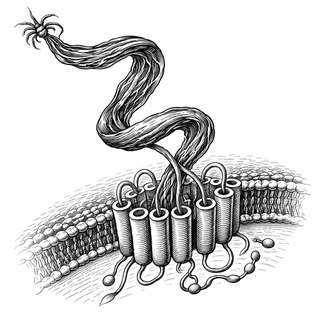
This isn't your garden-variety web material. Researchers have bioengineered a recombinant chimeric protein that combines the legendary mechanical properties of spider silk with the precision targeting capabilities of G-protein-coupled receptor (GPCR) activation. It's like giving spider silk a PhD in molecular biology.
Why Spider Silk in the First Place?
Spider silk has been the darling of materials science for decades. Pound for pound, it's stronger than steel. It's biodegradable. It doesn't trigger immune responses. Spiders have been perfecting this stuff for 400 million years, and we've been jealous the entire time.
The problem? Spiders are terrible at mass production. They're cannibalistic, territorial, and generally uncooperative. You can't exactly set up a spider farm and expect efficiency. This is why scientists turned to recombinant technology - essentially teaching bacteria or other organisms to produce silk proteins without all the spider drama.
But strength and biocompatibility are just the beginning. What if spider silk could actually do something beyond being tough and not killing you?
Enter the Chimera
The researchers behind this work didn't just recreate spider silk. They built something new. A chimeric protein, in biological terms, is essentially a Frankenstein molecule - pieces from different sources stitched together to create novel functions.
In this case, they fused spider silk protein sequences with peptides capable of activating GPCRs. These receptors are the workhorses of cellular communication. They sit on cell surfaces and respond to everything from hormones to neurotransmitters. Roughly 34% of all FDA-approved drugs target GPCRs. They're kind of a big deal.
By embedding GPCR-activating sequences into spider silk, the team created a material that doesn't just sit there looking pretty. It actively communicates with cells.
What Does "Targeted Activation" Actually Mean?
Think of it this way. Traditional drug delivery is like carpet bombing. You swallow a pill, it dissolves, and the active ingredient goes everywhere - your target tissue, your liver, your kidneys, that one cell in your toe that didn't ask for any of this.
Targeted activation flips the script. The bioengineered silk can be placed precisely where you need it. And because the GPCR-activating elements are built into the material itself, the signaling happens locally. No systemic side effects from drugs wandering through your bloodstream looking for trouble.
This could be transformative for tissue engineering, wound healing, and chronic disease management. Imagine a surgical mesh that doesn't just hold tissue together but actively promotes healing by talking directly to surrounding cells.
The Mechanical Advantage
Here's where spider silk really earns its keep. Most biomaterials face a tradeoff. Strong materials are often stiff and don't integrate well with soft tissues. Soft materials that play nice with cells tend to fall apart under stress.
Spider silk threads this needle beautifully. It's strong enough to handle mechanical loads but flexible enough to work with living tissue. The recombinant version maintains these properties while adding the signaling functionality.
The researchers essentially created a two-for-one deal. You get structural support AND biological activity from the same material.
Challenges Ahead
Before you start imagining spider silk implants everywhere, some reality checks are in order.
Scaling production remains tricky. Recombinant protein synthesis has improved dramatically, but making enough material for clinical applications is still expensive. The chimeric proteins are more complex than standard silk, adding another layer of manufacturing difficulty.
Then there's the question of specificity. GPCRs come in hundreds of varieties. Making sure your silk talks to the right receptor - and only that receptor - requires precise engineering. Off-target effects could undermine the whole point of targeted delivery.
Long-term stability is another open question. How do these materials behave after months or years in the body? Does the GPCR-activating function degrade? Does the silk structure change? These are questions that only extended studies can answer.
The Bigger Picture
This research represents a broader trend in biomaterials: moving from passive to active. First-generation implants and scaffolds were inert. They did their mechanical job and tried not to cause problems. Second-generation materials incorporated biodegradability and better tissue integration.
We're now entering a third generation where materials actively participate in biological processes. They sense, respond, and communicate. Spider silk with GPCR activation is one example. Others include scaffolds that release growth factors on demand or materials that change properties in response to inflammation.
The goal isn't just to replace damaged tissue. It's to guide healing, direct cell behavior, and integrate seamlessly with living systems.
Why This Matters to You
If you're not planning to need a biomaterial implant anytime soon, why care?
Because the principles here extend far beyond spider silk. The ability to engineer materials that communicate with cells opens doors across medicine. Smarter wound dressings that accelerate healing. Drug delivery systems that eliminate side effects. Implants that actively prevent rejection.
Every advance in this field brings us closer to biomaterials that work with the body rather than against it. Spider silk just happens to be an exceptionally good starting point - nature already did most of the hard work.
Looking Forward
The fusion of spider silk's mechanical excellence with GPCR signaling capability is genuinely novel. It demonstrates that biomaterials can be multifunctional in ways we're only beginning to explore.
Will you be getting spider silk implants next year? Probably not. The path from laboratory proof-of-concept to clinical application is long and winding. But the foundation is being laid for a future where the materials inside us are active participants in our health, not just passive scaffolding.
Spiders, it turns out, had the right idea all along. We just needed 400 million years to catch up.
This blog post discusses research findings and should not be taken as medical advice. If you have concerns about biomaterial implants or drug delivery systems, please consult a healthcare provider. Research discussed here represents ongoing scientific investigation and clinical validation is still in progress.
All images used in this post are decorative illustrations only and do not represent or reflect the accuracy, reality, or correctness of the referenced research.
Primary Source: A bioengineered recombinant spider silk provides targeted G-protein-coupled receptor activation. PubMed. 2025. DOI: https://pubmed.ncbi.nlm.nih.gov/41933774/