
Trying to detect tiny traces of cancer in blood is a bit like renovating an old house and discovering one suspicious speck of mold behind the drywall. You do not want to rip the whole building apart every time you see dust, but you also definitely do not want to ignore the warning sign. This new breast cancer study feels like someone built a hyper-alert, disposable smoke alarm for those molecular warning signs - and then gave it CRISPR-powered ears.
The paper, titled A Disposable CRISPR-Nanozyme Electrochemical Biosensor for Rapid and Sensitive Detection of Breast Cancer Circulating Tumor DNA, focuses on circulating tumor DNA, or ctDNA. That is one of those terms that sounds intimidating until you translate it into normal-human language: tiny fragments of DNA shed by tumor cells that can end up floating around in the bloodstream. In theory, ctDNA is a dream biomarker. Instead of needing invasive tissue sampling, you could potentially learn something important from a blood sample. Less poking, more information. Science loves that.
Why ctDNA is such a big deal
Breast cancer monitoring has a recurring problem: cancer does not always announce itself loudly. Sometimes the biologically meaningful signal is faint, scattered, and easy to miss. ctDNA is exciting because it could offer a more direct molecular clue that a tumor is present or changing over time.
The catch is painfully obvious. These DNA fragments can be present at extremely low levels. So the challenge is not just finding a needle in a haystack. It is finding a needle in a haystack while the haystack is moving, on fire, and being stirred by biology.
That is where this study gets fun.
The gadget in this paper has two very nerdy superpowers
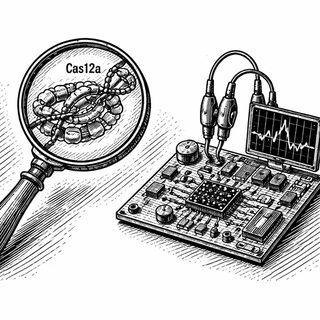
The researchers built an electrochemical biosensor by combining CRISPR/Cas12a with PB-Au nanoparticles. Even before getting into the details, that combination has strong "we brought specialists for every part of the mission" energy.
CRISPR/Cas12a is the precision scout. Its job is target recognition. It can be programmed to identify a specific DNA sequence, which makes it useful for spotting cancer-related genetic material with high specificity.
The nanoparticle part helps translate that molecular recognition into an electrochemical signal. In plain English, the system is not just detecting something quietly in a test tube. It is turning that event into a measurable electrical readout. That matters because electrical signals are practical. They are fast to measure, relatively simple to integrate into portable devices, and very compatible with the kind of test formats people dream about for real-world screening.
So the setup is basically this: CRISPR does the detective work, and the nanozyme-enhanced electrochemical platform acts like the microphone and amplifier. Wait, it gets better - the sensor is described as disposable. That means the researchers are not only chasing sensitivity and speed, they are also thinking about usability. Disposable testing formats are a huge deal if you care about scalable diagnostics outside highly specialized lab workflows.
Why the CRISPR angle matters
CRISPR is often introduced to the public as the gene-editing celebrity, which is fair, but it has another talent that deserves more fanfare: molecular recognition. In diagnostic systems, CRISPR enzymes can act like exquisitely picky bouncers. If the right DNA sequence shows up, they react. If not, they stay unimpressed.
In this case, the paper highlights Cas12a for precise target recognition. That is exactly what you want when the target is breast cancer ctDNA, where false positives and false negatives would both be deeply unhelpful. A biosensor that can distinguish the signal you care about from the giant mess of everything else in blood is doing the glamorous, uncelebrated labor of modern diagnostics.
And because this is paired with an electrochemical readout, the whole thing moves away from "beautiful biology experiment" and closer to "this could become a practical test platform." That shift is where a lot of interesting research either becomes real or quietly vanishes into the academic attic.
Why electrochemistry deserves more hype
Electrochemical biosensors do not always get the flashy headlines, but honestly, they should. They are attractive because they can be sensitive, fast, and adaptable. They also fit nicely with the larger push toward point-of-care diagnostics, where you want answers without a massive instrument the size of a small refrigerator humming angrily in the corner.
For ctDNA detection, speed and sensitivity are everything. You are dealing with tiny amounts of target material, and the clinical value often depends on catching subtle changes early. A disposable electrochemical platform suggests a future where testing could become more accessible and less cumbersome. That does not mean this paper instantly turns into a clinic-ready product tomorrow morning. Research is rude like that. But it does point in a useful direction.
The real-world promise here is huge
If follow-up development goes well, a technology like this could help with noninvasive cancer screening and monitoring. That means potentially tracking disease with blood samples rather than relying only on more invasive methods. It could also help clinicians watch for recurrence, treatment response, or early molecular changes before they become obvious by other means.
That is the part that made me sit up straighter reading this. A lot of cancer diagnostics research is about pushing the limit of what can be detected. This study is doing that, but in a format that also hints at practicality: disposable, electrochemical, and based on a highly programmable recognition system.
In other words, it is not just "can we detect this?" It is also "can we build a detection system that might actually fit into real workflows someday?" Those are different questions, and the second one is where the future gets interesting.
The challenges are still very real
Now for the responsible science voice, because my inner caffeinated squirrel still respects validation.
An exciting biosensor is not automatically a clinical test. It still has to prove reliability across real patient samples, not just idealized conditions. It has to show that it performs consistently when blood chemistry gets messy, when target levels are extremely low, and when the test is used at scale. Reproducibility, specificity, manufacturing stability, cost, and regulatory review all matter.
There is also the broader biological issue that ctDNA can vary a lot from one patient to another and from one stage of disease to another. A great sensing platform still has to contend with the fact that tumors are biologically complicated and often annoyingly uncooperative.
Still, this paper addresses a genuinely hard problem with a genuinely clever design. That combination deserves attention.
Why I cannot stop thinking about it
I love this kind of study because it feels like a mashup of molecular biology, nanotechnology, and practical engineering all trying to solve a problem that actually matters to patients. It is not science for the sake of making a graph prettier. It is science trying to hear a whisper in a storm.
And the whisper, in this case, is breast cancer ctDNA.
When a disposable sensor can pair CRISPR-level specificity with an electrochemical signal and nanozyme-assisted performance, you get something that feels less like a distant futuristic concept and more like a prototype for the next generation of liquid biopsy tools. That is a very exciting place to be.
This blog post discusses research findings and should not be taken as medical advice. If you have concerns about breast cancer, please consult a healthcare provider. Research discussed here represents ongoing scientific investigation and clinical validation is still in progress.
All images used in this post are decorative illustrations only and do not represent or reflect the accuracy, reality, or correctness of the referenced research.
Primary Source: A Disposable CRISPR-Nanozyme Electrochemical Biosensor for Rapid and Sensitive Detection of Breast Cancer Circulating Tumor DNA. PubMed record 42024570. https://pubmed.ncbi.nlm.nih.gov/42024570/