
Let me save you a trip to medical school: when you bleed, your body assembles an elaborate molecular Rube Goldberg machine called the coagulation cascade. Proteins activate other proteins, platelets show up like uninvited guests who turn out to be genuinely helpful, and eventually a fibrin mesh forms to plug the hole. It's elegant. It's beautiful. And it is completely useless in a growing number of patients whose blood has been chemically told to stop doing that.
Millions of people worldwide take anticoagulants - blood thinners like heparin and warfarin - because their doctors have decided that the risk of a catastrophic clot outweighs the inconvenience of bleeding like a faucet during surgery. This creates a genuinely awful clinical scenario: a patient on blood thinners who also needs emergency surgery for, say, a lacerated liver. You need the bleeding to stop. The patient's blood has been pharmacologically persuaded not to cooperate. The standard hemostatic sponges sitting on your instrument tray were designed to work with the coagulation cascade, not instead of it.
Enter the world's most overachieving sponge.
A Sponge With a Chemistry Degree
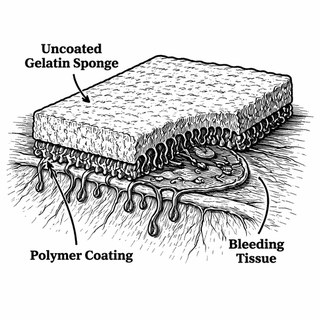
A research team has developed a gelatin sponge patch that sidesteps the coagulation cascade entirely (Li et al., 2025). Instead of politely asking the patient's blood to please form a clot, this sponge just... physically seals the wound shut. Like molecular duct tape, but with better peer-reviewed credentials.
Here's how it works. Take a standard gelatin sponge - the kind surgeons have been using for decades - and coat one side with a polymer called PANS (poly(acrylic acid-co-N-succinimidyl acrylate), for those of you who enjoy punishing your spellcheck). PANS is studded with NHS ester groups, which are reactive little chemical hooks that form covalent bonds with proteins in blood and tissue. Think of it as a molecular Velcro that bonds to wet, bleeding surfaces by grabbing onto whatever proteins happen to be nearby.
The genius is in the dual-function design. The PANS-coated side forms a chemical seal against tissue - achieving a lap-shear adhesion strength of up to 114.4 kPa, which in practical terms means "not coming off anytime soon." Meanwhile, the uncoated sponge side retains its macroporosity, soaking up blood and concentrating platelets at the wound site. So you get a physical barrier and platelet enrichment, without ever needing fibrin to show up and do its job.
The Rats Had a Rough Day (For Science)
The researchers put their creation through its paces using rat models of hepatic laceration (liver cuts) and femoral artery injury (the big artery in the thigh - not a place you want leaking). They tested both normal rats and rats that had been systemically heparinized, meaning their blood was about as interested in clotting as a cat is in following instructions.
The results were striking. In both heparinized and non-heparinized animals, the PANS-gelatin sponge composite significantly reduced bleeding time and blood loss compared to commercially available hemostatic sponges. The sponge didn't care whether the coagulation cascade was operational. It just showed up, stuck to the wound, and stopped the bleeding.
This is the hemostatic equivalent of a mechanic who fixes your car whether or not you remembered to bring the manual.
Why This Actually Matters
If you're wondering why surgeons can't just, you know, suture everything shut - welcome to the messy reality of visceral surgery. Organs like the liver and spleen are soft, vascular, and notoriously hostile to sutures. Try stitching a liver laceration and you may end up tearing more tissue than you fix. This is why hemostatic agents - sponges, powders, sealants - exist in the first place. They handle the bleeds that needles and thread cannot.
The anticoagulant problem compounds this further. The American Heart Association estimates that roughly 6 million Americans take blood thinners, and that number has been climbing steadily as the population ages and atrial fibrillation rates increase. Every one of these patients represents a potential surgical headache if they show up in the ER with blunt abdominal trauma or need an emergency procedure. Current hemostatic sponges work by facilitating the natural clotting cascade - which is exactly what the anticoagulant is designed to suppress. It's a pharmacological tug-of-war, and the patient's bleeding wound is the rope.
A coagulation-independent hemostatic agent sidesteps this entirely. No cascade required. No molecular negotiations with warfarin. Just chemistry and physics doing what they do best.
The Fine Print (Because There's Always Fine Print)
Before anyone gets too excited, the standard caveats apply. This is a rat study. Rat livers and human livers share some similarities, but a 300-gram rat and an 80-kilogram human present rather different hemostatic challenges. The polymer's long-term degradation profile, its performance in larger animal models, and the inevitable manufacturing scale-up hurdles all remain ahead.
That said, the biocompatibility data is encouraging. The composite showed minimal cytotoxicity and hemolysis (it doesn't destroy red blood cells, which is generally considered a positive feature in a medical device). Histopathological analysis showed no significant increase in inflammatory response compared to standard gelatin sponge, suggesting that the PANS coating isn't provoking the immune system into doing anything regrettable.
Beyond the Operating Room
The researchers also note potential applications in battlefield medicine, which makes intuitive sense. Combat casualty care often involves uncontrollable hemorrhage in austere environments where blood products and surgical suites are unavailable. A hemostatic sponge that works regardless of coagulation status - and doesn't require a surgeon's hands to apply it effectively - could be a genuine game-changer for field medics.
The broader concept of coagulation-independent hemostasis is worth watching. As the global population ages and anticoagulant use continues to rise, the gap between "patients who bleed" and "hemostatic tools designed for patients whose blood works normally" is only going to widen. This gelatin-PANS composite is one attempt to bridge that gap, and the early data suggests it's a credible one.
Sometimes the most elegant solution isn't getting the broken system to work harder. It's building something that doesn't need the broken system at all.
This blog post discusses research findings and should not be taken as medical advice. If you have concerns about bleeding disorders or anticoagulant therapy, please consult a healthcare provider. Research discussed here represents ongoing scientific investigation and clinical validation is still in progress.
All images used in this post are decorative illustrations only and do not represent or reflect the accuracy, reality, or correctness of the referenced research.
Primary Source: Li et al. Hemostatic Sponge With Excellent Wet Tissue Adhesion Performance for Anticoagulant-Associated and Unsuturable Visceral Hemorrhage Management. Advanced Healthcare Materials. 2025. DOI: 10.1002/adhm.202503751