
Picture this: you're at the gym, finally attempting that deadlift you've been avoiding for three months, when suddenly your lower back decides to remind you that you're not 22 anymore. Welcome to the club - and by "club," I mean roughly 80% of the human population who will experience low back pain at some point in their lives. If misery loves company, back pain sufferers are throwing the biggest party on Earth.
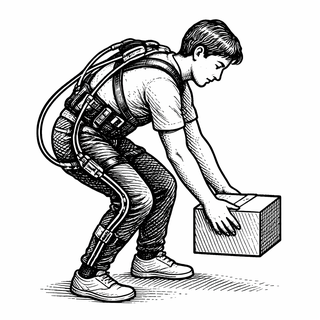
But here's where things get interesting. Researchers at Harvard's Wyss Institute and Boston University are working on something that sounds like it belongs in a Marvel movie: a soft robotic exosuit designed to help people with low back pain. And before you picture something out of Iron Man, let me clarify - this thing looks more like a fancy hydration backpack than Tony Stark's armor. Which, honestly, is probably better for your social life.
The Science of Why Your Back Hates You
Low back pain (LBP) has reached almost comedic levels of prevalence. About 20% of people who get it end up with chronic or recurrent episodes, creating a healthcare burden that approaches $100 billion annually in the United States alone. That's roughly the GDP of a small country, all because our spines apparently missed the memo about bipedal evolution.
The traditional approach to treating LBP involves physical therapy, which works for some people but leaves many still reaching for the ibuprofen. The effectiveness of most rehabilitative treatments hovers somewhere between "marginally helpful" and "well, at least you tried." This gap between what patients need and what medicine can offer has frustrated clinicians and researchers for decades.
Enter clinical trial NCT05736393 - Translation of Robotic Apparel for Alleviating Low Back Pain. Funded through the NIH's HEAL Initiative (that's "Helping to End Addiction Long-term" - because finding alternatives to opioids for pain management is kind of a big deal right now), this study aims to determine whether strapping a robot to your back could be the game-changer we've been waiting for.
How Does a "Soft Exosuit" Even Work?
The technology behind this trial emerged from years of research at Harvard's Wyss Institute, originally developed for military applications. The Defense Advanced Research Projects Agency (DARPA) funded early work through the Warrior Web Program, aiming to help soldiers carry heavy loads without destroying their bodies in the process. Because apparently, even the military has figured out that broken backs are bad for productivity.
The exosuit works by providing external mechanical assistance to the lower back during movement. Unlike rigid exoskeletons that look like something a robot from the 1980s would wear, this soft version uses flexible materials and cables to apply assistive forces. When you bend over to pick something up - or, more realistically, when you drop your phone for the fourth time today - the device helps your back muscles by sharing some of the mechanical load.
The genius lies in its simplicity of design. The suit straps across your chest and stomach with additional straps around your thighs. Sensors detect when you're about to do something that would typically make your back muscles work overtime, and small motors kick in to provide assistance. It's like having a very attentive gym spotter who never takes a day off and doesn't give unsolicited advice about your form.
What the Trial Actually Tests
Led by Louis Awad, an associate professor of physical therapy at Boston University, this study evaluates whether combining the exosuit with traditional physical therapy produces better outcomes than PT alone. The researchers are looking at several key questions:
Can augmenting physical therapy with external robotic assistance reduce pain and disability? The historical evidence for most PT interventions in back pain is, let's be honest, not exactly a slam dunk. By adding mechanical support during exercises, the theory is that patients can perform movements more confidently and with less pain, potentially accelerating recovery.
The study also examines changes in biomechanics - how people actually move when wearing the device. This gets at something that's been tricky in back pain research: the relationship between how someone moves and how much pain they experience isn't always straightforward. Some people with terrible-looking spines feel fine, while others with pristine imaging suffer tremendously.
Why This Matters Beyond the Lab
The team is collaborating with Conor Walsh, who leads the engineering side at Harvard's Biodesign Lab. Walsh's group has been developing soft exosuit technology for years, and their work has already led to commercial applications. ReWalk Robotics licensed the technology and received FDA clearance for the ReStore system, designed for stroke rehabilitation.
This matters because it shows the path from research to real-world application. Getting a device from "cool lab prototype" to "thing your physical therapist actually uses" is enormously difficult. The regulatory hurdles alone could fill a horror novel. But the ReStore's success suggests this technology can make the jump.
For back pain specifically, the implications are huge. Occupational injuries account for a massive portion of back problems, with over half a million workers in manufacturing and construction getting injured annually. If the exosuit proves effective in rehabilitation, it could also find applications in prevention - helping workers perform physically demanding tasks without accumulating damage over time.
The Bigger Picture
This trial is part of the Back Pain Consortium (BACPAC) Research Program, a larger NIH initiative throwing serious resources at the low back pain problem. The fact that organizations like the National Institute of Arthritis and Musculoskeletal and Skin Diseases (NIAMS) are backing research like this reflects a growing recognition that we need new approaches.
The current treatment landscape for chronic low back pain is, frankly, not great. Opioids work for short-term pain relief but come with addiction risks that have contributed to a national crisis. Surgery helps some patients but isn't appropriate for many and doesn't guarantee relief. Injections, medications, and various therapies all have their place, but none of them hit the mark consistently.
Wearable robotics represents a genuinely different approach - not masking pain pharmacologically, not surgically altering anatomy, but mechanically supporting the body as it heals. It's the kind of solution that makes you wonder why nobody thought of it sooner. (Spoiler: they did, but making it practical required decades of advances in materials, sensors, and miniaturized motors.)
What Participants Can Expect
The trial enrolls individuals aged 18-70 with low back pain. Participants receive physical therapy with or without the exosuit, allowing researchers to compare outcomes. The study tracks self-reported pain and disability scores along with objective measurements of movement and function.
Eligibility criteria help ensure the study population is appropriate for testing this specific intervention. Researchers need participants who can meaningfully benefit from PT and robotic assistance, which typically means excluding people with certain neurological conditions or spinal abnormalities that require different treatments.
Looking Ahead
Whether this particular trial will revolutionize back pain treatment remains to be seen. Science is a slow process full of unexpected results, and even promising technologies sometimes fail to deliver in larger studies. But the approach itself - using wearable robotics to augment human movement and support rehabilitation - isn't going anywhere.
The team at Harvard and BU has built something that represents years of engineering refinement and clinical testing. Even if this specific device needs more development, the underlying technology platform continues advancing. Future versions may be lighter, more responsive, and applicable to an even wider range of conditions.
For now, if you're one of the millions dealing with back pain, there's reason for cautious optimism. The research community is finally treating this as the serious problem it is, and solutions that would have seemed like science fiction a generation ago are now being tested in clinical trials.

And if nothing else, you can tell people you heard about the robot backpack that fights back pain before it was cool.
References:
- ClinicalTrials.gov Identifier: NCT05736393
- Wyss Institute for Biologically Inspired Engineering. "Soft Exosuits for Back Support During Strenuous Tasks." Harvard University.
- NIH HEAL Initiative - Back Pain Consortium (BACPAC) Research Program
- PMC10403307: "Reducing Back Exertion and Improving Confidence of Individuals with Low Back Pain with a Back Exosuit"
Disclaimer: This blog post is for informational purposes only and does not constitute medical advice. Always consult with qualified healthcare providers regarding treatment options for any medical condition. Clinical trials are ongoing research studies, and results may not be generalizable until peer-reviewed and replicated. Images and graphics are for illustrative purposes only and do not depict actual medical devices, procedures, mechanisms, or research findings from the referenced studies.