
Your retina has peeled away from the back of your eyeball like wallpaper in a condemned house. You're losing vision by the hour. A surgeon needs to reattach this tissue-paper-thin layer of nerve cells, and the current best option involves injecting a gas bubble into your eye, then asking you to lie face-down for weeks so gravity can press your retina back into place while scar tissue slowly forms to hold it there. Welcome to retinal detachment repair, a procedure whose fundamental approach hasn't changed dramatically since a Swiss ophthalmologist named Jules Gonin figured out the basics nearly a century ago.
So when a new review paper suggests that maybe, just maybe, we could skip the gas bubble and simply glue the retina back on, you can understand why eyeballs everywhere might perk up. But let's pump the brakes before we start celebrating.
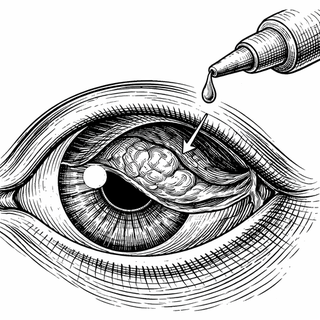
The Gas Bubble Problem
Here's the deal with current retinal detachment repair: it works, but it's not exactly a walk in the park. Surgeons use tamponade agents - gas bubbles or silicone oil injected into the eye - to physically press the detached retina against the back wall while the body creates a scar-based adhesion through thermal injury or laser-induced inflammation. Think of it like holding two pieces of paper together with a clamp while the glue dries, except the "glue" is your own inflammatory response and the "clamp" is a gas bubble that means you can't fly in an airplane or undergo certain types of anesthesia until it absorbs.
Silicone oil tamponade comes with its own fun party favors: cataracts, glaucoma, and the need for a second surgery to remove it. Gas tamponades require that delightful face-down positioning that can last days to weeks. Neither option is what you'd call patient-friendly.
Enter the Bioadhesives
A recent review published in 2025 surveys the landscape of intraocular bioadhesives (IOBs) - materials that could seal retinal breaks directly, potentially eliminating the need for tamponade agents altogether. The review covers four main contenders: cyanoacrylate, fibrin, polyethylene glycol (PEG), and transforming growth factor-beta (TGF-beta).
Each has its own personality. Cyanoacrylate is essentially medical-grade superglue - excellent tensile strength, bonds fast, but has a reputation for being toxic to delicate ocular tissues. Fibrin sealant mimics the body's natural clotting process and plays nicely with living tissue, but its adhesive strength is about as impressive as a damp Post-it note. PEG-based adhesives offer a middle ground with tunable properties, while TGF-beta takes a biological approach by encouraging the tissue itself to form stronger bonds.
The review also explores some wilder ideas still in experimental stages: foldable capsular vitreous bodies (artificial replacements for the gel inside your eye), retinal tacks (tiny mechanical fasteners - yes, stapling your retina), thermofusion (basically welding tissue with heat), and novel vitreous substitutes.
The "No One's Actually Approved This" Problem
Here's where the skeptic in me needs to speak up. The review itself states plainly: no intraocular bioadhesives are currently licensed for vitreoretinal surgery. Zero. None. Not a single one has made it through the regulatory gauntlet for this specific application.
And the clinical data? The authors describe it as "limited." That's academic-speak for "we really don't have much evidence that these work safely in human eyes over the long term."
This is a meaningful gap. The inside of the eye is one of the most sensitive environments in the body. It's an immune-privileged space with unique fluid dynamics, and anything you put in there needs to not only stick to tissue but also avoid triggering inflammation, toxicity, elevated eye pressure, or vision-obscuring reactions. The bar for biocompatibility is extraordinarily high.
The Tensile Strength vs. "Please Don't Poison My Eye" Trade-off
One of the more interesting tensions the review highlights is the inverse relationship between adhesive strength and biocompatibility. The materials that grip tissue most aggressively tend to be the ones most likely to cause damage. Cyanoacrylate bonds like a champion but can be cytotoxic. Fibrin is beautifully biocompatible but might not hold under the mechanical stresses inside a moving, fluid-filled eye.
This isn't a new problem in biomaterials science, but it's particularly acute in the eye, where even minor inflammation can cloud vision or trigger cascading complications. Finding a material that threads this needle - strong enough to seal a retinal break, gentle enough to leave surrounding tissue unharmed, and stable enough to last until biological healing takes over - remains the central challenge.
What's Actually Exciting Here
Despite my brake-pumping, there are genuinely promising directions in this space. The potential applications extend beyond retinal detachment to macular holes, diabetic vitrectomy complications, and even open globe injuries from trauma. If a reliable IOB could be developed, it might transform how we handle eye emergencies - imagine sealing a traumatic eye wound quickly in a field hospital without needing the full infrastructure of vitreoretinal surgery.
The concept of using bioadhesives for intraocular drug delivery is also intriguing. A biodegradable adhesive that releases medication as it dissolves could address conditions like diabetic macular edema without requiring repeated injections - a real quality-of-life improvement for patients currently getting needles in their eyes every month or two.
The Bottom Line
This review does a solid job mapping the landscape of intraocular bioadhesives and honestly acknowledging where the field stands: lots of interesting chemistry, some encouraging animal studies, but precious little human data and zero approved products. The authors deserve credit for not overselling the technology.
But the gap between "this adhesive sealed a retinal tear in a rabbit eye" and "this is safe and effective for your grandmother's retinal detachment" is enormous. We need randomized controlled trials, long-term follow-up data, and a much deeper understanding of how these materials behave in the complex environment of the human eye over months and years.
The concept is sound. The need is real. The science is early. And anyone who tells you we're about to start gluing retinas back together in routine clinical practice is, well, not seeing clearly.
This blog post discusses research findings and should not be taken as medical advice. If you have concerns about retinal detachment or other vitreoretinal conditions, please consult a healthcare provider. Research discussed here represents ongoing scientific investigation and clinical validation is still in progress.
All images used in this post are decorative illustrations only and do not represent or reflect the accuracy, reality, or correctness of the referenced research.
Primary Source: Current and future applications of intraocular bioadhesives in vitreoretinal surgery. PubMed. 2025. PMID: 41935794