
Meanwhile, in a research lab somewhere, a team of scientists is placing a tiny ring on a teenager's finger, wrapping a headband around another teen's forehead, sticking an adhesive patch on a third, and strapping a wristband on a fourth - and then doing the one thing most wearable tech companies never bother to do: actually asking these kids how it feels. The teenagers in question are on the autism spectrum, and if that detail strikes you as significant, congratulations, you already understand something that the $60 billion wearable technology industry has been spectacularly slow to figure out.
The Billion-Dollar Blind Spot
Here's a number that should bother anyone who works in health technology: autism spectrum disorder (ASD) affects roughly 1 in 36 children in the United States, according to the CDC's most recent surveillance data. That's nearly 3% of kids. And yet, when tech companies design their sleek fitness trackers and health-monitoring wearables, they overwhelmingly design for neurotypical users - people who generally don't have strong aversive reactions to certain textures against their skin, pressure on their wrists, or unfamiliar objects touching their heads.
For many individuals with ASD, sensory sensitivities aren't a minor inconvenience. They're a defining feature of daily life. Research has consistently shown that between 69% and 95% of autistic individuals experience atypical sensory processing, including hypersensitivity to tactile stimuli (Tavassoli et al., 2014; DOI: 10.1007/s10803-013-1985-8). That itchy shirt tag you find mildly annoying? For a kid with ASD, a similar sensation from a wearable device might be genuinely intolerable.
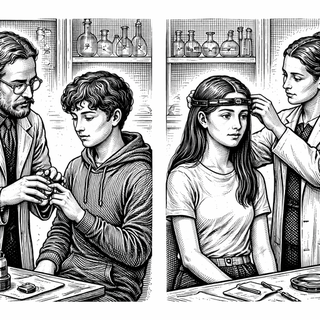
Which raises a question that seems almost embarrassingly obvious: has anyone thought to ask which type of wearable device autistic adolescents can actually tolerate wearing?
Enter the Great Wearable Showdown
A new clinical study (NCT07504224) is doing exactly that. Rather than diving straight into what health data wearables can collect from autistic youth - the shiny endpoint most researchers sprint toward - this team has pumped the brakes and asked the unsexy but absolutely foundational question: can these kids wear the things in the first place?
The study is comparing four different wearable form factors head-to-head (pun absolutely intended for the headband group):
- A wristband - the classic smartwatch-style device
- A headband - worn around the forehead
- An adhesive patch - stuck directly to the skin
- A finger ring - the most discreet option
Each adolescent participant with ASD gets assigned one device and wears it for a two-week trial period. During that time, researchers collect data through questionnaires, assessments, and semi-structured interviews with both the teens and their caregivers. The study involves four research visits - two in-person and two virtual - because, apparently, this research team also understands that dragging a teenager to a clinic more times than necessary is its own kind of feasibility challenge.
Why This Matters More Than You Think
I can almost hear the skeptics: "It's just a comfort study. Where's the real science?" And honestly? This might be some of the most important groundwork happening in digital health for neurodevelopmental populations right now.
Here's why. The promise of AI-driven health monitoring - what the study calls "HealthAI" - depends entirely on having continuous, reliable data streams. And you can't get continuous data from a device that's been thrown across the room, stuffed in a drawer, or peeled off and stuck to the family dog. Adherence is everything, and adherence in ASD populations comes with unique challenges that the wearable industry has largely hand-waved away.
Previous research on wearable biosensors in autism has highlighted this exact gap. A systematic review by Taj-Eldin and colleagues found that while wearable devices show tremendous potential for monitoring physiological signals like heart rate variability and electrodermal activity in autistic populations, the literature consistently identifies user acceptance and comfort as major barriers to adoption (Taj-Eldin et al., 2018; DOI: 10.3390/s18124312). Similarly, work exploring digital phenotyping in ASD has noted that the field's enthusiasm for what can be measured often outpaces its attention to whether measurements can be sustained over meaningful periods (Kouo & Egel, 2023; DOI: 10.1007/s40489-022-00348-0).
In other words, we've been building the analytical engine before checking whether the car has wheels.
The Sensory Puzzle
What makes this study particularly thoughtful is its attention to the "unanticipated factors" that might affect feasibility. Anyone who has spent time with autistic adolescents knows that sensory preferences are deeply individual. One teen might tolerate a snug wristband but find an adhesive patch unbearable. Another might barely notice a ring but rip a headband off within minutes. The textures, pressures, temperatures, and even the social visibility of a device all feed into a complex sensory equation.
Research into sensory processing differences in ASD has evolved significantly in recent years. A meta-analysis by DeBoth and Reynolds examined sensory subtypes within autism, finding that sensory profiles are neither uniform nor static - they vary across individuals and can shift over developmental periods (DeBoth & Reynolds, 2017; DOI: 10.1002/aur.1722). This heterogeneity is precisely why a one-size-fits-all approach to wearables in this population is doomed to fail, and why a comparative study like this one is so valuable.
There's also the social dimension. Teenagers - autistic or not - are acutely aware of how they look to peers. A bulky headband screams "I'm in a science experiment," while a slim ring might fly under the social radar entirely. The study's inclusion of caregiver perspectives alongside participant experiences acknowledges that wearable adoption is a family affair, not just an individual choice.
The Bigger Picture
If this trial succeeds in identifying which form factors work best, the downstream implications are genuinely exciting. Imagine wearable-powered AI systems that can detect early signs of anxiety episodes, sleep disruption, or physiological stress in autistic youth - not in a controlled lab setting, but in the messy, wonderful chaos of actual daily life. That's the door this study is trying to open.
And wouldn't it be something if the key to unlocking AI-powered health monitoring for millions of autistic individuals turned out not to be a fancier algorithm or a more sensitive sensor, but simply asking a teenager whether the thing on their wrist feels weird?
Sometimes the most revolutionary science starts with the most human question: how does this feel?
The study described in this post (NCT07504224) can be viewed in detail at ClinicalTrials.gov. This blog post is for informational and educational purposes only and does not constitute medical advice. Clinical trial information is subject to change. Interested individuals should consult with qualified healthcare professionals and visit ClinicalTrials.gov for the most current study details and enrollment information.