
A toddler coughs on a flight from Singapore to London, and 200 passengers have no idea whether they just inhaled the next pandemic strain. A nursing home resident feels fine on Monday, tests negative on a rapid antigen test Tuesday, and seeds an outbreak by Wednesday. A teacher standing in front of 30 kids wonders whether the tickle in her throat is allergies or something that will close the school. Three scenarios, one shared frustration: by the time we know someone is infectious, the damage is already spreading.
The numbers back this up. Studies estimate that 40-50% of SARS-CoV-2 transmission occurred from pre-symptomatic or asymptomatic individuals (DOI: 10.1126/science.abg6296). Rapid antigen tests, while convenient, miss early-stage infections when viral loads sit below their detection threshold. PCR tests are accurate but require lab infrastructure, trained personnel, and hours of waiting. We've been stuck in a diagnostic gap: fast but insensitive, or sensitive but slow. A new platform called EBCatch is trying to split that difference - and the data suggests it might actually pull it off.
The 8-Minute Breath Test
EBCatch stands for Exhaled Breath Condensate Catch, and the concept is almost absurdly simple. You breathe into a device. It tells you if you're infected. Total time: 8 minutes. No nasal swab, no blood draw, no spit tube, no reagents you need to buy separately.
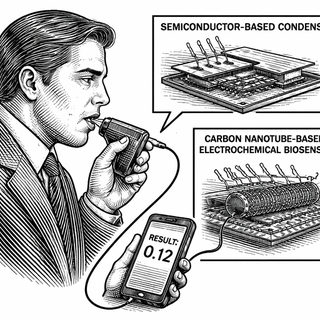
Under the hood, though, the engineering is anything but simple. The system has three components working in sequence. First, a semiconductor-based condenser collects exhaled breath condensate (EBC) in about 1 minute - that's the liquid moisture from your breath, which carries viral particles if you're infected. Second, a carbon nanotube-based electrochemical biosensor picks up the virus. Third, a smartphone app reads the electrical signal and tells you the result.
The biosensor itself is functionalized with ACE2 receptors - the same protein that SARS-CoV-2 uses to enter human cells. This is a clever design choice. Instead of using antibodies that target a specific viral protein (which mutates constantly, hello Omicron through whatever Greek letter we're on now), the sensor uses the virus's own entry mechanism against it. If the virus can bind ACE2, the sensor catches it. This also means the platform could theoretically detect future ACE2-binding coronaviruses without redesign.
The Numbers That Matter
Here's where my data-scientist brain gets excited. The limit of detection is 1.6 femtograms per milliliter for pseudovirus. A femtogram is 10⁻¹⁵ grams. To put that in perspective, a single grain of salt weighs about 58 micrograms, which is roughly 58 billion femtograms. We're talking about detecting a quantity of virus so small it borders on philosophical.
More practically, 1.6 fg/mL sits substantially below the viral loads measured in exhaled breath condensate from infected individuals, which means the sensor has headroom. It's not scraping the bottom of its detection range - it's catching virus concentrations that real patients actually produce with sensitivity to spare.
Clinical validation involved 155 samples, and the performance metrics are strong:
- Sensitivity: 95.06% (catches 95 out of 100 true positives)
- Specificity: 97.30% (correctly clears 97 out of 100 true negatives)
- Overall accuracy: 96.13%
For context, standard rapid antigen tests typically hit 50-80% sensitivity depending on viral load and timing (DOI: 10.1002/rmv.2387). EBCatch's 95% sensitivity at pre-symptomatic and antigen-negative stages is a different league entirely. The specificity of 97.3% also means a low false-positive rate, which matters enormously for a home-use test. Nobody wants to quarantine for a week based on a false alarm.
Catching the Uncatchable: Pre-Symptomatic Detection
Perhaps the most striking finding is that EBCatch detected infections in individuals who were pre-symptomatic and tested negative on standard antigen tests. This is the diagnostic holy grail for respiratory pandemics. The virus is there, replicating, potentially being exhaled onto every surface in a 6-foot radius, and conventional rapid tests can't see it yet. EBCatch can.
This matters because exhaled breath is arguably the most relevant sample type for assessing transmission risk. A nasal swab tells you there's virus in your nose. A breath test tells you there's virus in what you're actively breathing on other people. That's a more direct measure of whether you're a walking biohazard.
Beyond Detection: Measuring Infectivity
Here's where the platform gets genuinely novel. The EBCatch signal correlates with not just viral load but viral activity - meaning the sensor can distinguish between someone shedding live, active virus and someone whose body is still clearing viral debris after the infection has resolved. Research has shown that viral RNA can persist in respiratory samples for weeks after a person is no longer infectious (DOI: 10.1016/j.ijid.2020.11.146). A PCR test would still flag them positive. EBCatch, by leveraging ACE2 binding activity, reflects actual infectivity status.
This distinction between "infected" and "infectious" could reshape isolation guidelines. Instead of blanket 5-day or 10-day quarantines, individuals could test daily with a breath-based sensor and return to normal life the moment their infectivity signal drops. The economic and social implications are significant.
The Road Ahead
Let's calibrate expectations. A 155-sample clinical validation is promising but small. Larger multi-site trials across diverse populations, viral variants, and co-infection scenarios will be needed before this reaches your bathroom cabinet. The ACE2-based detection strategy, while elegant, currently limits the platform to ACE2-tropic viruses - influenza, RSV, and other major respiratory pathogens use different entry receptors and would require sensor redesign.
Manufacturing scalability, shelf-life stability, and regulatory approval are also open questions. Carbon nanotube biosensors are not yet commodity hardware, and the semiconductor condenser adds engineering complexity beyond a simple lateral flow strip.
Still, the concept of a breath-based, smartphone-connected, sub-10-minute infection monitor that detects pre-symptomatic cases and measures infectivity is the kind of diagnostic platform that pandemic preparedness experts have been sketching on whiteboards for years. EBCatch is the first time the data has shown it might actually work.
The next "Disease X" is a matter of when, not if. Having a device that lets you breathe into a chip and know your status before breakfast? That's the kind of math I like.
This blog post discusses research findings and should not be taken as medical advice. If you have concerns about respiratory infections or diagnostic testing, please consult a healthcare provider. Research discussed here represents ongoing scientific investigation and clinical validation is still in progress.
All images used in this post are decorative illustrations only and do not represent or reflect the accuracy, reality, or correctness of the referenced research.
Primary Source: EBCatch: A label-free electrochemical biosensor for non-invasive at-home monitoring of viral infection and infectivity via exhaled breath condensate. PubMed. 2025. PMID: 42034896