
Picture this: You’re in a busy café, sipping your favorite latte, when suddenly, the barista's machine goes haywire, beeping like a caffeinated squirrel on a sugar rush. Everyone looks around, some chuckle, and then the barista rushes to fix it. Now imagine that same chaotic energy but in a hospital setting, where the stakes are much higher. Welcome to the world of hemodialysis, where equipment alarms play a significant role in patient safety and clinical workflow. A recent study out of Shanghai sheds light on this very topic, helping us understand the incidence of equipment malfunctions and what we can do about them.
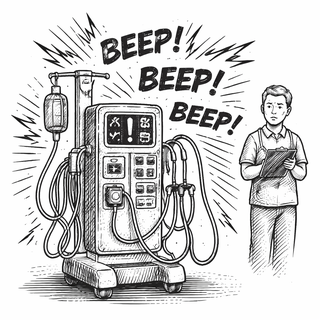
The Alarm Symphony: What’s Causing All the Noise?
Researchers Wang and Xu conducted a retrospective study at Ruijin Hospital, analyzing alarm data from hemodialysis equipment over a three-year period. They tallied a staggering 4,231 alarm events! That’s like a concert of beeping devices, with monthly averages hitting 132.2 alarms. If you think that’s a lot, wait until you hear this: during the COVID-19 pandemic, alarm rates spiked, accounting for a whopping 82.2% of all alarms. Post-pandemic, the numbers dropped significantly - thank goodness for that!
Interestingly, not all equipment is created equal. The B.Braun machines were the biggest culprits, generating 68.7% of alarms, while Gambro and Nikkiso devices were much quieter at 21.2% and 10.1%, respectively. What made B.Braun's devices so chatty? It turns out, their lower pressure thresholds and higher sensor sensitivity lead to more frequent alarms - kind of like that friend who always has something to say, regardless of whether it’s relevant or not.
The Human Factor: Who’s Pulling the Strings?
While machines may be sending out alarms, a significant number of these incidents stem from human factors - 83.6% to be exact. Think about it: most of the time, those alarms are reacting to patient conditions and clinician actions. The researchers found that patients with a body mass index (BMI) over 30 kg/m² were 28% more likely to trigger alarms. This highlights the importance of personalized alarm strategies that consider patient characteristics. So, the next time you hear an alarm, just remember: it could be a miscommunication between the patient and the machine.
Turning Down the Noise: How Predictive Analytics Can Help
So, what can we do to mitigate this cacophony of alarms? Enter predictive analytics! The study's findings reveal that implementing predictive models can significantly improve alarm management. With a sensitivity of 72.3% and specificity of 75.8%, these models help identify potential issues before they lead to alarm-triggering events. Imagine having a crystal ball that tells you when your coffee might spill - you’d definitely want that!
The researchers found that after implementing targeted interventions, alarm rates plummeted: a 43% reduction in total alarms, a 56% decrease in false alarms, and a 51% drop in treatment interruptions. This means smoother clinical workflows and, most importantly, improved patient safety. In a world where every beep and boop can change lives, finding a way to quiet the noise is a game changer.
Real-World Impact: Why This Matters for Everyone
Now you might be wondering, “Why should I care about a bunch of machines beeping in a hospital?” Well, consider this: when alarms go off frequently, healthcare professionals may become desensitized to them. Just like how you might ignore the persistent sound of your phone buzzing. This can lead to missed critical alerts, jeopardizing patient safety. By studying alarm patterns and improving alarm management, we can ensure that healthcare providers have the tools they need to respond effectively.
Moreover, as someone who might one day find themselves in a hospital bed or having a loved one undergo treatment, knowing that the healthcare system is actively working to reduce alarm fatigue gives you peace of mind. Fewer alarms mean less confusion and a better quality of care - something we can all get behind.
In a nutshell, this study not only shines a light on the intricacies of hemodialysis machine alarms but also paves the way for better practices in managing them. It’s a reminder that in healthcare, sometimes it’s about turning down the volume to hear the important things clearly.
Disclaimer: This blog post is intended for informational purposes only and does not substitute professional medical advice. Always consult with your healthcare provider for personal medical inquiries. Images and graphics are for illustrative purposes only and do not depict actual medical devices, procedures, mechanisms, or research findings from the referenced studies.
Citation: Wang J, Xu T. Hemodialysis equipment malfunction incidence and risk profiling in clinical settings: a retrospective single-center cohort analysis. Biomed Eng Online. 2025 Dec 10;24(1):145. doi: 10.1186/s12938-025-01493-3.