
Spoiler alert: chemists built a water-soluble molecular ring that swallows a paralytic drug whole, and it works really, really well. Now let me tell you why that matters and how they pulled it off, because the backstory is honestly wild.
The Paralysis Problem Nobody Talks About
Here's something I wish I'd never learned on the job: during surgery, anesthesiologists routinely paralyze you. Like, fully. Your diaphragm stops doing its one job. This is by design. Surgeons tend to prefer patients who aren't twitching while they're elbow-deep in your abdomen, and honestly, fair enough.
The drug responsible for a lot of this deliberate paralysis is cisatracurium, a non-depolarizing neuromuscular blocking agent. It parks itself on your acetylcholine receptors at the neuromuscular junction and basically hangs a "closed for business" sign on your voluntary muscles. Great for surgery. Less great when the surgery's over and your body is still running on the neurological equivalent of airplane mode.
This leftover paralysis - called residual neuromuscular blockade - is more common than you'd think. Studies suggest it affects anywhere from 20% to 60% of patients arriving in post-anesthesia care units (DOI: 10.1213/ANE.0b013e31829b3f6c). The consequences range from "uncomfortable" to "can't breathe properly," which, having been on the receiving end of a few panicked post-op calls during my medic days, is about as fun as it sounds.
The Current Playbook (and Its Limitations)
Right now, the reversal toolkit is... fine. Neostigmine has been the go-to for decades. It works by inhibiting acetylcholinesterase, which basically floods the junction with more acetylcholine to outcompete the blocking agent. Think of it like trying to get into a sold-out concert by showing up with 500 friends and hoping sheer numbers overwhelm the bouncer.
The problem? Neostigmine comes with a carry-on bag full of side effects - bradycardia, bronchospasm, excessive salivation. You also need to co-administer atropine to manage the muscarinic effects. It's a bit like fixing a leaky faucet by also installing a second faucet to catch the drips from the first one.
Then there's sugammadex, which was a genuine breakthrough when it arrived. It's a modified cyclodextrin that encapsulates rocuronium and vecuronium like a molecular sock. Brilliant concept, works beautifully - but it doesn't touch cisatracurium. It's like having a world-class goalkeeper who only defends against left-footed shots. Helpful, sure, but the game has two sides.
Enter the Macrocycle: A New Kind of Molecular Trap
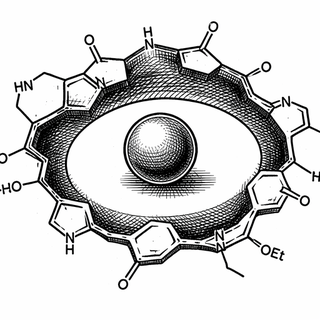
This is where the new research gets genuinely exciting. A team of chemists designed a water-soluble acylhydrazone macrocycle - basically a ring-shaped molecule with an electron-rich cavity - specifically engineered to grab cisatracurium and not let go.
If sugammadex is a sock, this new macrocycle is more like one of those claw machines at the arcade, except one that actually works. The macrocycle's cavity is electron-rich, and cisatracurium carries a positive charge. Opposites attract, as they say in both chemistry and bad romantic comedies.
The binding happens through two mechanisms working in tandem: electrostatic interactions (the charge attraction pulling cisatracurium into the cavity) and hydrophobic interactions (the non-polar parts of both molecules essentially hugging each other to avoid water, like two introverts finding each other at a party). The result? A binding constant of up to 10^7 M^-1, which in chemistry terms is the equivalent of a defensive midfielder who simply does not let anyone past.
Why "Water-Soluble" Is Doing Heavy Lifting in That Title
Here's the thing about designing molecules that work inside a human body: your body is basically a bag of saltwater. Any drug candidate that doesn't dissolve well in water is about as useful as a screen door on a submarine.
Previous macrocyclic host molecules have shown promise in binding various drug targets, but many of them have solubility issues that make them impractical for clinical use. The researchers here specifically tackled this by incorporating structural features that enhance water solubility while maintaining that strong binding affinity for cisatracurium. It's a tricky balancing act - like trying to make a sponge that's both super absorbent AND floats.
The acylhydrazone bonds in the macrocycle framework aren't just structural. They contribute to the electron density of the cavity, making it better at attracting positively charged guests. It's elegant molecular engineering where every piece of the architecture earns its spot on the team.
Supramolecular Chemistry: The Unsung MVP
This research falls under the umbrella of supramolecular chemistry - the study of how molecules interact with each other through non-covalent bonds. If regular chemistry is about building with Legos, supramolecular chemistry is about how those Lego structures snap together and come apart.
The beauty of the host-guest approach (where the macrocycle is the "host" and cisatracurium is the "guest") is its specificity. Rather than flooding the system with competing molecules like neostigmine does, you're deploying a targeted molecular escort that finds the paralytic agent and takes it out of circulation. The drug doesn't get metabolized differently; it just gets kidnapped.
This same general strategy is what made sugammadex so successful for rocuronium reversal, and it's encouraging to see the approach being extended to cisatracurium, which until now has been the paralytic without a dedicated reversal dance partner.
What This Could Mean in the Real World
If this work progresses through further development and clinical testing, it could fill a significant gap in anesthesia practice. Cisatracurium is widely preferred in many clinical scenarios - particularly for patients with hepatic or renal impairment - because it degrades via Hofmann elimination (a fancy way of saying it breaks down on its own at body temperature and pH, no liver or kidney required).
Having a specific, targeted reversal agent for cisatracurium would give anesthesiologists more flexibility and patients more safety. Instead of waiting for the drug to clear naturally or relying on the indirect approach of neostigmine, clinicians could have a direct molecular countermeasure.
Think of it like the difference between waiting for rain to wash your car versus having a pressure washer. Both get the job done, but one of them lets you get on with your day.
The Road Ahead
This is still early-stage work. The jump from "binds really well in lab conditions" to "safely reversing paralysis in actual humans" involves a marathon of preclinical studies, toxicology assessments, pharmacokinetic profiling, and clinical trials. Many promising molecules have stumbled at various points along that path.
But the fundamentals here are solid. The binding affinity is strong, the water solubility is practical, and the supramolecular approach has already been validated by sugammadex's clinical success. This isn't a shot in the dark - it's a well-aimed follow-up to a proven strategy, just targeting a different player on the field.
And for anyone who's ever watched a patient struggle to breathe in recovery because their paralytic hadn't fully worn off, the idea of a better, faster, more targeted reversal agent isn't just interesting chemistry. It's the kind of research that makes you lean forward in your chair.
This blog post discusses research findings and should not be taken as medical advice. If you have concerns about anesthesia or neuromuscular blockade, please consult a healthcare provider. Research discussed here represents ongoing scientific investigation and clinical validation is still in progress.
All images used in this post are decorative illustrations only and do not represent or reflect the accuracy, reality, or correctness of the referenced research.
Primary Source: Water-soluble acylhydrazone macrocycles as potent reversal agents for cisatracurium-induced neuromuscular blockade. PubMed. 2026. PMID: 41914046