
Good news: scientists are getting better at building materials that could help grow or repair human tissue. Bad news: some of those materials still act a bit like packing a kid into a snowsuit and then asking them to do gymnastics. Safe? Maybe. Comfortable and functional? Not so much. This new PubMed-indexed study looks at a gelatin-based hydrogel and asks a very practical question: if you give cells a roomier place to live, do they do better?
For any parent reading tissue engineering news with one eyebrow up, that question matters. A lot of regenerative medicine sounds promising right up until you ask, "Fine, but will it actually help cells grow where they need to grow?" This paper tackles exactly that bottleneck.
What are we even talking about?
The material in this study is called gelatin methacryloyl, or GelMA. That sounds like the name of a villain in a children’s cartoon, but it is actually a very popular lab material. Researchers like it because it is biocompatible, meaning cells generally tolerate it well, and it can be shaped into hydrogels. Hydrogels are soft, water-rich materials that can act like scaffolding for cells.
Think of a scaffold as temporary real estate for cells. If the goal is to repair tissue one day, cells need somewhere to sit, spread, communicate, and get fed. That last part matters more than it sounds. Cells are needy in the same way toddlers are needy. They need nutrients coming in, waste going out, and enough breathing room not to fall apart.
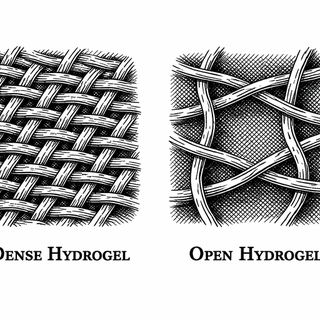
The trouble with regular GelMA is that its internal network can be too dense. In simple terms, stuff does not move through it easily. Nutrients, signaling molecules, and other substances can get slowed down, which is bad news for cells trying to grow and multiply.
What this study tested
The researchers made a series of GelMA hydrogels with larger pores, or macropores, using a method called liquid-liquid phase separation combined with photopolymerization. That is a mouthful, but the basic idea is straightforward: they engineered the gel so it would have tunable hole sizes inside it, then tested how well different substances could move through those holes.
This is where the paper gets more interesting than the usual "looks better under the microscope" story. A lot of past work has described permeability in a mostly qualitative way. In plain English, researchers often say things like "this seemed more porous" or "transport appeared improved." Useful, sure, but a little like judging a minivan by kicking the tires.
This study tried to quantify that transport. The team used model solutes with different molecular weights and applied a diffusion model based on Fick’s second law to estimate the effective diffusion coefficient through the hydrogel network. Translation: they did not just ask whether bigger pores looked better. They tried to measure how much better substances actually moved.
Why bigger pores might matter
If you are wondering why pore size deserves a whole paper, here is the practical answer: cells cannot thrive in a neighborhood where groceries never arrive and trash pickup is unreliable.
In tissue engineering, permeability is a big deal because cells depend on a constant exchange of materials. Nutrients and oxygen need to get in. Waste products need to get out. Biological signals need to move around. If a scaffold is too cramped, cells may survive poorly, grow slowly, or fail to organize into useful tissue.
According to the study summary, increasing pore size improved substance permeability and promoted cell proliferation. That link is the headline. More open internal structure seems to let materials move more efficiently, which then helps cells multiply.
That does not mean "bigger is always better" in every situation. A scaffold also has to hold together, support cells, and match the job it is being built to do. But this paper adds a helpful piece to the puzzle by showing that pore size is not just a design detail for materials scientists to argue about over coffee. It can directly affect how well cells do.
Why this is interesting from a family perspective
When I read something like this as a parent, I am not thinking about equations first. I am thinking about the long game. Could this kind of work eventually help with better wound repair, tissue reconstruction, cartilage restoration, or engineered implants that support healing more effectively?
That is the real-world lane here.
Hydrogels like GelMA are widely studied for regenerative medicine because they can mimic some features of natural tissue and support cell growth. If researchers can make these scaffolds better at transporting nutrients and signals, they may be able to build lab-grown tissues that survive better and function better.
For kids, that kind of progress matters because pediatric medicine has its own challenges. Growing bodies are not just small adult bodies with cartoon bandages. Repair materials may need to support ongoing development, not just patch a static problem. Better scaffold design could someday feed into therapies that are more adaptable and more biologically friendly.
We are not there yet, and this paper does not claim we are. Still, improving the basic "house rules" for cell survival is exactly the kind of unglamorous but necessary work that future treatments depend on.
What the study does well
One strength here is that the researchers tried to build a quantitative framework instead of stopping at a visual impression. That matters because tissue engineering can sometimes drift into "trust us, the images are prettier" territory. Pretty images are nice. My refrigerator can confirm that. But medicine needs measurements.
By systematically varying pore size and testing diffusion with model solutes of different sizes, the study gives a more structured way to think about transport in these materials. That could help other researchers compare scaffold designs more rigorously rather than reinventing the wheel in slightly squishier form.
Another strength is the link to cell proliferation. Improved permeability is only useful if it translates into better biological performance. Based on the summary provided, this scaffold redesign seems to have done that.
What this does not prove
This is the point where the sensible parent voice has to tap the brakes.
A better hydrogel in the lab is not the same thing as a ready-to-use treatment in a clinic. Not even close.
This study is about material design and cell behavior in a controlled research setting. It does not show that a child with an injury or tissue defect can be treated tomorrow with a pore-optimized GelMA implant. It does not answer long-term safety questions, performance in living organisms, manufacturing challenges, cost, or how the material behaves in the messy reality of actual tissue repair.
It also does not settle what pore size is best for every application. Bone, cartilage, skin, nerve, and other tissues all have different needs. Biology loves making every answer more complicated than anyone asked for.
So, will this help my kid?
Today, probably not directly.
Tomorrow, maybe as part of something bigger.
That is not a brush-off. It is the honest answer. This study looks like a useful step in the kind of foundational engineering that future regenerative treatments need. If you want better tissue scaffolds, better nutrient flow, and better cell growth, understanding how pore size changes diffusion is a solid place to work.
The paper is interesting because it focuses on a stubborn problem and treats it like an engineering problem that can actually be measured and improved. No miracle claims. No magic wand. Just a better-built cellular neighborhood.
For families following medical research, that is often what genuine progress looks like at first. Not a cure headline. Not a dramatic before-and-after story. Just a smarter material, a clearer model, and one less reason for cells to struggle.
This blog post discusses research findings and should not be taken as medical advice. If you have concerns about tissue repair, wound healing, or regenerative treatments, please consult a healthcare provider. Research discussed here represents ongoing scientific investigation and clinical validation is still in progress.
All images used in this post are decorative illustrations only and do not represent or reflect the accuracy, reality, or correctness of the referenced research.
Primary Source: The increase in the pore size of gelatin methacryloyl (GelMA) macroporous hydrogel promotes cell proliferation by enhancing substance permeability. PubMed record 41804628. https://pubmed.ncbi.nlm.nih.gov/41804628/