
Liver cancer has a nasty habit of hiding in plain sight, showing up late, resisting treatment, and turning precision medicine into a game of medical whack-a-mole. The puzzle is brutal: how do you hit hepatocellular carcinoma hard enough to matter, while sparing the rest of the body from the collateral damage? This study’s answer is delightfully complex in a very science-fiction-meets-public-health way: build a tiny targeted delivery system that sneaks directly to tumor cells, heats them up, strips their defenses, and may even help the immune system join the fight.
Why hepatocellular carcinoma is such a tough customer
Hepatocellular carcinoma, or HCC, is the most common form of primary liver cancer. It carries a heavy global burden, and that burden is not shared equally. People facing delayed diagnosis, limited access to specialty cancer care, higher exposure to hepatitis infections, cirrhosis, environmental toxins, or fragmented healthcare systems often get the shortest end of the stick. By the time many patients are diagnosed, the disease is already at an intermediate or advanced stage.
That timing matters. Early liver cancer can sometimes be treated with surgery, ablation, or transplant. Later-stage disease is much less forgiving. Standard treatments may help, but they often run into familiar problems: toxicity, drug resistance, weak tumor targeting, and the ever-unwelcome possibility of metastasis. Cancer, apparently, did not get the memo about cooperating with treatment plans.
So when researchers look for a therapy that is more precise, more potent, and less damaging to healthy tissue, that is not just a lab exercise. It is a health equity issue. Better targeting could mean safer care, fewer treatment interruptions, and more realistic options for patients who cannot afford extra complications.
The nanoplatform, translated into normal human language
The treatment described in this paper is a multifunctional nanoplatform. That phrase sounds like it belongs in a grant proposal and a superhero movie at the same time, so let’s unpack it.
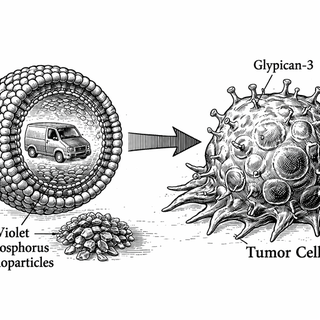
The researchers built a liposome-based delivery system. Liposomes are tiny bubble-like carriers made from fat-like molecules. Think of them as microscopic cargo vans. Into those vans, the team loaded three main components:
- Violet phosphorus nanoparticles
- RSL3, a ferroptosis-promoting drug
- Sulfasalazine, another agent that helps push cells toward ferroptosis
Then they wrapped the whole package in engineered macrophage membranes. Macrophages are immune cells, and their membranes can help disguise or guide the nanoparticle system. In this case, the membrane was engineered to express a molecule that targets glypican-3, or GPC3, a protein commonly found on hepatocellular carcinoma cells.
In plain terms, the researchers gave the therapy a mailing address.
The three-pronged attack
What makes this approach interesting is that it does not rely on one mechanism alone. It combines multiple ways of stressing and destroying cancer cells.
1. Photothermal therapy
Violet phosphorus nanoparticles can generate heat when exposed to near-infrared light. That heat can damage or kill tumor cells. Photothermal therapy is attractive because it can be spatially controlled, at least in principle. Shine the light where the tumor is, and you get a more focused effect.
The problem is that violet phosphorus alone may not be strong enough to do the job efficiently. So the researchers paired it with other strategies rather than asking it to carry the whole performance like an overworked lead actor.
2. Ferroptosis
Ferroptosis is a form of regulated cell death driven by iron-dependent lipid damage. Cancer cells often work very hard to prevent this kind of meltdown. RSL3 and sulfasalazine interfere with key protective systems, including GPX4 activity and the System x_c^- pathway described in the paper summary. In effect, the drugs make it harder for tumor cells to neutralize oxidative damage.
That matters because many cancers survive by building biochemical panic rooms. This approach tries to remove the locks.
3. Immune-related effects
The title also points to immunotherapy potential. When cancer cells are injured in certain ways, they can release signals that help the immune system notice them. Researchers are increasingly interested in combination approaches that not only kill tumor cells directly but also make the tumor microenvironment less hospitable to cancer growth.
For HCC, where recurrence and spread are major concerns, that immune angle is especially compelling.
Why the targeting matters
The study emphasizes receptor-mediated endocytosis through binding between the engineered carrier and GPC3 on HCC cells. Once inside, the acidic lysosomal environment helps trigger drug release.
This is the kind of detail that can sound technical and distant, but it gets at a real-world problem: many cancer drugs are effective in theory and messy in practice. If drugs circulate widely, they may harm healthy tissues before enough of them reach the tumor. If they are unstable or poorly soluble, they may not perform well at all. If targeting is weak, treatment becomes less efficient and more toxic.
That is why this design is worth watching. It is attempting to solve several translational headaches at once:
- Poor tumor targeting
- Low stability of the ferroptosis drugs
- Off-target toxicity
- Limited effectiveness of photothermal treatment alone
From a public health perspective, better efficiency is not just a scientific flex. Therapies that work more precisely could eventually reduce the burden of side effects, extra clinic visits, and treatment drop-off. Those benefits matter most for patients already navigating transportation barriers, insurance hurdles, caregiving demands, or limited oncology infrastructure.
What is exciting, and what still needs proof
The optimistic reading is easy to see. This platform is clever. It is tailored. It tries to outsmart liver cancer instead of merely punching harder. That is good science.
The realistic reading is equally necessary. This is still research, not routine care. A sophisticated nanoparticle system can look excellent in preclinical development and still face steep challenges later. Manufacturing complexity, reproducibility, long-term safety, immune interactions, cost, and scalability all matter. So does the simple question of whether a promising targeted strategy in the lab will produce meaningful survival benefits in actual patients.
And then there is the access question, my favorite public health elephant in the room. Precision oncology has a habit of being dazzling and expensive. If this kind of therapy advances, we should be asking early who will get it, where it will be available, and whether communities with the highest liver cancer burden will benefit. Innovation is wonderful. Innovation that reaches real people is better.
Why this paper deserves attention
I find this study intriguing because it treats liver cancer like the layered problem it is. Rather than betting everything on one drug or one energy-based therapy, the researchers built a system that combines targeting, triggered release, thermal injury, and ferroptosis induction in one package. That is ambitious, and ambition is sometimes exactly what hard cancers demand.
For underserved populations, the long-term promise is especially meaningful. A therapy that reduces off-target damage and improves delivery could someday support safer, more effective treatment in patients who have the least margin for added toxicity or failed first attempts. We are not there yet. Still, this is the kind of research that nudges cancer care away from blunt force and toward smarter precision.
And frankly, when liver cancer keeps changing the rules, a nanoparticle wearing an immune-cell costume and carrying a three-part anti-tumor toolkit is a pretty strong counter-move.
This blog post discusses research findings and should not be taken as medical advice. If you have concerns about liver cancer or related symptoms, please consult a healthcare provider. Research discussed here represents ongoing scientific investigation and clinical validation is still in progress.
All images used in this post are decorative illustrations only and do not represent or reflect the accuracy, reality, or correctness of the referenced research.
Primary Source: Genetically Engineered Membrane-Mimetic Liposome-Wrapped Violet Phosphorus Nanoplatform for Targeted Synergistic Ferroptosis/Photothermal/Immunotherapy of Hepatocellular Carcinoma. PubMed Record 42027106. https://pubmed.ncbi.nlm.nih.gov/42027106/