
Every great recipe has a moment where you toss in that one weird ingredient - fish sauce in a chocolate cake, anchovies in a Caesar dressing - and suddenly the whole thing transforms. Skeletal muscle tissue engineering just found its fish sauce, and it's magnetic nanoparticles. Tiny specks of iron oxide, smaller than a red blood cell's worst nightmare, that somehow convince muscle cells to line up, differentiate, and behave like they've been doing this their whole lives. A comprehensive new review lays out the full cookbook for this approach, and I have to say, as someone who's spent decades watching people lose muscle to trauma, disease, and plain old bad luck in the ER, this recipe is looking pretty tasty.
The Problem: Muscles Don't Just Grow Back
Here's the thing nobody tells you in high school biology: skeletal muscle is a diva. It's the largest tissue type in your body, making up roughly 40% of your total weight, and it handles everything from blinking to bench-pressing. But when it gets seriously damaged - think major trauma, volumetric muscle loss from a blast injury, or degenerative conditions like muscular dystrophy - it doesn't just bounce back. Small injuries? Sure, satellite cells (the muscle's built-in repair crew) can handle a patch job. But lose a big enough chunk and you're looking at scar tissue, fibrosis, and permanent functional loss.
Current treatments are, to put it diplomatically, not great. Autologous muscle flaps (borrowing from Peter to pay Paul) create donor site problems. Decellularized grafts have limited success. Physical therapy can only do so much when the tissue simply isn't there anymore. We needed something better, and bioengineers have been working on it for years under the banner of skeletal muscle tissue engineering, or SMTE.
Enter the Magnetic Nanoparticles
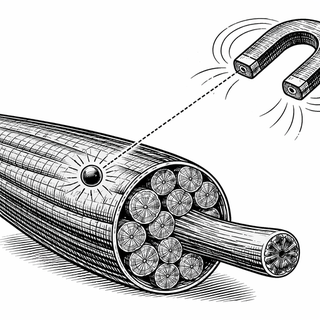
This is where it gets fun. Magnetic nanoparticles - mostly iron oxide-based (think magnetite, Fe3O4, or maghemite, γ-Fe2O3) - are absurdly versatile little tools. They're typically between 10 and 100 nanometers in diameter. For scale, if a nanoparticle were a marble, a human hair would be a highway tunnel. You can coat them with polymers, functionalize their surfaces with bioactive molecules, and - here's the party trick - control them with external magnetic fields.
The review published in the International Journal of Biological Macromolecules walks through the full landscape of how these particles are being deployed in muscle tissue engineering, and the breadth of applications is genuinely impressive (DOI: 10.1016/j.ijbiomac.2025.142655).
Four Ways Magnets Are Building Better Muscles
1. Scaffold Supercharging
Tissue engineering typically needs a scaffold - a three-dimensional framework that gives cells something to grab onto while they organize themselves into functional tissue. Embed magnetic nanoparticles into these scaffolds and you get electromagnetic-responsive structures. Apply an external magnetic field, and the scaffold can physically guide cell alignment. Skeletal muscle isn't just a random blob of cells; it's highly organized, with parallel fibers that need to line up properly to generate force. Magnetic scaffolds essentially act as a GPS for confused muscle cells, nudging them into the right formation.
2. Drug Delivery on Demand
One of the oldest problems in medicine: getting the right amount of the right drug to the right place at the right time. Load up magnetic nanoparticles with growth factors, anti-inflammatory agents, or differentiation signals, and you can steer them to the injury site with an external magnet. Then, by adjusting the magnetic field, you can control release rates. It's like having a medication remote control, which, honestly, is something I've fantasized about during many a 3 AM shift.
3. Myogenic Differentiation
Here's where the biology gets genuinely wild. Magnetic nanoparticles aren't just passive delivery vehicles - they can actively promote the transformation of stem cells into muscle cells. The mechanism involves mechanotransduction pathways; basically, the physical forces exerted by MNPs under magnetic fields trigger signaling cascades inside cells that push them toward a muscle cell fate. You're literally using magnets to convince stem cells to become muscle. If you had told me this in medical school, I would have assumed you were describing a sci-fi movie plot.
4. Remote Mechanical Stimulation
Muscle cells need mechanical stimulation to develop properly - it's why physical therapy matters, why astronauts lose muscle mass in space. Magnetic nanoparticles embedded in or near cells can be vibrated, pulled, or stressed using external alternating magnetic fields, providing mechanical stimulation without anyone having to touch the tissue. Remote-controlled exercise for cells that haven't even formed a proper muscle yet. We're living in the future.
The Catch (Because There's Always a Catch)
Before you start imagining magnetically-controlled super-soldiers, let's talk about the fine print. The review doesn't shy away from the challenges. Dosage matters - too few nanoparticles and you get no effect, too many and you run into cytotoxicity. Iron oxide particles can generate reactive oxygen species at high concentrations, which is a fancy way of saying they can stress cells out until they die. Not the goal.
Long-term biocompatibility is still an open question. Where do these particles go after the muscle forms? How does the body clear them? The liver and spleen tend to be the final destination for most nanoparticles, but the long-term effects of iron oxide accumulation need more study. There's also the challenge of scaling up from lab dishes and mouse models to actual human-sized muscle repairs. A lot of promising tissue engineering approaches have stumbled at this particular hurdle.
Why This Matters
Volumetric muscle loss affects hundreds of thousands of people annually - military personnel, trauma victims, cancer patients post-surgery, and those with congenital conditions. The current standard of care leaves a lot of room for improvement. If magnetic nanoparticle-enhanced tissue engineering can deliver on even half its promise, we're looking at a future where surgeons don't just patch muscle damage - they rebuild it, with magnetically-guided precision, at the cellular level.
The convergence of smart materials, nanotechnology, and cell biology in this field is accelerating. This review serves as both a progress report and a roadmap, cataloguing what works, what doesn't, and what needs more investigation before any of this reaches a bedside near you.
I've been in emergency medicine long enough to be skeptical of anything that sounds too good to be true. But magnetic nanoparticles for muscle regeneration? The science is solid, the progress is real, and the applications are exactly where we need innovation most. I'm cautiously optimistic - which, for an ER doc, is basically doing backflips.
This blog post discusses research findings and should not be taken as medical advice. If you have concerns about muscle injuries or degenerative conditions, please consult a healthcare provider. Research discussed here represents ongoing scientific investigation and clinical validation is still in progress.
All images used in this post are decorative illustrations only and do not represent or reflect the accuracy, reality, or correctness of the referenced research.
Primary Source: Skeletal muscle tissue engineering using magnetic nanoparticles: a comprehensive review. International Journal of Biological Macromolecules. 2025. DOI: 10.1016/j.ijbiomac.2025.142655