
Most lab equipment that handles oocytes has the situational awareness of a blindfolded waiter carrying soup - it knows roughly where things should be, but good luck if anything moves. A new dual-camera microfluidic chip just changed that game entirely, and honestly, it's the kind of elegantly nerdy solution that makes me want to slow-clap for bioengineering.
The Problem With Moving Microscopic Eggs Around
Here's something that might surprise you: oocytes (egg cells, for those of us who didn't memorize our reproductive biology textbook) are absolute workhorses in research labs. Scientists use them for everything from gene expression studies to drug screening to electrophysiology experiments. They're like the lab rats of the cellular world, except rounder and significantly more delicate.
The catch? Moving these tiny spheres from point A to point B - and then to points C, D, and E - has traditionally been a logistical nightmare. Most setups rely on a single microscope view, which works fine if you're only dealing with one oocyte at one location. But modern bioengineering research increasingly needs to shuffle multiple oocytes between different worksites, kind of like running a very small, very fragile postal service.
Imagine trying to coordinate a three-ring circus while only being able to look through one telescope. That's essentially what researchers have been dealing with.
Enter the Dual Vision System (It's Exactly What It Sounds Like)
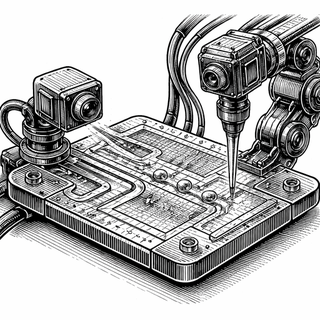
A research team has developed what they're calling a "dual vision-equipped microfluidic chip," and the name pretty much tells you everything. It's a tiny chip with two miniature cameras - one to track oocytes flowing through microchannels, and another positioned above the pipette tip to nail the precise pick-and-place positioning.
The whole contraption mounts onto a robotic manipulator, which is fancy talk for "a very precise mechanical arm that does what the cameras tell it to do."
What makes this clever isn't just slapping two cameras onto existing equipment. The system uses something called hydrodynamic flow focusing to separate and release multiple oocytes in sequence. Think of it like using water currents to sort marbles in a tube - except the marbles are living cells and the tube is thinner than a human hair.
The Clever Bit: When Things Go Wrong (Because They Always Do)
Here's where the engineering gets genuinely impressive. Anyone who's worked with microfluidics knows that cells don't always cooperate. Sometimes two oocytes decide they'd rather stick together than flow through a channel separately, like stubborn commuters refusing to single-file through a turnstile.
The researchers designed a well port - basically a tiny trap - that can catch and isolate individual oocytes when the flow-based separation doesn't quite work. The vision system detects when oocytes aren't properly separated and redirects them to this backup system.
It's the kind of redundancy that makes engineers smile and biologists sigh with relief. Because nothing ruins an experiment quite like losing track of your cells or accidentally squishing two together.
Why Should Anyone Care About Oocyte Logistics?
Fair question. Unless you're actively researching fertility treatments or developmental biology, the phrase "spatiotemporal sequential pick-and-place of oocytes" probably doesn't quicken your pulse.
But consider the downstream applications. Drug screening often requires testing compounds on multiple cells under controlled conditions - and doing that efficiently means moving cells around without damaging them. Gene expression studies need cells positioned precisely for analysis. Electrophysiological measurements require stable, isolated cells in specific locations.
Every one of these applications benefits from being able to handle multiple oocytes simultaneously across different work areas. It's the difference between processing samples one at a time (slow, tedious) versus running parallel operations (faster, more data, happier researchers).
The Robot-Mounted Future
What really catches my attention is the integration with robotic manipulation. This isn't just a static chip sitting under a microscope - it's a mobile system that can transport oocytes between completely different areas of a larger experimental setup.
The researchers demonstrated the full workflow: pick up multiple oocytes, transport them, and place them into different well chip areas. Each step guided by visual feedback from those dual cameras.
It's a bit like upgrading from a manual transmission to a self-driving car, except the car is microscopic and carries eggs instead of passengers.
What's Next for Microfluidic Cell Handling?
The team suggests their method has "application potential in oocyte biomedical engineering," which is scientific understatement for "this could be useful in a lot of places." I'd expect to see similar dual-vision approaches applied to other cell types - embryos, stem cells, maybe even organoids as that field continues to explode.
The principles here aren't limited to reproductive cells. Any situation where you need precise, vision-guided manipulation of delicate biological samples could benefit from this kind of redundant, multi-camera approach.
Will this specific chip revolutionize fertility clinics next year? Probably not - there's a long road between a proof-of-concept demonstration and clinical-grade equipment. But it represents a meaningful step forward in how we think about automated cell handling.
And honestly? There's something deeply satisfying about watching engineering elegantly solve a biological logistics problem. Two tiny cameras, some clever fluid dynamics, and suddenly we can juggle eggs like never before.
This blog post discusses research findings and should not be taken as medical advice. If you have concerns about fertility or reproductive health, please consult a healthcare provider. Research discussed here represents ongoing scientific investigation and clinical validation is still in progress.
All images used in this post are decorative illustrations only and do not represent or reflect the accuracy, reality, or correctness of the referenced research.
Primary Source: Dual vision-equipped microfluidic chip for spatiotemporal sequential pick-and-place of oocytes. PubMed. 2025. PMID: 41804661