
We have spent half a century perfecting the part of the dental implant that screws into bone, and we've largely cracked that problem. Osseointegration - the fusion of titanium with living bone - is, by now, almost boringly reliable. But the quiet disaster happening just a few millimeters above, where the abutment meets your gum tissue? That's the part keeping implant researchers up at night. And a team of materials scientists may have just figured out how to fix it using little more than hot water and a handful of metal ions.
The Soft Tissue Problem Nobody Talks About
Here's the situation. A dental implant has three main parts: the fixture (the screw in your jawbone), the abutment (the connector poking through your gums), and the crown (the tooth-shaped bit you actually chew with). The fixture-bone interface gets all the glory in textbooks, but the abutment-gum interface is where things quietly go sideways.
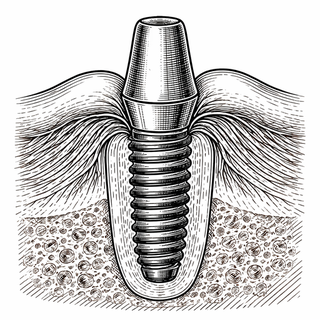
Natural teeth have a beautifully evolved seal between gum tissue and tooth surface. Connective tissue fibers anchor themselves perpendicular to the tooth, creating a tight biological gasket that keeps bacteria out. Implant abutments, typically made from grade V titanium (Ti-6Al-4V), don't get this luxury. The connective tissue around an abutment tends to run parallel to the surface rather than anchoring into it, creating what amounts to a welcome mat for bacterial infiltration. Over time, this weak seal can lead to peri-implant mucositis and, eventually, peri-implantitis - the implant world's version of gum disease, and a leading cause of implant failure.
I spent years watching colleagues celebrate successful osseointegration while ignoring the soft tissue slowly retreating around their patients' abutments. It was a bit like congratulating yourself on a perfectly built foundation while the roof leaked.
Giving Titanium a Molecular Makeover
The research in question, recently published and catalogued on PubMed, takes a clever approach to this old problem. The team started with anodised titanium V surfaces - that's titanium with an electrochemically grown oxide layer, which creates a nanoporous or nanotubular architecture on the surface. Think of it as turning a smooth metal wall into something resembling a microscopic sponge.
Then comes the interesting part: hydrothermal treatment. The anodised surfaces were placed in solutions containing divalent metal ions - magnesium (Mg²⁺), calcium (Ca²⁺), strontium (Sr²⁺), and zinc (Zn²⁺) - and subjected to elevated temperature and pressure in an autoclave. This process drives the ions into the titanium oxide nanostructure, fundamentally changing the surface chemistry without altering the bulk material properties.
Why these particular ions? Each one plays a biological role in tissue health. Magnesium is involved in hundreds of enzymatic reactions and promotes cell adhesion. Calcium is, well, calcium - the body's favorite structural ion. Strontium has known bone-friendly properties and has been explored in orthopedic coatings for years. Zinc has antimicrobial properties and plays roles in wound healing. Loading these into the abutment surface is essentially giving the titanium a biochemical vocabulary it never had.
Why This Approach Is Particularly Clever
Surface modification of implant materials is hardly new. Researchers have tried coatings, plasma treatments, laser texturing, and enough chemical baths to fill a swimming pool. Many of these approaches suffer from durability problems - coatings can delaminate, surface treatments can wear off under the mechanical stresses of the oral environment.
What makes hydrothermal ion incorporation appealing is that the ions become part of the oxide layer itself, not a separate coating sitting on top. It's the difference between painting a wall and dyeing the plaster. The modified surface should, in theory, be far more resistant to mechanical degradation during abutment insertion, removal, and the constant micro-movements of daily function.
The anodisation step is also worth appreciating. By creating nanotubular structures on the titanium surface before the hydrothermal treatment, the team dramatically increased the available surface area for ion incorporation and, subsequently, for cell attachment. Cells respond to topography at the nanoscale - they "feel" their environment through structures called filopodia, and surfaces with features in the tens-to-hundreds of nanometers range tend to promote better adhesion and spreading.
The Bigger Picture for Implant Patients
If this approach translates from bench to bedside (and that "if" carries about a decade of further research, clinical trials, and regulatory hurdles), the implications are significant. Peri-implantitis affects somewhere between 10% and 47% of implant patients, depending on which study you read and how strictly you define the condition. Even at the conservative end, that's a lot of people dealing with inflammation, bone loss, and potential implant removal.
A better gingival seal wouldn't just reduce infection rates. It could extend implant longevity, reduce the need for maintenance surgeries, and potentially make implants viable for patients currently considered high-risk due to conditions like diabetes or autoimmune disorders that compromise soft tissue healing.
The approach also has an elegance that appeals to the pragmatist in me. Anodisation and hydrothermal treatment are established industrial processes. They don't require exotic equipment or rare materials. Scaling this from a research lab to a manufacturing line wouldn't require reinventing the wheel - more like giving the existing wheel slightly better tires.
What Comes Next
The road from a promising surface modification to a product in your dentist's office is long and paved with regulatory paperwork. The next steps would likely involve long-term in vitro studies examining how human gingival fibroblasts and epithelial cells respond to these modified surfaces, followed by animal studies assessing the gingival seal in vivo. Questions about ion release rates, long-term stability, and potential systemic effects all need answering.
But as someone who has watched implant science evolve from a curiosity to a cornerstone of restorative dentistry, I find this work genuinely encouraging. The field spent its first few decades solving the bone problem. It's about time we gave the gums the same attention.
After all, even the best foundation in the world isn't worth much if the seal around the door lets in the rain.
This blog post discusses research findings and should not be taken as medical advice. If you have concerns about dental implants or gum health, please consult a healthcare provider. Research discussed here represents ongoing scientific investigation and clinical validation is still in progress.
All images used in this post are decorative illustrations only and do not represent or reflect the accuracy, reality, or correctness of the referenced research.
Primary Source: Building a better gingival seal in dental implants: hydrothermal ion incorporation into titanium abutment surfaces. PubMed. 2026. PMID: 41962436