
Let's be real - our current approach to adolescent obesity prevention kind of sucks. We've spent years wagging fingers at teenagers about their screen time while simultaneously designing algorithms specifically engineered to keep their eyeballs glued to TikTok. The advice has been vague, the science has been murky, and the results speak for themselves: childhood obesity rates keep climbing like they're training for an Olympic event nobody asked for.
But here's the thing. A massive new study just dropped some actual numbers on what's really happening with our kids, and the data tells a more nuanced story than "screens bad, exercise good."
The Numbers Don't Lie (But They Do Complicate Things)
Researchers followed 5,356 US adolescents through the Adolescent Brain Cognitive Development (ABCD) Study, tracking them from ages 11-12 to ages 13-14. This wasn't some small sample recruited from a single school district - we're talking about a genuinely representative slice of American teenagers.
Here's what their daily lives looked like at baseline: an average of 6.1 hours of screen time per day and about 9,265 steps. For context, that screen time number means many kids are spending more time staring at screens than they spend in school. The step count? It's actually not terrible - the often-cited 10,000 steps goal was literally invented by a Japanese pedometer company in the 1960s as a marketing gimmick, so 9,265 is reasonably respectable.
Two years later, 32.7% of these kids met criteria for overweight or obesity. Nearly one in three. That's the number we're working with.
Screen Time: Not Quite the Villain We Thought
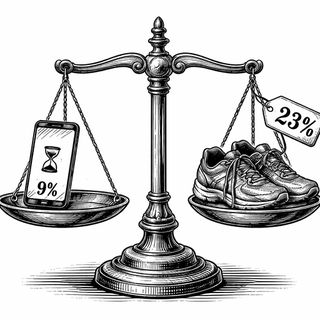
Now here's where it gets interesting. When the researchers ran their Poisson regression models (that's statistics-speak for "we did the math properly"), high screen time - defined as more than 8 hours per day - was associated with a 9% increased risk of overweight or obesity compared to low screen time (0-4 hours daily).
Nine percent. Not nothing, but not the dramatic villain origin story we've been told either.
The risk ratio was 1.09 with a 95% confidence interval of 1.02-1.16. For the non-stats folks: this means we're pretty confident the effect is real, but it's relatively modest. Statistically significant? Yes. The single most important factor? Not even close.
Steps: The Unsung Hero of This Story
Here's where the data gets spicy. Low step counts - between 1,000 and 6,000 steps per day - were associated with a 23% increased risk of overweight or obesity compared to high step counts (over 12,000 steps daily). That risk ratio of 1.23 is more than double the effect size of screen time.
The linear regression showed even more dramatic results: kids in the low step count group had BMI percentiles that were 3.27 points higher than the high-activity group. In the world of population health, that's a pretty substantial shift.
What's particularly fascinating is what the researchers didn't find. There was no significant interaction between screen time and step count. In plain English: these two factors operate independently. A kid who walks 15,000 steps a day isn't magically protected from the effects of 10 hours of screen time, and a kid who barely touches their phone but also barely moves their body doesn't get bonus points.
Why This Changes the Conversation
For years, public health messaging has focused heavily on screen time as the primary culprit in adolescent weight gain. And I get it - it's an easy target. Phones are visible, measurable, and parents already feel guilty about them.
But these numbers suggest we've been putting too many eggs in the wrong basket. If you had to choose between getting your teenager to cut their screen time from 8 hours to 4 hours (a 50% reduction) or getting them from 5,000 steps to 12,000 steps daily, the step count change would likely have a bigger impact on their metabolic health.
This isn't to say screen time doesn't matter. It clearly does. But the relative effect sizes suggest that physical activity deserves equal - if not greater - billing in our prevention efforts.
The Real-World Translation
So what does this actually mean for parents, schools, and public health folks trying to help kids stay healthy?
First, stop treating this as an either/or situation. The research explicitly states that "obesity prevention efforts should consider both greater physical activity and less recreational screen use as behavioral interventions." Both. Not one or the other.
Second, maybe recalibrate where we're putting our energy. Getting a teenager to voluntarily reduce their screen time is roughly as easy as getting a cat to take a bath. But finding ways to increase their physical activity - whether through sports, active transportation, or just making movement more convenient - might be a more achievable target with a bigger payoff.
Third, let's acknowledge the structural issues. Many kids live in neighborhoods where walking isn't safe, schools have cut PE programs to the bone, and after-school activities cost money that families don't have. The individual behavior change message only goes so far when the environment is working against you.
The Bigger Picture
This study is part of the ABCD Study, one of the largest long-term studies of brain development and child health in the United States. The fact that researchers are now pulling apart the relative contributions of different lifestyle factors is exactly the kind of granular analysis we need.
Because here's the uncomfortable truth: we've been fighting adolescent obesity with blunt instruments and vague guidance. "Get more exercise" and "reduce screen time" are about as helpful as telling someone to "be healthier." The data from studies like this one help us get specific about what actually moves the needle - literally.
The 23% risk increase associated with low physical activity versus the 9% increase from high screen time isn't just a statistical curiosity. It's a roadmap. It tells us where to focus limited resources and how to prioritize interventions.
What We Still Don't Know
A few caveats, because I'm a data person and we love caveats. This study measured recreational screen time and step counts, but it didn't differentiate between types of screen activities (educational vs. entertainment, active gaming vs. passive scrolling) or types of physical activity (structured sports vs. incidental movement).
There's also the question of causality. While the prospective design (measuring exposures before outcomes) strengthens the case for a causal relationship, this is still observational research. We can't rule out confounding factors entirely.
And of course, BMI is an imperfect measure of health. It doesn't distinguish between muscle and fat, and it's particularly problematic for certain populations. But for large-scale epidemiological research, it remains a useful proxy.
The Bottom Line
If I had to summarize 5,356 kids and two years of data into actionable advice, it would be this: yes, manage screen time, but don't let that effort come at the expense of promoting physical activity. The numbers suggest that getting kids moving might be the higher-yield intervention.
And maybe, just maybe, we should stop acting like this is purely a matter of individual willpower. Building environments where the healthy choice is the easy choice - that's the real challenge. The data just confirms what we probably already suspected: there are no shortcuts here, and one-dimensional solutions won't cut it.
This blog post discusses research findings and should not be taken as medical advice. If you have concerns about adolescent weight management or physical activity, please consult a healthcare provider. Research discussed here represents ongoing scientific investigation and findings may be refined as more data becomes available.
All images used in this post are decorative illustrations only and do not represent or reflect the accuracy, reality, or correctness of the referenced research.
Primary Source: Nagata JM et al. Associations of Screen Time and Physical Activity With Body Mass Index in Early Adolescence: A Prospective Cohort Study. JAMA Network Open. 2025. DOI: 10.1001/jamanetworkopen.2025.12345