
If a cancer biosensor were a LEGO set, it would be the kind where you painstakingly build the entire Millennium Falcon, only to watch it explode the second you try to stick a minifigure inside the cockpit. That, in a nutshell, has been the problem with carbon nanotube field-effect transistor (CNT-FET) biosensors. These incredibly sensitive little chips can theoretically detect the faintest molecular traces of cancer in your blood, but the moment you try to attach the biological probes that actually do the detecting? The whole thing falls apart. Or at least, it stops working as well as it should. A team of researchers just figured out a beautifully simple fix: stop gluing the LEGO together and make it snap-on instead.
Tiny Transistors, Big Ambitions
First, let's talk about what these biosensors are actually trying to find. Floating around in your bloodstream are minuscule molecules called microRNAs (miRNAs) - tiny snippets of genetic material that cells spit out like breadcrumbs. When cancer starts growing, certain miRNAs show up in abnormal amounts. One of the most studied is miRNA-21, which tends to spike in patients with liver, lung, and breast cancers. Think of miRNAs as the smoke before the fire - catch them early enough, and you might catch the cancer early enough too.
The catch? These molecules exist at staggeringly low concentrations. We're talking attomolar levels - that's 10 to the negative 18th moles per liter, or roughly the molecular equivalent of finding one specific grain of sand on an entire beach. Detecting something that rare requires a sensor so sensitive it practically needs to hold its breath.
CNT-FET biosensors are built for exactly this job. Carbon nanotubes are phenomenal electrical conductors at the nanoscale, and when you configure them as transistors, even the slightest change in their chemical environment - like a miRNA molecule landing on the sensor's surface - shifts the electrical signal in a measurable way. No fluorescent labels needed. No chemical amplification steps. Just pure electrical detection, label-free, and ready for miniaturization.
The Assembly Problem (Or: Why You Can't Have Nice Things)
Here's where things have traditionally gone sideways. To make a CNT-FET biosensor actually recognize miRNA-21, you need to attach biological probes - usually complementary DNA strands - to the sensor's gate electrode. This biofunctionalization process involves chemicals, incubation steps, and washing procedures that are, to put it politely, not gentle. The harsh conditions required to anchor those probes onto the gate can degrade the delicate carbon nanotube transistor sitting right underneath.
It's like trying to wallpaper a room while someone is simultaneously building the walls. The result? Sensors that should theoretically detect attomolar concentrations end up with sensitivity that's all over the map. Reproducibility suffers. Reliability tanks. And if you want to test for a different biomarker, you basically have to build a whole new sensor from scratch.
The Modular Fix: Just Unplug It
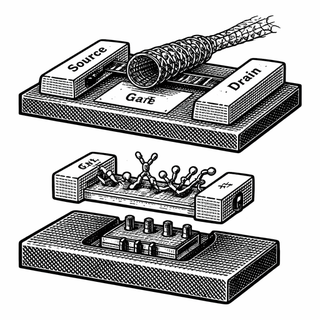
The solution reported in this new study is one of those ideas that makes you say, "Why didn't anyone think of this sooner?" Instead of building the probe layer directly onto the transistor, the researchers split the biosensor into two separate modules: the CNT-FET chip and the gate chip. Each module is fabricated independently, with reserved liquid metal connection ports that allow them to snap together after the messy biofunctionalization is already done.
Picture it like a phone case with a built-in screen protector. You put the screen protector through all the rough handling - cutting, adhesive treatment, alignment - and then gently click it onto the phone. The phone's screen never gets touched during the process. Similarly, the sensitive gate array gets all its biological probes attached in a separate facility, far away from the pristine carbon nanotubes. Once the probes are in place, the gate module connects to the FET module through liquid metal contacts, and the biosensor is ready to go.
This modular design delivers two huge wins. First, the CNT-FET's electrical performance stays intact because it never gets exposed to the chemical gauntlet of probe assembly. Second - and this is the part that makes engineers grin - the FET modules become reusable. Swap out the gate chip, and you've got a fresh sensor ready for a different target or a new patient sample.
The Numbers That Matter
So does this snap-together approach actually work? The results are pretty jaw-dropping. Using miRNA-21 as their test target, the researchers achieved a limit of detection of 0.36 attomolar. To put that in perspective, many existing biosensors struggle to reliably detect miRNAs at femtomolar levels, which is a thousand times higher. This sensor is playing in an entirely different league.
Even more impressive is the reproducibility. The response variation came in below 5.1%, which for a biosensor at these concentration ranges is remarkably tight. Consistency has always been the Achilles' heel of ultra-sensitive detection platforms - it doesn't matter how sensitive your sensor is if you get a different answer every time you run it.
From Lab Bench to Clinical Relevance
The team didn't stop at buffer solutions and artificial samples. They ran their modular biosensor against 48 clinical serum samples from real patients - including individuals diagnosed with liver, lung, and breast cancer, alongside healthy controls. The biosensor reliably identified significantly elevated miRNA-21 levels in cancer patients compared to healthy individuals. When they cross-checked their results against qRT-PCR (the current gold standard for miRNA quantification), the agreement was excellent.
That last detail is worth pausing on. A biosensor that matches the gold standard while being simpler, smaller, more reusable, and potentially cheaper to operate starts to look like something that could actually show up in a clinical lab someday. Not to replace qRT-PCR entirely, but to complement it - especially in point-of-care settings where speed and simplicity matter.
What Comes Next?
There's still a road between "impressive lab results" and "available at your doctor's office." Questions about long-term stability, manufacturing scalability, and regulatory approval all loom large. But the modular architecture itself opens interesting doors. If you can swap gate modules, you can potentially create panels that test for multiple miRNAs from a single blood draw - a kind of mix-and-match cancer screening toolkit.
For now, the biggest takeaway might be the design philosophy itself: when the assembly process is destroying your sensor, stop trying to make the sensor tougher. Just take it out of the room.
This blog post discusses research findings and should not be taken as medical advice. If you have concerns about cancer biomarkers or screening, please consult a healthcare provider. Research discussed here represents ongoing scientific investigation and clinical validation is still in progress.
All images used in this post are decorative illustrations only and do not represent or reflect the accuracy, reality, or correctness of the referenced research.
Primary Source: Modular Functionalized Gates for Field-Effect Transistor Biosensors Enabling Reliable Detection of Trace miRNAs. PubMed. 2025. PubMed: 42029234