
The strip is already wicking. A droplet creeps across nitrocellulose, the test line waits, and somewhere between the benchtop optimism and the coffee going cold, a familiar problem shows up again: these handy rapid tests often depend on biological components that can be fussy, expensive, and not especially thrilled about heat, storage, or mass production. So when a paper proposes swapping part of that biological machinery for a synthetic stand-in, my first reaction is not "revolution!" It is more like, "All right, show me the receipts."
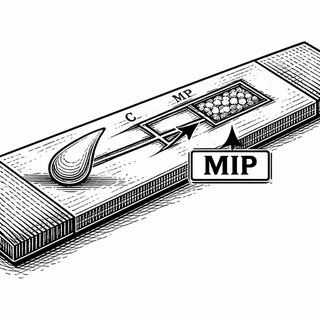
This study looks at lateral flow assays, the same broad family of test-strip technology that made itself very famous during the pandemic, and asks whether the test line can work with a molecularly imprinted polymer, or MIP, designed to recognize biotin. That is a mouthful, but the core idea is fairly simple: instead of using a natural receptor such as an antibody, make a synthetic material with binding sites shaped for the target, like a custom parking space built around a specific car.
That does not automatically make it better. But it does make it interesting.
Why mess with lateral flow tests in the first place?
Lateral flow assays are popular because they are quick, portable, and relatively easy to use. They shine in clinics, low-resource settings, and anywhere "wait three business days for a lab result" is not a crowd-pleaser. The catch is that many of these tests rely on biological recognition elements, often antibodies, which can be fragile and expensive and may not always scale gracefully.
This paper takes aim at that weak spot. The researchers developed biotin-specific MIPs and placed them directly into the nitrocellulose membrane as the test line in a nucleic acid lateral flow assay. In plain English, they tried to build the part of the strip that catches the target using a synthetic recognition material instead of a conventional biological one.
That is a smart target for innovation. If synthetic binders can be made robustly and cheaply, they could help with shelf life, manufacturing consistency, and deployment outside carefully controlled lab conditions. Those are not glamorous engineering details, but they matter a lot in the real world. Diagnostics do not live by clever chemistry alone.
What the researchers actually did
The paper reports that the team synthesized and structurally characterized biotin-specific MIPs, then tested whether those MIPs could selectively bind a biotinylated model analyte, specifically biotinylated horseradish peroxidase. That is a reasonable early validation step. Before you claim your synthetic test line works in a real assay, you should first prove it can grab onto something biotin-tagged under controlled conditions. Gold star for not skipping the boring but necessary homework.
After that, the researchers moved to a more relevant use case: detecting double-tagged PCR amplicons from Escherichia coli labeled with biotin and digoxigenin in a nucleic acid lateral flow format. The reported outcome was a visual detection limit of 2 ng/mL, based on the summary provided.
That progression, from model analyte to tagged PCR product, is methodologically solid. It is not a full leap into messy clinical reality, but it is at least a walk in the right direction rather than a sprint into hype.
Why this is a neat idea
Biotin is already a common tag in bioassays, so designing a synthetic material that reliably recognizes it could be a useful modular trick. Think of biotin as a kind of molecular luggage tag. If your assay target carries that tag, and your strip can reliably catch the tag, you may be able to build flexible detection systems around the same basic capture strategy.
The appealing part here is not just "polymer instead of antibody." It is the possibility of making lateral flow systems that are:
- More stable during storage and transport
- Less dependent on delicate biological reagents
- Potentially cheaper or easier to manufacture at scale
- Better suited for harsh environments where traditional components may underperform
If that holds up, it could matter for point-of-care testing, field diagnostics, and resource-limited settings where test durability is not a luxury feature. It is survival gear.
Now for the brake pedal
This is where the science communicator in me starts tapping the "steady now" sign.
First, this appears to be a proof-of-concept study, not a clinical validation paper. Showing that a synthetic test line can capture biotin-tagged analytes and detect PCR products from E. coli is encouraging, but it is still several steps away from proving broad clinical usefulness. Real samples are messy. Real workflows are messy. Real manufacturing is messier still.
Second, the target being recognized by the MIP is biotin, which is a tag, not the pathogen itself. That is not a flaw, but it does shape the claim. The polymer is not directly recognizing E. coli DNA sequence features in the way people might casually assume. It is recognizing a chemical label attached within an assay design. That can still be very useful, but it is more "smart assay engineering" than "magic synthetic receptor that identifies bacteria by smell."
Third, visual detection limits are helpful, but they are not the whole story. We would also want to know about:
- Specificity against non-target sample components
- Reproducibility between batches
- Performance in real clinical or environmental samples
- Shelf-life under heat and humidity stress
- Comparison against standard antibody-based lateral flow formats
Without that broader validation, it is too early to declare synthetic capture lines the new sheriff in diagnostic town. At best, we can say the paper makes a credible case that the idea deserves more serious testing.
The bigger picture
What I like about this work is that it addresses a practical bottleneck rather than chasing novelty for novelty's sake. Replacing fragile biological components with synthetic alternatives is the kind of advance that could quietly improve diagnostics in ways users actually notice: fewer storage headaches, lower costs, and better reliability where infrastructure is limited.
What I do not want is for anyone to oversell it. A successful benchtop demonstration is not the same thing as a field-ready platform. Science is full of promising substitutes that behave beautifully in tidy experiments and then become divas the minute the world gets involved.
Still, this paper earns attention because it asks a useful question with a sensible experimental setup: can a molecularly imprinted polymer act as a biomimetic test line in a lateral flow assay? Based on the reported results, the answer appears to be yes, at least in this controlled nucleic-acid testing setup.
That is not a grand finale. It is a solid opening act. And honestly, diagnostics could use more of those: careful, incremental improvements that make tests sturdier instead of flashier.
This blog post discusses research findings and should not be taken as medical advice. If you have concerns about infectious disease testing or diagnostic results, please consult a healthcare provider. Research discussed here represents ongoing scientific investigation and clinical validation is still in progress.
All images used in this post are decorative illustrations only and do not represent or reflect the accuracy, reality, or correctness of the referenced research.
Primary Source: Biotin-specific molecularly imprinted polymers as a biomimetic test line in lateral flow assays. PubMed Record 41604871. https://pubmed.ncbi.nlm.nih.gov/41604871/