
"You can't make a sensor out of gelatin. That's literally Jell-O."
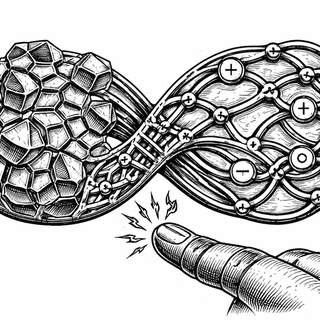
"It hits 1.9 megajoules per cubic meter of toughness."
"...Excuse me, what?"
"Also it doesn't leak salt and it won't kill your cells."
"Okay, now you're just making things up."
But nobody is making things up. A research team just built a gelatin-based hydrogel sensor tough enough for real-world human-machine interaction, and the numbers are genuinely wild. Let's talk about why a dessert ingredient might be the future of wearable tech.
The Problem: You Can't Have Nice Things (in Hydrogel Form)
Hydrogels - those squishy, water-swollen polymer networks - have been the darling of flexible sensor research for years. They stretch, they conduct, they conform to skin. In theory, they're perfect for human-machine interaction (HMI), the field concerned with making your body movements translate into signals that machines can understand.
In practice? There's always been a frustrating trade-off. Make a hydrogel mechanically tough, and you sacrifice its ability to sense things. Make it a great sensor, and it falls apart when you flex your wrist too aggressively. It's the materials science equivalent of wanting a car that's both a sports car and a minivan. Everyone claims they've solved it. The data usually disagrees.
Traditional approaches to toughening hydrogels have another problem: they rely on adding salts directly into the gel, which sounds fine until those salts start leaching out over time. Salt leakage degrades performance and, in biomedical applications, raises cytotoxicity concerns. Nobody wants a wearable sensor that slowly poisons the skin it's sitting on. That's a bad product review waiting to happen.
The Fix: Let Chemistry Do the Heavy Lifting
The research team behind this study took a different path. Instead of dumping salts into the hydrogel and hoping for the best, they used something called a polyelectrolyte-induced Hofmeister effect. Let's unpack that, because it's genuinely clever.
The Hofmeister effect, discovered back in 1888 by Franz Hofmeister, describes how different ions affect protein stability in solution. Some ions make proteins more soluble ("salting in"), and others force proteins to aggregate and crystallize ("salting out"). It's one of the oldest known phenomena in biochemistry, and researchers are still finding new ways to exploit it over 130 years later.
Here's the twist: instead of using free-floating salt ions to trigger this effect, the team incorporated sodium polyacrylate (PAANa) - a polyelectrolyte - into a gelatin matrix. PAANa is a polymer chain studded with negatively charged groups. When you mix it with gelatin, those charged groups interact electrostatically with the gelatin chains, creating a localized salting-out effect. The gelatin doesn't just sit there; it crystallizes around the polyelectrolyte backbone, forming dense, tightly crosslinked regions throughout the material.
The result? A double network hydrogel where one network (gelatin) provides crystalline toughness and another (PAANa) provides flexibility and ionic conductivity. Two networks, each doing what it does best, cooperating instead of compromising.
The Numbers: Where It Gets Interesting
For the quantitatively inclined (and honestly, what's the point of a tough hydrogel if you can't put a number on it?), the optimized Gelatin-PAANa hydrogel achieves a toughness of 1.9 MJ/m³. To put that in perspective, many conventional hydrogels sit in the range of 0.01 to 0.1 MJ/m³. We're talking about an order-of-magnitude improvement, possibly two, depending on which baseline you choose.
And because the salt-like effects come from a polymer that's physically trapped in the network rather than free ions floating around, there's no salt leakage. The polyelectrolyte stays put. This is a meaningful engineering win: it means the sensor doesn't degrade over time the way salt-loaded hydrogels do, and it sidesteps the cytotoxicity problems that make regulatory agencies nervous.
Why Human-Machine Interaction Cares
HMI research is hungry for materials that can reliably translate human motion into electrical signals. Think about what your body does in a day: you bend fingers, rotate wrists, tilt your head, shift your posture. A sensor attached to your skin needs to survive all of that without losing sensitivity or falling apart.
The Gelatin-PAANa hydrogel's combination of toughness and conductivity makes it a strong candidate for strain sensors, pressure sensors, and gesture-recognition interfaces. Imagine controlling a robotic arm by flexing your hand, with a gel patch on your skin picking up every subtle movement. Or a rehabilitation device that tracks a patient's range of motion in real time, providing feedback to both the patient and their therapist.
The fact that this hydrogel is gelatin-based also matters. Gelatin is biocompatible, biodegradable, abundant, and cheap. It comes from collagen, which is the most plentiful protein in the human body. From a manufacturing and sustainability standpoint, building sensors from gelatin is vastly preferable to building them from synthetic polymers derived from petrochemicals.
The Bigger Picture
This research fits into a broader trend in materials science: using biological polymers and smart chemistry to create materials that work with the body rather than on it. Over the past five years, we've seen an explosion of interest in hydrogel-based electronics, from self-healing sensors to hydrogel batteries to gel-based neural interfaces.
What makes this particular study stand out is the elegance of the mechanism. The polyelectrolyte-induced Hofmeister effect is not a brute-force solution. It's a way of making the physics of polymer interactions do the structural engineering for you. The gelatin chains crystallize because the local electrostatic environment tells them to, not because someone cranked the crosslinker concentration up to eleven.
Whether this specific formulation makes it into commercial wearable devices remains to be seen - the gap between lab-scale toughness measurements and a product surviving six months on someone's sweaty wrist is always wider than researchers would like. But the underlying strategy - using polyelectrolytes to locally manipulate protein chain behavior - opens a design space that goes well beyond this one hydrogel.
And if nothing else, the next time someone dismisses gelatin as "just Jell-O," you can point them at a 1.9 MJ/m³ toughness value and watch their eyebrows do something interesting.
This blog post discusses research findings and should not be taken as medical advice. If you have concerns about wearable sensors or biocompatible materials, please consult a healthcare provider. Research discussed here represents ongoing scientific investigation and clinical validation is still in progress.
All images used in this post are decorative illustrations only and do not represent or reflect the accuracy, reality, or correctness of the referenced research.
Primary Source: Tough double network gelatin-based hydrogel sensor via polyelectrolyte-induced Hofmeister effect for human-machine interaction. PubMed. 2026. PMID: 41932475