
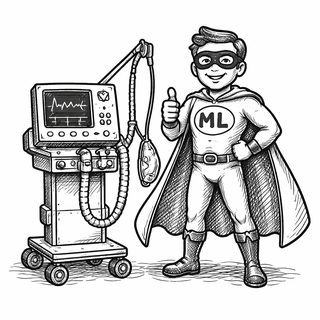
Ever tried to assemble a piece of IKEA furniture without the right tools? It’s a nightmare. Now, imagine that feeling multiplied by a hundred when it comes to medical devices in a hospital. If ventilators, dialysis machines, or CT scanners break down, it isn’t just about missing a few screws; it’s about patient care hanging in the balance. Fortunately, a recent study sheds light on how machine learning (ML) can be the superhero we didn’t know we needed - helping hospitals keep the vital spare parts for critical medical devices available when they’re needed most.
The Research Rundown
A group of researchers from Malaysia published a fascinating paper entitled Impact of machine learning on spare parts availability for critical medical devices: a supervised machine learning perspective. They tackled a pressing issue: how can we ensure that the medical equipment we rely on is up and running without unnecessary downtime? By combining traditional failure mode and effects analysis (FMEA) with advanced supervised machine learning techniques, they found a way to not just predict when spare parts would be needed but also significantly improve their availability.
Picture this: they analyzed a dataset of 2,800 maintenance records from six different hospitals. Their aim? To understand which medical devices were most likely to fail and how to mitigate that risk before it even happens. By calculating risk priority numbers (RPNs) for ten types of medical devices, including ventilators and infusion pumps, they provided insights that could spell the difference between life-saving treatment and a patient waiting too long.
The Machine Learning Mashup
Here’s where things get spicy: they employed three powerful ML models - Random Forest, Artificial Neural Network, and Support Vector Machine - to analyze the data. You might be thinking, “What’s with all the tech jargon?” Don’t worry; I’m not here to put you to sleep. Think of these models as a group of highly skilled detectives, each with its own method of solving the case of the missing spare parts.
Through a series of evaluations, they found that the accuracy of the Random Forest and Artificial Neural Network models was a perfect 1.00 - yes, that’s right, a straight-A student in the world of data analytics! Meanwhile, the Support Vector Machine shone in terms of sensitivity, meaning it was particularly adept at catching those sneaky spare parts that needed replacing.
Real-World Implications: Why It Matters
So, what does this mean for the average person? Imagine walking into a hospital where the machines are fully operational, and doctors can focus on what they do best - caring for patients - rather than scrambling for spare parts like a caffeinated squirrel searching for acorns.
predicting when medical devices will need maintenance, hospitals can optimize their inventory planning and preventive maintenance schedules. This not only reduces downtime for critical equipment but also enhances patient safety and healthcare quality overall. In short, your next hospital visit might just come with fewer hiccups.
Moreover, this study aligns beautifully with global initiatives for health and sustainability. It supports the United Nations Sustainable Development Goals, specifically SDG 3 (Good Health and Well-Being) and SDG 12 (Responsible Consumption and Production). In a world where healthcare systems are stretched thin, this hybrid approach could be the dose of innovation needed to bridge the gap.
Bridging Technology and Healthcare
What's particularly exciting about this research is its originality. This study is one of the first to merge traditional reliability engineering with machine learning, creating a clear, actionable strategy for hospital maintenance. In a sense, it's like giving biomedical engineering departments a cheat sheet for managing spare parts - making it easier for hospitals to adhere to quality standards and ultimately enhancing patient care.
Think of it this way: If traditional approaches were a vintage car, this new hybrid model is a shiny electric vehicle, modernizing and speeding up the maintenance processes in healthcare. Not only does it improve operations, but it also helps facilities be more environmentally conscious by optimizing parts usage.
The Future of Healthcare is Bright
As we step into a world increasingly shaped by technology, the intersection of machine learning and healthcare is one to watch. The implications of this study promise a future where hospitals operate like well-oiled machines - or at least much better than the old clunker that needs a new part every month.
For those of us who’ve ever had to wait for a hospital procedure because of a broken machine, this research offers hope that soon, those delays may become a thing of the past. The bottom line is clear: when hospitals have the right tools and parts at their disposal, everyone wins.
So, here’s to the researchers, data analysts, and, yes, even to the machine learning algorithms that are paving the way for a more reliable healthcare system. We might just be witnessing the dawn of a new era - one where downtime is minimized, and patient care is prioritized.
Disclaimer: The views expressed in this post are those of the author and do not necessarily reflect those of the institutions involved in the research. Images and graphics are for illustrative purposes only and do not depict actual medical devices, procedures, mechanisms, or research findings from the referenced studies.
Citation: Dattu FHPA, Syed Shazali ST, Tanjong SJ, Rosli N, Abdullah ARA. Impact of machine learning on spare parts availability for critical medical devices: a supervised machine learning perspective. Int J Health Care Qual Assur. 2025 Dec 17:1-14. doi: 10.1108/IJHCQA-05-2025-0063.