
"So let me get this straight," my friend Sarah said, squinting at me over her coffee like I'd just suggested we communicate exclusively through interpretive dance. "You're telling me there's a medical device that electrically zaps people's legs to make them stop moving, and this somehow helps them sleep better?"
"Correct."
"And this isn't from some 1950s asylum documentary?"
"It's from a systematic review published in 2025. Five studies. Randomized controlled trials. The whole legitimate scientific enterprise."
Sarah took a long sip. "Medicine is weird."
She's not wrong.
The Midnight Leg Rebellion
For the blissfully unaware, Restless Legs Syndrome (RLS) is exactly what it sounds like - except worse. Imagine an overwhelming, irresistible urge to move your legs, typically accompanied by uncomfortable sensations that patients variously describe as creeping, crawling, pulling, or "ants having a tiny parade under my skin." The real kicker? Symptoms predominantly strike in the evening and at night, because apparently your nervous system has a flair for dramatic timing.
RLS affects somewhere between 5-15% of the population, and for those with moderate-to-severe cases, it's not just annoying - it's life-disrupting. We're talking chronic sleep deprivation, daytime fatigue, reduced quality of life, and the kind of frustration that makes you want to negotiate with your own limbs like they're rebellious teenagers.
Current treatments include dopaminergic medications, alpha-2-delta ligands, and opioids for severe cases. But here's the rub: many patients either don't respond adequately to these medications, can't tolerate the side effects, or experience something called augmentation - where the medications actually make symptoms worse over time. It's the pharmacological equivalent of your solution becoming part of the problem.
Enter TOMAC: The Elegant Paradox
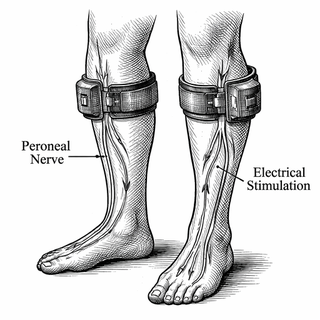
This is where Tonic Motor Activation - mercifully abbreviated as TOMAC - enters the picture, wrapped in the kind of irony that would make O. Henry proud. The treatment involves a bilateral wearable device that delivers high-frequency electrical stimulation to the peroneal nerve (that's the nerve running along the outside of your lower leg, for the anatomically curious).
The concept seems counterintuitive: to stop unwanted leg movement, we're going to... activate the motor system? It's like treating insomnia with espresso, or curing stage fright by pushing someone onto a bigger stage. Yet somehow, it works.
The mechanism appears to involve engaging specific neural pathways that essentially satisfy whatever neurological itch is driving the restless sensations. Think of it as giving your nervous system a controlled, therapeutic version of what it's desperately seeking, so it stops throwing a tantrum trying to get it on its own terms.
The Numbers Don't Lie (And They're Pretty Compelling)
A recently published systematic review and meta-analysis dug into the individual participant data from five U.S. studies, including three randomized controlled trials with 252 participants. This isn't some preliminary "we tried it on twelve grad students" situation - this is proper science with respectable sample sizes.
The results? TOMAC significantly reduced scores on the International RLS Study Group Rating Scale (IRLS) compared to sham treatment. The effect held up whether patients used TOMAC as an add-on to their existing medications (mean difference: 3.39 points, p = 0.0001) or as standalone therapy (mean difference: 3.80 points, p = 0.0047).
For those who don't speak clinical trial, a 3-4 point reduction on the IRLS might not sound earth-shattering, but in a condition this stubborn, it's meaningful. We're talking about people who've already tried standard treatments and still couldn't get relief.
But wait - there's more. Sleep quality, measured by the Medical Outcomes Study Sleep Problem Index II, also improved significantly. As adjunctive therapy, patients saw an 8.23-point improvement (p = 0.0006). As monotherapy, a 9.65-point improvement (p = 0.0236). For people who've been staring at their ceiling at 3 AM while their legs staged a one-organ protest, better sleep isn't just a nice bonus - it's the whole point.
The Great Equalizer
One of the more intriguing findings was what didn't matter. The researchers performed subgroup analyses looking at age, sex, age of RLS onset, symptom severity, and stimulation amplitude. None of these factors significantly influenced the treatment effect.
This is actually good news. It suggests TOMAC might work across a broad patient population rather than only helping some narrow, cherry-picked demographic. Young, old, male, female, early-onset, late-onset - the legs don't discriminate, and apparently neither does the treatment.
The Safety Dance
Now, any device that sends electrical signals into your nervous system rightfully prompts the question: what could go wrong?
The available data suggests the answer is "not much." Device-related adverse events were described as mild - think localized skin irritation rather than anything requiring medical intervention. No serious adverse events were attributed to TOMAC in the analyzed studies.
This safety profile matters enormously for a chronic condition. Long-term medication use comes with accumulating risks and side effects. A non-pharmacological option that patients can use nightly without worrying about augmentation, tolerance, or drug interactions fills a genuine clinical gap.
The Bigger Picture
What makes this research particularly satisfying is how it addresses a real clinical problem. Medication-refractory RLS isn't rare - it's common enough that neurologists regularly encounter patients who've tried everything and are still suffering. For these individuals, a validated non-drug option represents genuine hope.
The fact that TOMAC works both as add-on therapy and as monotherapy gives clinicians flexibility. Some patients might use it to boost inadequate medication responses. Others might use it to reduce medication doses or avoid drugs entirely.
There's also something philosophically appealing about treating a movement disorder with precisely controlled movement activation. It's fighting fire with fire, except the fire is electricity and the fighting is... also electricity. The metaphor breaks down, but the science holds up.
What's Next?
As with any emerging therapy, questions remain. Longer-term efficacy data would be valuable - does the benefit persist over months and years, or does the nervous system eventually adapt? What about comparative effectiveness against established treatments? And while five studies provide a solid foundation, larger and more diverse trials would strengthen the evidence base.
The individual participant data approach used in this meta-analysis deserves a nod, too. By drilling into patient-level data rather than just aggregate results, the researchers could perform subgroup analyses that would otherwise be impossible. It's more work, but it yields more nuanced answers.
For now, TOMAC joins the small but growing list of neuromodulation approaches proving their worth in conditions that have historically frustrated patients and clinicians alike. Your legs may still want to boogie at 3 AM, but at least now there's a scientifically validated zap to help negotiate a ceasefire.
This blog post discusses research findings and should not be taken as medical advice. If you have concerns about restless legs syndrome, please consult a healthcare provider. Research discussed here represents ongoing scientific investigation and clinical validation is still in progress.
All images used in this post are decorative illustrations only and do not represent or reflect the accuracy, reality, or correctness of the referenced research.
Primary Source: Efficacy and safety of tonic motor activation (TOMAC) for restless legs syndrome as adjunctive and monotherapy: An individual participant data systematic review and meta-analysis. 2025. PubMed: 41581285