
For $1,000 - what medical innovation just changed the game for gluteal tendinosis? If you answered, "Possibly a needle with ultrasound guidance and a more high-tech personality than the usual hypodermic version," congratulations, you have spent more time reading musculoskeletal trial registries than most people at brunch. The study in question, NCT07540806, is comparing two minimally invasive procedures for gluteal tendinosis: ultrasound-guided percutaneous needle tenotomy, or PNT, and percutaneous ultrasonic needle tenotomy, or PUT.
That is interesting because gluteal tendinosis sits in the awkward zone of medicine where the pain can be very real, the day-to-day limitation can be surprisingly disruptive, and the treatment menu often contains a little too much shrugging. People with this problem can have persistent pain on the outside of the hip, trouble walking, pain when lying on the affected side, and a general sense that their hip has become a grumpy coworker.
What problem is this trial trying to solve?
Gluteal tendinosis is a degenerative tendon problem involving the gluteal tendons near the hip. In plain English, the tissue is irritated and structurally worn rather than simply "inflamed" in the old-fashioned sense. That distinction matters because not every nagging tendon problem responds well to treatments aimed only at short-term inflammation.
This trial asks a sensible question: if you mechanically treat the unhealthy tendon with one needle-based technique, does it help pain and function? And if both techniques help, does one do a better job?
That is refreshingly concrete. No vague wellness fog. No "supporting the body’s natural harmony" language. Just pain, function, and a head-to-head procedural comparison.
The two contenders: simple needle versus ultrasonic gadgetry
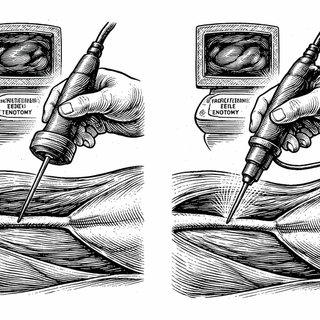
The traditional option in this study is percutaneous needle tenotomy. That generally means using a needle, guided by ultrasound, to repeatedly fenestrate or poke the damaged tendon tissue in a controlled way. The idea is to disrupt the degenerative area and trigger a healing response. It is a bit like aerating a lawn, except the lawn is your tendon and everyone involved would prefer fewer gardening metaphors.
The newer option is percutaneous ultrasonic needle tenotomy. This approach uses ultrasound energy through a specialized needle-like device to break down and remove diseased tendon tissue more selectively. In theory, that could mean a more targeted cleanup job rather than just needling the area and asking biology to take it from there.
That theory is appealing. Medicine loves a shiny tool with a good origin story. But theory is not the same thing as outcome data, and the whole reason to run a trial like this is to find out whether the more elaborate technology actually earns its keep.
Why this study is worth watching
The main outcomes here are the ones patients actually care about: pain and function. That deserves credit. If a treatment produces beautiful imaging changes but the patient still cannot sleep on one side or walk comfortably through the grocery store, the tendon has not exactly received a standing ovation.
This trial is also focused on a real-world clinical fork in the road. If you are a clinician treating chronic gluteal tendon pain, you might reasonably ask whether the fancier ultrasonic procedure is better enough to justify its extra complexity, equipment, and likely cost. If you are a patient, the question is even simpler: "Will this help me more than the other option, and is it worth the hassle?"
Those are good questions. They are not glamorous, but they are how useful medicine gets made.
What we do and do not know yet
Here is where we pump the brakes a bit. This is a registered clinical trial, not a result paper. The listing tells us the study is designed to compare improvement in pain and function between PNT and PUT for gluteal tendinosis. That means we can talk about why the question matters, but we cannot yet pretend the answer has arrived wearing a cape.
And that restraint matters because procedure-based treatments often sound impressive long before they prove they are meaningfully better. Sometimes the newer device wins. Sometimes it performs about the same as a simpler approach with a less cinematic billing code. Sometimes both help, but only modestly. Tendons, annoyingly, do not read marketing brochures.
The bigger challenge in tendon care
One reason this trial stands out is that chronic tendon problems are messy. They sit at the intersection of biomechanics, tissue degeneration, pain sensitivity, activity demands, and patient expectations. A treatment can fail because it does not address the right tissue problem. It can also fail because the rehab afterward is weak, the diagnosis was sloppy, or the patient had several overlapping sources of lateral hip pain to begin with.
So a fair trial in this space has to do more than compare gadgets. It has to compare them in a way that isolates whether the procedural difference actually matters. That is harder than it sounds. If the methodology is tight, this kind of study could be genuinely useful. If the methodology is loose, we are just watching two needles audition for a role they may not deserve.
If the trial succeeds, what could change?
If PUT clearly outperforms standard PNT on pain and function, that would strengthen the case for using a more specialized ultrasonic approach in selected patients with gluteal tendinosis. It could shift procedural practice, affect referral patterns, and give people with stubborn hip pain another evidence-backed option.
If both treatments work similarly, that is also valuable. A result like that would suggest clinicians might reasonably choose the simpler or more accessible approach without feeling like they are offering the bargain-bin version of care. In medicine, "the expensive tool is not obviously better" is not a disappointing finding. It is often the adult in the room.
And if neither approach shows much benefit, that would be useful too. Negative results are not party crashers. They save future patients from spending time, money, and hope on procedures that do not move the needle. Yes, that pun was unavoidable. No, I am not proud of it.
The practical takeaway
This trial matters because gluteal tendinosis is common, stubborn, and often underappreciated. People can spend months being told they have bursitis, hip weakness, back pain, or some vague lower-body betrayal, when the tendon itself may be a big part of the problem. A careful comparison of two minimally invasive treatments is exactly the kind of incremental research that can make care less guessy.
Still, registered intent is not proven benefit. Until results are published, the right stance is cautious interest. Applaud the direct comparison. Appreciate the patient-centered outcomes. Keep both eyebrows at least partially raised.
Disclaimer
This article is for educational purposes only and is not medical advice. The clinical trial discussed here is a registered study, and the summary above reflects the trial description rather than published outcome data. Patients should discuss diagnosis and treatment options with a qualified clinician.
Citation
ClinicalTrials.gov. Ultrasound-Guided Percutaneous Needle Tenotomy (PNT) vs Percutaneous Ultrasonic Needle Tenotomy (PUT) for Gluteal Tendinosis (NCT07540806). Available at: https://clinicaltrials.gov/study/NCT07540806
Table view: https://clinicaltrials.gov/study/NCT07540806?tab=table