
I'm going to tell you about a treatment that sounds like it was invented by someone who really likes explosions. Extracorporeal shock wave therapy - ESWT for short - involves bombarding your tissue with acoustic pressure waves to make it heal better. If that sounds like using a tiny jackhammer on your wrist to fix nerve problems, well, you're not entirely wrong.
The clinical trial NCT06531746 is investigating the electrophysiological effects of ESWT, which is science-speak for "what happens to your nerves when we blast them with shock waves?" It's a reasonable question because, as it turns out, shooting pressure waves through tissue isn't just breaking stuff up - it's triggering some surprisingly sophisticated biological responses.
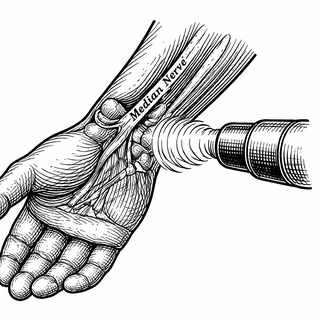
Let's talk about carpal tunnel syndrome, the most common entrapment neuropathy on the planet, and why researchers think sound waves might be the answer.
Your Median Nerve Is Having a Bad Time
Carpal tunnel syndrome occurs when your median nerve - the one running through that narrow passage in your wrist called the carpal tunnel - gets compressed. Maybe you type too much. Maybe it's your job. Maybe your body just decided to store extra fluid in an inconvenient location. Whatever the cause, the result is the same: tingling, numbness, pain, and weakness in your thumb and the first three fingers.
The median nerve handles sensation for most of your palm-side hand and motor control for some thumb muscles. When it gets squeezed, signals don't travel through as efficiently. Electrophysiologically (measuring the electrical activity of nerves), this shows up as prolonged distal latencies and decreased conduction velocities. The nerve is still working, just slowly and poorly, like an underpaid employee on a Monday morning.
Left untreated, carpal tunnel can progress from annoying to debilitating. The traditional treatments include wrist splints, corticosteroid injections, and ultimately surgery to release pressure on the nerve. But surgery is surgery - it involves cutting things and comes with all the risks and recovery time that implies.
Which brings us to the weird and wonderful world of shock wave therapy.
What Even Is a Shock Wave?
Shock waves, in this context, aren't the kind that level buildings after explosions. They're acoustic pressure waves - essentially very powerful sound pulses. ESWT devices generate these waves and focus or radiate them into tissue.
The technology was originally developed in the 1980s for lithotripsy - breaking up kidney stones without surgery. Doctors noticed that in addition to pulverizing stones, shock waves seemed to promote tissue healing in unexpected ways. The technology spread to treating tendinopathies, plantar fasciitis, and other musculoskeletal problems.
There are two main types: focused ESWT (fESWT), which concentrates the energy at a specific depth, and radial ESWT (rESWT), which disperses energy more broadly from the probe surface. Both are used for carpal tunnel, with varying protocols and parameters.
When shock waves hit tissue, several things happen. There are mechanical effects from the pressure differential. There are cavitation effects - tiny bubbles forming and collapsing. And there are biological signaling cascades triggered by the mechanical stress. The combination appears to stimulate tissue repair processes.
The Evidence: Does Blasting Nerves Actually Help?
This is where it gets interesting. Multiple studies have now shown that ESWT improves both symptoms and electrophysiological measurements in carpal tunnel syndrome.
A meta-analysis by Ke et al. found that ESWT showed significant improvement over control groups, with better symptom scores, functional outcomes, AND electrophysiologic parameters. Both motor and sensory components of nerve conduction improved (DOI: 10.1097/MD.0000000000017435).
A double-blind, placebo-controlled trial published in 2023 found that radial ESWT produced "a significant decrease in median nerve sensory (p=0.002) and motor (p=0.003) distal latency, and a significant increase in median nerve sensory conduction velocity (p=0.026)." That's the nerve actually conducting signals faster and more efficiently after treatment (Cosman et al., DOI: 10.1007/s00508-023-02168-0).
Another study using electrodiagnostic testing found improvements in motor latency, peak sensory latency, motor and sensory amplitudes, and sensory nerve conduction velocity after ESWT in mild and moderate carpal tunnel cases. Severe cases showed more limited improvement, which makes sense - there's only so much you can help a nerve that's been really badly squished (DOI: 10.1186/s41983-020-00181-4).
The improvements aren't imaginary or just patient perception. When you measure the actual electrical signals traveling through the nerve, they're objectively better after treatment.
How Does Blasting Stuff Help Nerves?
This is the $64,000 question, and honestly, we don't completely understand the mechanisms yet. But researchers have several theories.
The metabolic theory suggests that shock waves increase blood flow and metabolic activity in the treated area. More blood means more nutrients and oxygen for tissue repair. The pressure waves may stimulate neovascularization - the formation of new blood vessels.
The inflammation resolution theory proposes that shock waves help resolve chronic inflammation. Carpal tunnel often involves persistent low-grade inflammation around the nerve. By triggering an acute inflammatory response followed by accelerated resolution, ESWT may help break the cycle of chronic inflammation.
The growth factor theory points to the release of various growth factors and cytokines triggered by the mechanical stress of shock waves. These signaling molecules promote tissue regeneration and repair.
The neural theory - particularly relevant for carpal tunnel - suggests that shock waves may directly affect nerve tissue in beneficial ways. Studies have shown that ESWT can increase motor unit number estimation (MUNE), suggesting improved nerve function at the individual axon level.
One study noted that "ESWT promotes biological and neurological effects through a combination of mechanical conduction, angiogenesis, vacuolation and biochemical signals." That's a fancy way of saying "a bunch of different things are happening and they seem to be good."
The Electrophysiological Question
Trial NCT06531746 is specifically focused on the electrophysiological changes produced by ESWT. This matters because electrophysiology gives us objective measures of nerve function that don't depend on patient reporting.
The key measurements include:
- Distal motor latency: How long it takes for an electrical signal to travel from the wrist to the thumb muscles
- Sensory nerve conduction velocity: How fast sensory signals travel along the nerve
- Compound motor action potential (CMAP): The electrical signal produced by muscle activation
- Sensory nerve action potential (SNAP): The electrical signal produced by sensory nerve activation
When the median nerve is compressed, all of these get worse - signals slow down, amplitudes decrease. Effective treatment should improve these numbers, and studies so far suggest that ESWT does exactly that.
One particularly interesting finding used advanced electrophysiological techniques called MScanFit MUNE (motor unit number estimation) to show that ESWT actually increased the estimated number of functioning motor units. This suggests that the treatment isn't just helping existing nerve fibers work better - it may be helping damaged ones recover function.
The Combination Question
Some research has explored combining ESWT with other treatments. A large randomized controlled study found that when wrist splints were used together with radial ESWT, improvements in hand function and motor nerve conduction velocity were higher than either splint or ESWT alone.
This makes intuitive sense. ESWT may help the nerve heal, but if you're still typing eight hours a day in poor ergonomic position, you're fighting an uphill battle. Combining regenerative treatment with protective measures could yield better results than either alone.
The Practical Reality
ESWT is generally well-tolerated with minimal side effects. The treatment is non-invasive - no needles, no incisions, no anesthesia required. Sessions typically take 15-20 minutes. Protocols vary but often involve weekly treatments for 3-4 weeks.
Is it a miracle cure? No. Studies show it works best for mild to moderate carpal tunnel. Severe cases may get some benefit but are less likely to avoid surgery. And like most treatments, not everyone responds equally well.
But for people who want to avoid surgery, have had limited success with splinting alone, or can't tolerate corticosteroid injections, ESWT offers a legitimate option backed by growing evidence.
The Bigger Picture
What's fascinating about ESWT research is how it challenges our intuitions about treatment. The idea that bombarding tissue with pressure waves would help it heal seems counterintuitive - we usually think of mechanical force as damaging. But biology is weird, and sometimes stress triggers repair mechanisms that wouldn't otherwise activate.
Trial NCT06531746 is adding to our understanding of exactly how these electrophysiological changes occur. Better understanding of the mechanisms could lead to optimized treatment protocols - figuring out the ideal wave parameters, treatment frequency, and patient selection criteria.
For now, if you're dealing with carpal tunnel syndrome and someone suggests sound wave therapy, you can confidently tell them that yes, actually, there's real science behind that apparently ridiculous-sounding idea.
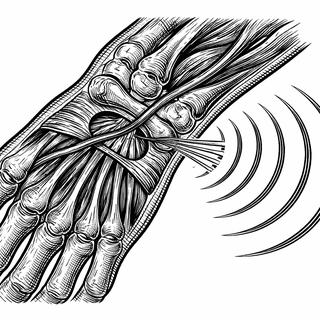
The body is weird, and sometimes so are the treatments that help it heal.
Medical Disclaimer: This blog post is for educational and informational purposes only. It is not intended to be a substitute for professional medical advice, diagnosis, or treatment. Always seek the advice of your physician or other qualified healthcare provider with any questions you may have regarding carpal tunnel syndrome or any other medical condition. Images and graphics are for illustrative purposes only and do not depict actual medical devices, procedures, mechanisms, or research findings from the referenced studies.