
Raise a glass to tree bark - yes, actual bark - because it just pulled off something remarkable. While pharmaceutical companies pour billions into developing new antibiotics and bacteria keep laughing in their microscopic little faces, a traditional Chinese medicinal plant called Sophora flavescens has been quietly sitting in the corner, saying "I told you so" for roughly two thousand years. A new study has finally cracked open the science behind why this plant works, and the results are enough to make even the most stubborn superbug nervous.
The Antibiotic Resistance Problem (a.k.a. Bacteria Are Getting Too Cocky)
Let's set the scene. Antibiotic resistance is one of the scariest public health challenges of our time. The World Health Organization has called it one of the top ten global threats to humanity, and every year, drug-resistant infections kill over a million people worldwide - disproportionately in low- and middle-income countries where access to newer, more expensive antibiotics is limited. We desperately need new antibacterial agents, and we need them to be affordable and accessible.
Enter Sophora flavescens, sometimes called "ku shen" in traditional Chinese medicine. This leguminous plant has been used for centuries to treat dysentery, eczema, vaginal infections, and various inflammatory conditions. Healers across Asia have long known that it works. The problem? Modern science hadn't fully explained how it works or identified exactly which compounds are doing the heavy lifting. That's like knowing your car runs but having no idea what's under the hood - not exactly reassuring to regulatory agencies.
Bark vs. Wood: A Botanical Showdown
This new study took a refreshingly systematic approach. Rather than just grinding up the whole root and hoping for the best, the researchers separated the root into its component tissues: bark (BSF), xylem (XSF, the woody inner part), and phloem (PSF, the nutrient-transporting tissue). Then they tested each one separately against pathogenic bacteria using standardized broth microdilution methods.
The winner? The bark, and it wasn't even close. BSF - the bark extract - turned out to be the antibacterial powerhouse. Using nuclear magnetic resonance (NMR) spectroscopy, the team identified the bark's major active components as prenylated flavonoids - a class of naturally occurring compounds where flavonoid molecules sport extra chemical "arms" called prenyl groups. Think of regular flavonoids as polite dinner guests and prenylated flavonoids as those same guests, but now they've brought grappling hooks.
Nine compounds were isolated, and all nine showed potent antibacterial activity. But one stood out from the pack.
Sophoraflavanone G: The MVP Nobody Knew About
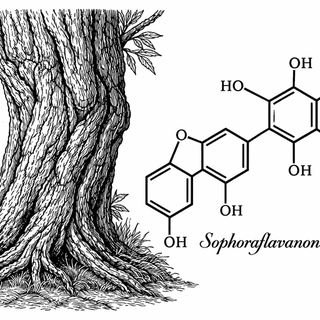
The star player in this lineup is a compound called Sophoraflavanone G, or SFG for those of us who value our breath. SFG demonstrated what you'd want in a dream antibiotic candidate: rapid bactericidal effects, low cytotoxicity (meaning it's not particularly harmful to your own cells), and low hemolytic activity (meaning it doesn't go around popping your red blood cells like bubble wrap). That trifecta of "kills bacteria fast, leaves you alone" is harder to find than you might think.
But SFG's resume doesn't stop there. The researchers found that it also disrupts biofilm formation. For the uninitiated, biofilms are basically bacterial apartment complexes - slimy, organized communities where bacteria hunker down and become dramatically harder to kill. Biofilms are a major reason why wound infections become chronic and why medical device infections are so stubborn. A compound that prevents bacteria from building these fortresses? That's a big deal.
Peeling Back the Mechanism
Here's where the study gets genuinely exciting from a scientific perspective. Using transcriptomics - essentially reading the entire gene-expression playbook of bacteria exposed to SFG - the researchers mapped out how the compound actually disrupts bacterial function. SFG appears to mess with gene expression related to cell membrane integrity.
To confirm this, they pulled out some impressive imaging tools. Scanning electron microscopy (SEM) and laser scanning confocal microscopy (LSCM) with propidium iodide staining showed clear physical disruption of bacterial cell membranes after SFG exposure. The bacteria's protective walls were compromised, leading to leakage of proteins and nucleic acids - verified by Bradford assay and ultramicro fluorescence spectrophotometry.
In plain language: SFG pokes holes in bacteria. Their insides leak out. The bacteria die. It's not subtle, and that's kind of the point.
From Petri Dish to Living Tissue
The researchers didn't stop at lab bench experiments. They tested SFG in a mouse model of full-thickness skin wound infection - the kind of wound that, in clinical settings, leads to devastating outcomes, especially in patients with diabetes, compromised immune systems, or limited access to healthcare. SFG showed real efficacy in promoting infected wound healing in vivo, confirming that the antibacterial activity observed in test tubes translates to actual living systems.
This matters enormously for health equity. Chronic wound infections are a massive burden in underserved communities globally. If compounds from a readily cultivable plant can be developed into affordable topical treatments, we're looking at a potential game-changer for wound care in resource-limited settings. Traditional medicine plants like S. flavescens are already grown in many of the regions where antibiotic access is most limited.
What This Means (and What It Doesn't)
Let's keep our feet on the ground. This is preclinical research - mouse models and petri dishes, not human clinical trials. The journey from "this compound kills bacteria in a lab" to "here's your prescription" is long, expensive, and littered with promising candidates that didn't make the cut. Many compounds that work beautifully in vitro face challenges with bioavailability, stability, manufacturing scale, and regulatory approval.
That said, this study represents a meaningful step forward. By systematically identifying the active components, characterizing the mechanism of action at the transcriptomic level, and validating efficacy in an animal wound model, the researchers have laid solid groundwork for future development. They've essentially given the scientific community a detailed map and said, "Here - now you know exactly which molecules to develop and why they work."
The Bigger Picture
There's something deeply satisfying about traditional medicine getting its scientific receipts. For centuries, practitioners treated patients with Sophora flavescens based on accumulated clinical wisdom. Now, molecular biology is catching up and saying, "Yeah, they were right - there are at least nine potent antibacterial compounds in that bark, and the best one kills bacteria by shredding their membranes while leaving human cells largely unharmed."
In the fight against antibiotic resistance, we need every tool in the toolbox. And sometimes, the most promising tools have been growing in the ground the whole time, just waiting for someone to look closely enough.
This blog post discusses research findings and should not be taken as medical advice. If you have concerns about wound infections or antibiotic resistance, please consult a healthcare provider. Research discussed here represents ongoing scientific investigation and clinical validation is still in progress.
All images used in this post are decorative illustrations only and do not represent or reflect the accuracy, reality, or correctness of the referenced research.
Primary Source: Discovery of antibacterial active components from the root barks of Sophora flavescens and evaluation of their antibacterial in vitro and infected wound healing activity in vivo. PubMed. 2026. PMID: 41933752