
Picture this: you've got high blood pressure. Not just "maybe cut back on the salt" high - we're talking "three medications aren't cutting it" high. Your doctor has tried everything in the pharmaceutical arsenal, and your blood pressure is still high-fiving levels that make cardiologists nervous. What do you do?
Well, if you're in the clinical trial NCT07005050, you might let someone thread a device up through your urinary tract and zap the nerves around your kidney with radiofrequency energy. Because modern medicine is nothing if not creative.
Welcome to the world of renal pelvic denervation - a procedure that sounds like science fiction, addresses a real and serious problem, and involves an anatomical approach that had me double-checking my medical textbooks.
The Problem: Your Sympathetic Nervous System Has Gone Rogue
To understand why someone would willingly undergo a procedure involving their kidneys and radiofrequency ablation, we need to talk about the sympathetic nervous system and its complicated relationship with blood pressure.
Your sympathetic nervous system is the "fight or flight" response writ large across your entire body. It makes your heart beat faster, your blood vessels constrict, and - relevant to our discussion - it tells your kidneys to retain sodium and release renin, an enzyme that triggers a hormonal cascade leading to even higher blood pressure.
Normally, this system activates when you need it (saber-toothed tiger attack, important job interview) and calms down when you don't. But in many hypertensive patients, particularly those with resistant hypertension, the sympathetic nervous system is stuck in "on" mode. It's like having an alarm that won't stop ringing - eventually, the constant noise (or in this case, constant vasoconstriction and sodium retention) causes serious problems.
The kidneys are both victims and perpetrators in this cycle. Overactive efferent sympathetic nerves - the ones sending signals from the brain to the kidneys - increase renin release, promote sodium retention, and reduce renal blood flow. Meanwhile, afferent nerves - the ones sending signals from the kidneys to the brain - can amplify central sympathetic activity, creating a feedback loop of elevated blood pressure.
The elegant solution? Cut those nerve signals. If you can't calm the sympathetic nervous system through medication, maybe you can disconnect the kidneys from the whole dysfunctional circuit.
Renal Denervation: From Concept to Reality
The idea of renal denervation isn't new. Proof-of-principle experiments date back to 1945, when researchers demonstrated that electrically stimulating renal nerves in dogs produced chronic elevations in blood pressure. If stimulation raised blood pressure, logic suggested that disruption might lower it.
Traditional renal denervation approaches the problem from the arteries. A catheter is threaded through the femoral artery in the groin, navigated up to the renal arteries, and used to deliver radiofrequency or ultrasound energy to the sympathetic nerves running along the arterial walls. Multiple devices have now received FDA approval for this approach, including the Symplicity Spyral system from Medtronic and the Paradise system from Recor Medical.
But here's where the clinical trial NCT07005050 gets interesting - and where you should perhaps cross your legs.
The Transurethral Approach: Going Where Few Catheters Have Gone Before
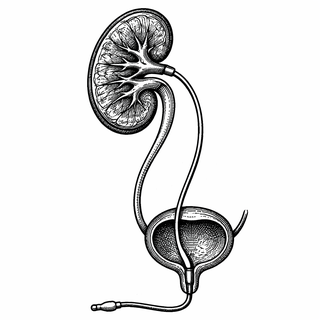
The RPD (Renal Pelvic Denervation) system being tested in this trial takes a completely different route to the same destination. Instead of entering through the arteries, it enters through... well, the natural orifice at the other end of the urinary tract.
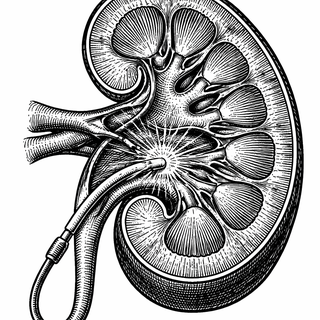
Yes, we're talking about a transurethral approach. The catheter goes through the urethra, up the bladder, through the ureter, and into the renal pelvis - the funnel-shaped central area of the kidney where urine collects before heading down to the bladder.
From the renal pelvis, radiofrequency energy is delivered to ablate the sympathetic nerves that pass through the outer wall. These are many of the same nerves targeted by arterial approaches, just accessed from the inside-out rather than the outside-in.
If you're wondering "why would anyone choose that route?" - fair question. The potential advantages include:
- No arterial puncture: Lower risk of bleeding complications
- Direct access to the renal pelvis: Potentially more complete denervation
- Different nerve fiber targeting: Afferent nerves from the renal pelvis may be particularly important in certain forms of hypertension
The Evidence So Far: Small But Impressive
A feasibility trial of transurethral renal pelvic denervation has already been published in Hypertension (DOI: 10.1161/HYPERTENSIONAHA.122.20048), and the results raised some eyebrows.
Eighteen patients (mean age 56 years, taking an average of 2.7 antihypertensive drugs daily) underwent the procedure. Mean daytime systolic blood pressure dropped by 19.4 mmHg from a baseline of 148.4 mmHg - that's a clinically significant reduction that puts some medications to shame.
To put that in perspective: many antihypertensive drugs lower systolic blood pressure by 5-15 mmHg. Getting nearly 20 mmHg from a single procedure is genuinely impressive, especially in patients whose blood pressure was already resistant to multiple medications.
Based on these initial findings, the investigators concluded that a larger, sham-controlled trial was justified. Which brings us to NCT07005050.
The Pilot Trial Design: Rigorous Science for a Bold Claim
The RPD Pilot Trial isn't messing around with its methodology. This is a randomized, double-blind, sham-controlled study - the gold standard for medical device trials.
Here's how it works:
Active treatment group: Patients undergo the full renal pelvic denervation procedure, with the RPD device deployed into the renal pelvis of each kidney and radiofrequency energy delivered to ablate the nerves.
Sham control group: Patients undergo an identical procedure - guidewire placement, cystoscope and sheath advancement into the renal pelvis, device deployment - except the radiofrequency energy is never actually delivered. The device sits in place for 2 minutes per kidney to simulate the treatment duration, then is withdrawn.
This sham-controlled design is essential. The placebo effect is real, especially for blood pressure (which is exquisitely sensitive to stress and expectation). Previous renal denervation trials that lacked sham controls showed much more impressive results than later sham-controlled trials - suggesting that some of the benefit was psychological rather than physiological.
Patients will be followed at 2, 6, and 12 months post-procedure, with measurements of ambulatory blood pressure, office blood pressure, renal function, and adverse events. After the 12-month assessments, sham-treated subjects who still meet criteria may cross over to receive active treatment.
The Inclusion Criteria: Finding the Right Patients
Not everyone with high blood pressure is a candidate for renal denervation. The trial specifically targets patients with uncontrolled blood pressure despite taking at least two antihypertensive medications at therapeutic doses.
This is important for several reasons. First, you want to ensure patients have genuinely resistant hypertension rather than poor medication compliance or inadequate dosing. Second, you're selecting for patients who have the most to gain - if medications worked fine, why undergo a procedure at all?
The goal is to identify patients whose hypertension is likely driven by sympathetic overactivity that would respond to nerve ablation, rather than other causes that wouldn't benefit from denervation.
The Bigger Picture: Hypertension Is Serious Business
If you're not hypertensive, it's easy to underestimate how serious this condition is. High blood pressure is called "the silent killer" for good reason - it typically causes no symptoms until it's already damaged your heart, kidneys, brain, or eyes.
Globally, hypertension affects over a billion people. It's the leading modifiable risk factor for cardiovascular disease, stroke, and chronic kidney disease. And despite having dozens of antihypertensive medications available, a significant percentage of patients simply can't get their blood pressure under control.
Resistant hypertension - defined as blood pressure remaining above goal despite three medications (including a diuretic) - affects an estimated 10-15% of hypertensive patients. For these individuals, novel interventions like renal denervation represent hope when pills have failed.
The Future: Nerves as Drug Targets
Renal denervation is part of a broader trend in medicine toward treating diseases by modulating the nervous system rather than (or in addition to) using drugs. Vagal nerve stimulation for epilepsy and depression. Spinal cord stimulation for chronic pain. Deep brain stimulation for Parkinson's disease.
The nervous system acts as a vast network of information highways, and we're learning that many diseases involve dysfunctional signaling along these pathways. If you can identify the problematic signals and selectively interrupt them, you may be able to treat conditions that resist other approaches.
The transurethral approach tested in NCT07005050 is particularly intriguing because it targets nerves from a novel angle. Different anatomical approaches may affect different nerve populations, potentially offering complementary or superior results to arterial-based methods.
The Bottom Line
Renal pelvic denervation through a transurethral approach is one of those medical innovations that makes you appreciate just how creative and determined physicians can be when facing stubborn diseases. If conventional medications don't work and arterial denervation isn't cutting it, why not try coming at the problem from the inside of the kidney?
The NCT07005050 trial will help determine whether this approach is ready for prime time. If the results confirm and extend the promising feasibility data, we could see another tool added to the arsenal against resistant hypertension.
And for the patients whose blood pressure remains stubbornly elevated despite everything else - that's not just a clinical trial. That's hope in a radiofrequency catheter.
Just maybe don't think too hard about the specific anatomy involved. Some things are better left to the imagination.
Disclaimer: This blog post is for educational and entertainment purposes only and does not constitute medical advice. Clinical trial information was sourced from ClinicalTrials.gov (NCT07005050). Renal denervation procedures should only be performed by qualified specialists in appropriate clinical settings. Always consult your healthcare provider about treatment options for hypertension. Images and graphics are for illustrative purposes only and do not depict actual medical devices, procedures, mechanisms, or research findings from the referenced studies.
References:
- ClinicalTrials.gov. NCT07005050: Renal Pelvic Denervation Pilot Trial
- Kandzari DE, et al. (2022). Transurethral Renal Pelvic Denervation: A Feasibility Trial in Patients with Uncontrolled Hypertension. Hypertension. DOI: 10.1161/HYPERTENSIONAHA.122.20048
- Mahfoud F, et al. (2024). Renal Denervation for the Treatment of Hypertension. A Scientific Statement From the American Heart Association. Hypertension.
- Tsioufis C, et al. (2020). Renal sympathetic denervation for resistant hypertension: where do we stand after more than a decade. J Hum Hypertens. DOI: 10.1038/s41371-020-0361-6