
What does it mean to be treated, really? Is it enough to throw a drug at a cancer and hope it lands somewhere useful, or does real treatment mean getting the right punch to the right cell at the right moment? In the ER, I have seen plenty of medicine behave like a fire hose aimed at a kitchen grease fire. Lots of action, uneven results, and everybody ends up tense. This new liver cancer paper is trying something smarter: less blind swinging, more guided delivery.
The study looks at hepatocellular carcinoma, the most common kind of primary liver cancer. This is not a polite disease. It often shows up late, grows in a hostile neighborhood, and has a habit of adapting when we would really prefer it not to. Researchers are always hunting for ways to hit it harder without turning the rest of the body into collateral damage.
The Problem With Useful Drugs
One of the stars here is desloratadine, a drug better known to most people as an antihistamine. Yes, the same general medication family people associate with allergy season and miserable pollen forecasts. Cancer biology enjoys this kind of irony.
In this context, desloratadine is interesting because it appears to interfere with NMT1, an enzyme involved in keeping cancer cells running smoothly. When that system gets disrupted, tumor cells can build up oxidative stress and endoplasmic reticulum stress. In plain English, the cancer cell starts choking on its own internal chaos. That can push it toward death, which is exactly the sort of bad day we want cancer cells to have.
The catch is familiar: a potentially useful drug is only as good as its ability to reach the tumor in enough concentration to matter. If delivery is sloppy, the treatment effect gets blunted. Cancer, like an experienced scam artist, thrives when your system is inefficient.
Enter the Nanoparticle
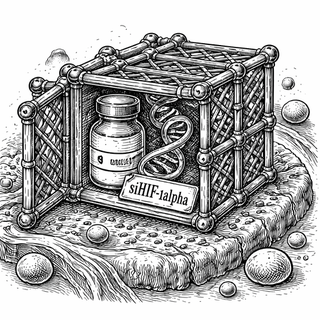
That is where the engineering part of this paper comes in. The researchers built a copper-based metal-organic framework, or MOF, called MOF-199. Think of it as a microscopic cargo crate with a few nasty surprises packed inside. Into that structure they loaded two payloads:
- Desloratadine
- siHIF-1alpha, a small interfering RNA designed to shut down the gene for HIF-1alpha
Then they added folic acid to the surface. That detail matters because many cancer cells, including some liver cancer cells, are eager consumers of folate-related molecules. Decorating the nanoparticle with folic acid is a bit like putting a fake delivery badge on the package so tumor cells wave it through the door.
The final construct, called DL/siHIF-1alpha@MOF-199@FA, is not exactly poetry, but laboratory naming has never been a glamour profession.
Why HIF-1alpha Matters
HIF-1alpha is one of those proteins cancer likes to lean on when conditions get rough, especially in low-oxygen environments. Tumors often outgrow their blood supply, so they become skilled at surviving in hypoxic, stressed conditions. HIF-1alpha helps coordinate that survival response.
If you block HIF-1alpha with siRNA, you take away one of the tumor's emergency management systems. If you also increase oxidative stress with desloratadine and add the copper-based framework's ability to help generate damaging hydroxyl radicals, you get a multi-angle attack. That is the appeal here: not one weapon, but a coordinated ambush.
The paper frames this as a combination of gene therapy, drug therapy, and chemodynamic therapy. Chemodynamic therapy, for those who do not spend evenings reading nanomedicine papers for entertainment, uses chemical reactions inside the tumor to generate toxic reactive oxygen species. In this case, copper in the framework helps the process along, especially in the tumor's biochemical environment.
The Tumor Microenvironment Gets Used Against It
This is the part I like. Tumors are not just lumps of bad cells. They are little ecosystems with their own quirks, and those quirks can be exploited.
The nanoparticle in this study was designed to respond to conditions common in tumors:
- Acidic pH helped trigger faster drug release
- High glutathione levels helped destabilize the structure
- That collapse was linked to increased hydroxyl radical production
So the system is built to stay relatively stable in circulation, then become more active once it reaches the more acidic, chemically peculiar tumor setting. It is less "spray and pray" and more "wait until you're inside the building."
The researchers also found that the nanoparticle protected the siRNA from nuclease degradation. That is a big deal, because naked siRNA in the body usually gets chewed up fast. Biological fluids are not sentimental.
What They Actually Found
The particle itself measured about 178.9 nanometers and had a negative surface charge. Lab characterization suggested the researchers successfully loaded both desloratadine and siHIF-1alpha into the MOF.
In Huh7 liver cancer cells, folic acid modification improved cellular uptake and helped the payload localize in the cytoplasm, where the siRNA has a fighting chance to do its job. The treatment showed anti-tumor effects in cell experiments and in a xenograft mouse model, which is a standard preclinical step where human tumor cells are grown in mice.
Mechanistically, the system appeared to:
- Deliver functional siHIF-1alpha
- Promote reactive oxygen species production
- Increase tumor-cell stress
- Enhance anti-tumor activity compared with less sophisticated approaches
That is the broad promise. Instead of relying on a single weak shove, the platform stacks several stressors against the cancer cell at once.
Why This Is Interesting Beyond the Lab Bench
This study is intriguing because it tackles a recurring problem in oncology: cancer adapts, and single-agent therapies often run out of steam. A targeted co-delivery platform offers a way to combine treatments that reinforce each other while limiting premature release elsewhere.
If this line of work pans out, the real-world impact could be meaningful. Liver cancer is notoriously difficult to manage once advanced. A platform that improves tumor targeting, protects fragile genetic cargo, and activates more strongly inside the tumor could someday help make treatment more potent and more selective.
That said, this is still preclinical research. No one with liver cancer should read this and assume a new therapy is around the corner next Tuesday. Mouse models are useful, but they are not tiny humans with billing departments and complicated comorbidities. Many elegant cancer strategies have looked excellent in the lab before face-planting in clinical development.
The Hard Part Still Ahead
The big questions now are the boring, decisive ones:
- Can this platform be manufactured reliably?
- Will it stay safe at larger scale and over longer follow-up?
- Will the targeting remain strong in the messy reality of human tumors?
- Will the benefits outweigh the complexity?
Because complexity is the tax collector of modern cancer therapy. The more moving parts you add, the more chances something goes sideways.
Still, there is real creativity in this design. Using a familiar drug in a new role, pairing it with gene silencing, wrapping both in a tumor-responsive nanoparticle, and then exploiting the tumor's own chemistry against it is the kind of approach that gets attention for good reason. It is not a cure. It is not ready for clinic. But it is clever, and in oncology, clever is often where the story starts.
This blog post discusses research findings and should not be taken as medical advice. If you have concerns about liver cancer, please consult a healthcare provider. Research discussed here represents ongoing scientific investigation and clinical validation is still in progress.
All images used in this post are decorative illustrations only and do not represent or reflect the accuracy, reality, or correctness of the referenced research.
Primary Source: PubMed Record 42010649. A Cu-based metal-organic framework based on desloratadine and siHIF-1alpha for achievement of genes/drugs/CDT combination therapy in hepatocellular carcinoma. PubMed