
There's a quiet revolution happening in nanomedicine, and most people have no idea. It lives at a scale where "engineering" starts to look suspiciously like molecular matchmaking, and one of its biggest problems is surprisingly practical: how do you build a tiny drug carrier that can hold many different kinds of cargo, stay stable long enough to matter, and release its payload when the timing is right? In the paper behind PubMed record 42008336, researchers describe a black phosphorus-based nanoplatform that looks a lot like a better shipping container for modern medicine. And as with most good logistics stories, the details are where the plot gets interesting.
The bottleneck no one brags about
Drug delivery research often focuses on the headline act - the cancer drug, the gene therapy, the breakthrough molecule. Fair enough. But the carrier matters too. A promising therapy is a bit like a valuable package: if the truck falls apart, the package does not care how elegant your roadmap was.
That is the challenge this study takes on. The team wanted a more universal nanocarrier, meaning something that can work with many classes of therapeutic cargo rather than one narrow category. In practice, that is hard. Small molecules behave differently from proteins. Metal ions are not the same beast as inorganic nanostructures. Building one platform that handles all of them efficiently is the sort of task that makes chemistry quietly sigh into its coffee.
Why black phosphorus was not enough on its own
Black phosphorus has attracted attention in nanomedicine because it has useful photothermal properties. That means it can convert near-infrared light into heat, which can help kill tumor cells. It is also an appealing material for drug delivery more broadly.
The catch is stability. Black phosphorus nanosheets can degrade, which is not ideal when your delivery system is supposed to remain intact long enough to do something medically useful. A high-potential platform that falls apart too quickly is basically the scientific version of buying a sports car with a paper-mache axle.
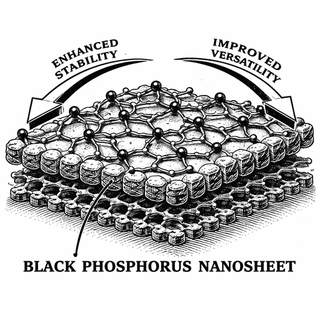
The researchers addressed this by coating black phosphorus nanosheets with a metal-polyphenol network, creating what they call BP@MPN. That coating appears to do two jobs at once. First, it improves the structural stability of the underlying material. Second, it creates a versatile surface that can interact with many different therapeutic agents.
The chemistry is doing more than one trick
What makes BP@MPN interesting is not just that it holds drugs, but how it holds them. According to the study, the surface supports multiple non-covalent interactions, including hydrogen bonding, electrostatic interactions, hydrophobic interactions, and pi interactions.
That matters because different drugs "prefer" different kinds of chemical handshakes. If your nanocarrier only offers one style of interaction, compatibility stays limited. If it offers several, the odds improve that a wide variety of therapeutics can latch on effectively. From a data-pattern perspective, this is the difference between a one-feature model and a richer feature space. More ways to connect usually means better odds of useful generalization.
And the study did not stop at theory. The authors report a multidimensional evaluation showing strong loading performance across several categories: small molecules, proteins, inorganic nanostructures, and metal ions. That is a broad compatibility profile, which is exactly what "universal platform" claims are supposed to prove.
What the numbers actually say
The strongest headline number in the paper comes from the tumor experiment. In a B16F10 tumor model, a doxorubicin-loaded version of BP@MPN combined with near-infrared irradiation achieved a tumor growth inhibition rate of 88.5 percent.
That is the kind of result that immediately gets attention, and for good reason. The treatment is not relying on a single mechanism. It combines chemotherapy from doxorubicin with photothermal therapy from the black phosphorus platform under NIR light. In plain English, the system carries a drug and also helps generate heat at the tumor site when activated. Two attack routes are often better than one, particularly when the goal is to improve local tumor control without causing unnecessary collateral damage.
Just as relevant, the study reports minimal systemic toxicity in this model, along with good biocompatibility and hemocompatibility in vitro and in vivo. Those are not glamorous words, but they are the words you want nearby when discussing anything intended to circulate in or interact with the body. A nanocarrier that loads well but causes broad toxicity is not a platform. It is a cautionary tale.
Why controllable release is a big deal
One recurring problem in drug delivery is simple to state and difficult to solve: too much drug released too early is inefficient at best and dangerous at worst. Controlled release aims to improve where and when the payload gets deployed.
This BP@MPN system appears designed for that sort of precision-minded work. The paper emphasizes controllable release and strong drug-carrier interactions, with quartz crystal microbalance analysis supporting the idea that the loading advantage is driven by meaningful interaction strength between cargo and carrier.
That may sound technical, but the practical takeaway is straightforward. The platform is not just acting as a passive bucket. It is behaving more like an adjustable docking system. If future studies continue to support that behavior, it could expand the usefulness of combination therapies, especially in cases where timing and localization affect both efficacy and side effects.
Why this paper stands out
Plenty of nanomedicine papers show one platform carrying one drug under one set of conditions. Useful, yes. Broadly transformative, not always. What makes this work more intriguing is the attempt to demonstrate range.
A carrier that performs well with multiple cargo types solves a more general problem. That increases the chance it could be adapted for different therapies instead of being locked into one narrow application. In research terms, that kind of versatility can shorten the path between platform design and platform reuse. In budget terms, it gives scientists fewer reasons to reinvent the nanoscopic wheel every Tuesday.
The photothermal angle also adds practical value. Near-infrared-triggered heating is attractive because it offers external control. If you can decide when to activate part of the therapy, you gain another lever for precision. Medicine likes precision. Tumors, historically, do not.
The usual reality check
This does not mean we are about to see BP@MPN at the pharmacy next week. The reported efficacy is promising, but it comes from preclinical work, including a mouse tumor model. That is an important step, not a final destination.
A good next phase would involve deeper validation of long-term safety, reproducibility, degradation behavior, dose optimization, manufacturing consistency, and performance across additional disease models and therapeutic cargos. Broad platforms live or die on repeatability. One exciting experiment is a spark. Translation needs an electrical grid.
Still, this study addresses a real bottleneck with a design that looks unusually flexible. If the platform continues to hold up under follow-up testing, it could help push drug delivery toward something smarter: carriers that are stable, adaptable, efficient, and externally controllable.
And honestly, that is the pattern worth watching. The future of therapy may not belong only to better drugs. It may also belong to better vehicles.
This blog post discusses research findings and should not be taken as medical advice. If you have concerns about cancer treatment or drug delivery technologies, please consult a healthcare provider. Research discussed here represents ongoing scientific investigation and clinical validation is still in progress.
All images used in this post are decorative illustrations only and do not represent or reflect the accuracy, reality, or correctness of the referenced research.
Primary Source: A Stable Metal-Polyphenol Network-Functionalized Black Phosphorus Nanoplatform for Multidrug-Loading and Controllable Chemo-Photothermal Therapy. PubMed Record 42008336. https://pubmed.ncbi.nlm.nih.gov/42008336/