
Let's talk about something that nobody wants to talk about but absolutely everyone needs to talk about: going to the bathroom when your body has decided that mobility is no longer its priority.
There's a clinical trial happening right now (NCT07221552) that's addressing one of healthcare's most overlooked yet profoundly important challenges - and it involves a piece of equipment called the PPAL. No, that's not a typo for "pal," though given what this device does, the name is remarkably fitting.
The Elephant in the Room (Or Rather, The Elephant on the Commode)
Here's an uncomfortable truth: for millions of older adults and people with mobility limitations, the simple act of going to the toilet is one of the most challenging and potentially dangerous activities of their day.
Research consistently shows that older adults rank toileting among their most difficult daily activities, right up there with showering. And unlike skipping a shower (which, let's be honest, we've all done when nobody was looking), you really can't skip toileting. Biology is remarkably non-negotiable on this point.
The bathroom is basically an obstacle course designed by someone who hates elderly people. Hard surfaces? Check. Slippery when wet? Check. Awkward angles and heights that require significant strength and balance? Double check. It's like the room was specifically engineered to maximize fall risk.
Falls during toileting transfers are a major cause of injury for older adults and often result in the terrifying cascade of: hip fracture, hospitalization, loss of independence, and dramatically reduced quality of life. And those are just the physical consequences. The psychological impact of needing help with something this private can be devastating.
Studies have found that independent toileting is essential for maintaining self-esteem. Losing that independence is often cited by older adults as one of the most distressing aspects of declining health. It's not just about the logistics - it's about the fundamental human need for dignity and privacy.
Traditional Bedside Commodes: Helpful, But...
Standard bedside commodes have been around forever. They're basically chairs with a hole in the seat and a bucket underneath. Revolutionary stuff, I know.
They help, certainly. Having a toilet option next to your bed is better than trying to navigate to a bathroom down the hall at 3 AM with a mobility impairment. But traditional commodes have a significant limitation: you still need to transfer onto and off of them.
If you've never had to help someone transfer from a bed or wheelchair onto a commode, let me paint a picture for you. It involves pivoting, significant upper body strength, balance, coordination, and often at least one person providing physical assistance. It's a multi-step process with multiple failure points, any of which can result in a fall.
For caregivers - whether professional or family members - these transfers are also a leading cause of musculoskeletal injuries. There are only so many times you can help lift and pivot another adult before your back starts sending you strongly-worded complaints.
Enter the PPAL: Engineering Meets Empathy
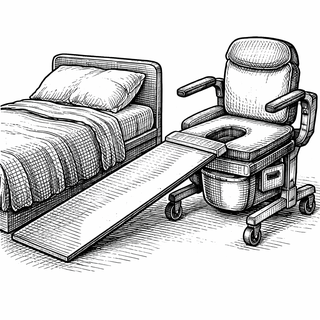
The PPAL is what happens when engineers actually talk to the people who will use their products. This powered, height-adjustable commode chair with integrated transfer boards represents a fundamentally different approach to the toileting problem.
Here's the key insight: most toileting transfers involve moving from one surface to another surface at a different height. Your bed might be at one level, your wheelchair at another, and a standard commode at yet another. Each height transition requires significant effort and creates fall risk.
The PPAL's innovation is almost elegantly simple: what if the commode could come to you at your height, and what if the path between your current surface and the commode was always downhill?
The device features an internal motorized lift that adjusts the seat height to match whatever surface you're transferring from. A securely affixed transfer board creates a stable, continuous pathway from your bed or wheelchair to the commode seat. Because the system can position itself to be slightly lower than your starting point, you're always sliding gently downhill - working with gravity instead of against it.
It's a bit like those automated parking systems at fancy garages, except instead of parking your car, you're parking yourself. Safely. Independently. Without someone having to grab you under the arms.
The Clinical Trial: Real-World Testing
The study (NCT07221552) is evaluating the PPAL in actual home settings over a 6-week period. This is the kind of practical, real-world research that too often gets skipped in favor of controlled laboratory environments that look nothing like where patients actually live.
The trial involves two groups of participants:
Patient Participants must:
- Weigh 300 pounds or less and fit within the PPAL's dimensions
- Have difficulty with getting on or off a toilet or commode at some point during a typical 24-hour period
- Reside in a home, independent living residence, assisted living, or extended care facility
- Be able to maintain sitting balance independently for at least 2 minutes
Caregiver Participants must be formal (paid) or informal (unpaid) caregivers who provide toileting assistance at least 3 days per week.
Including caregivers in the study is smart. Any assistive device that doesn't consider the caregiver experience is missing half the picture. A tool that's great for patients but terrible for caregivers isn't really a solution - it's just shifting the burden.
The Risks They're Watching For
The researchers are admirably upfront about potential risks. Participants could experience scrapes, bruises, cuts, or pinch injuries from working with unfamiliar equipment. There's also the possibility of falling during transfers, though the study protocol includes thorough demonstration and monitoring to minimize this risk.
This kind of honest risk disclosure is exactly what clinical research should look like. No device is perfectly safe, especially devices designed to help people with existing physical vulnerabilities. The question isn't "are there any risks?" - it's "do the benefits outweigh the risks?"
Who's Behind This?
The PPAL is a collaborative effort between QUA Inc. (which holds the patent) and research partners including the University of Pittsburgh and Georgia Tech's Center for Inclusive Design and Innovation.
The project received SBIR (Small Business Innovation Research) funding from NIH's National Institute of Nursing Research, which is specifically focused on supporting innovative solutions for healthcare challenges. Phase II of the project focused on refining the device's size and weight, adding wheelchair-to-commode transfer capability, and conducting safety and usability tests in home environments.
This is exactly the kind of practical, patient-centered research that nursing research funding should support. It's not glamorous. It won't make headlines. But it addresses a real problem that affects real people every single day.
Why This Matters Beyond the Individual User
The implications of successful toileting assistive devices extend well beyond the immediate users. Consider:
Healthcare System Impact: Falls are expensive. Hip fractures from bathroom falls can cost tens of thousands of dollars in medical care, not to mention rehabilitation and potential long-term care placement. Preventing even a fraction of these falls would represent significant savings.
Caregiver Sustainability: Family caregivers - who provide the majority of care for aging adults - are at high risk of injury and burnout. Devices that reduce the physical demands of caregiving can help people stay in their caregiving roles longer without destroying their own health.
Aging in Place: Most people want to stay in their homes as they age. Toileting is often the activity that determines whether this is possible. If you can't safely use the bathroom independently, home-based living becomes extremely challenging or requires 24-hour assistance.
Quality of Life: The ability to manage basic bodily functions privately and independently is foundational to human dignity. Technology that preserves this ability isn't just medically valuable - it's humanistically valuable.
The Bigger Picture
The PPAL represents a growing recognition that assistive technology for older adults and people with disabilities deserves serious engineering attention. For too long, this space has been dominated by basic, low-tech solutions that haven't evolved much in decades.
New approaches are emerging - technology-assisted toilets that provide washing and drying, powered lift systems like the PPAL, and smart home integration that can detect falls or other problems. Research published in Burns & Trauma and other journals is beginning to investigate how these technologies affect not just the specific task they address, but overall independence and quality of life.
There's also growing interest in how improving one ADL (activity of daily living) might cascade into improvements in others. When someone can toilet independently, do they also become more confident about dressing themselves? Staying social? Engaging in other activities? These are questions that researchers are only beginning to explore.
What to Watch For
As this trial progresses, the key outcomes to watch include:
- Actual reduction in caregiver assistance required for toileting
- User and caregiver satisfaction with the device
- Safety outcomes - falls, injuries, near-misses
- Impact on overall independence and quality of life
- Practical issues like device durability, maintenance, and ease of use over time
If the results are positive, the next challenge will be getting devices like the PPAL covered by insurance and accessible to the people who need them. Great technology that nobody can afford isn't really a solution either.
The Bottom Line
The PPAL clinical trial might not be the most exciting research happening in medicine right now. It's not going to cure cancer or unlock the secrets of the brain. But it's addressing a problem that millions of people face every day - one that profoundly affects their independence, dignity, and quality of life.
Sometimes the most valuable innovations aren't the flashiest. Sometimes they're the ones that help an 85-year-old maintain their privacy and self-respect while doing something that every human being needs to do multiple times a day.
And honestly? That's pretty remarkable.
Clinical Trial Reference: NCT07221552 - "Development and Evaluation of the PPAL Bedside Commode for Safe Independent Toileting"
For more information on toileting assistive technology research: effectivehealthcare.ahrq.gov and www.sbir.gov/node/1914311
Disclaimer: This blog post is for informational purposes only and does not constitute medical advice. The PPAL is currently being evaluated in clinical trials and is not yet commercially available. Always consult with a qualified healthcare provider and occupational therapist for guidance on assistive devices for toileting and mobility challenges. Images and graphics are for illustrative purposes only and do not depict actual medical devices, procedures, mechanisms, or research findings from the referenced studies.