
Fun fact: the liver is one of the few organs that can regenerate itself, which is basically the biological version of a team climbing back from a 28-point deficit. The problem is that in end-stage liver disease, even that comeback magic starts to run out. A new study on liver tissue engineering looks at a workaround: building a better scaffold for liver repair, then making that scaffold friendlier to blood vessels and a lot less inviting to clots.
That may sound like a niche lab problem. It is not. For people with advanced fibrosis or cirrhosis, liver transplantation is often the only real option, and donor organs are painfully limited. Researchers have been trying to engineer replacement liver tissue for years, but one stubborn obstacle keeps showing up like a loose IV pump wheel at 3 a.m.: blood supply. If a scaffold cannot develop a healthy lining of endothelial cells, the cells that normally coat blood vessels, it tends to clot and fail before it can do much good.
The basic problem: a liver scaffold without a vascular system is a bad bet
In tissue engineering, a scaffold is the structural framework left behind after cells are removed from an organ. In this case, the researchers worked with decellularized liver scaffolds, meaning the original tissue architecture stayed in place while the living cells were stripped out. That gives scientists a kind of natural blueprint to rebuild on.
But a blueprint is not a finished house. The scaffold still needs working blood vessels, or at least a good start on them. Without that endothelial lining, blood meets the scaffold a bit like a car hitting black ice. Clotting happens, circulation stalls, and the whole construct becomes a much less promising candidate for therapy.
So this study tackled two linked goals at once: make the scaffold less thrombogenic, meaning less likely to trigger clots, and make it better at attracting the kind of cells and signals needed for angiogenesis, the growth of new blood vessels.
What the researchers changed
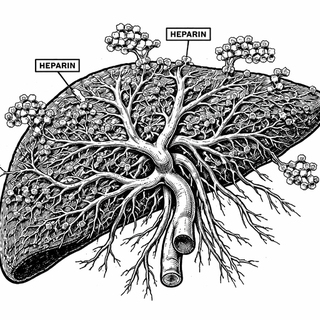
The team created a heparin-functionalized decellularized liver scaffold, referred to as HEP-DLS. Heparin is best known as an anticoagulant. In plain English, it helps keep blood from clotting. That alone makes it interesting for any biomaterial that may eventually come into contact with flowing blood.
But the heparin here was doing double duty. The researchers covalently immobilized it onto the scaffold using an end-point attachment technique. That matters because it helps keep the heparin fixed in place rather than just loosely hanging around. Think less "sprinkled on top" and more "bolted into the frame."
They then loaded the scaffold with pleiotrophin, or PTN, a heparin-binding growth factor. PTN has been associated with angiogenesis and tissue regeneration. Since it binds to heparin, the heparinized scaffold could also serve as a delivery platform, holding onto PTN and releasing it over time instead of dumping it all at once like a rookie burning the whole playbook in the first quarter.
The result was a combined construct: HEP + PTN-DLS.
Why that combo is interesting
This is where the paper gets genuinely clever. A liver scaffold needs blood vessels to survive, but blood flow without a proper vessel lining can quickly lead to thrombosis. So the scaffold has to be both less hostile to blood and more welcoming to endothelial cells.
Heparin helps with the first part. PTN aims to help with the second.
According to the study summary, the PTN-loaded heparinized scaffolds were designed to improve endothelialization and angiogenesis. The scaffolds were reseeded with HUVECs, which are human umbilical vein endothelial cells commonly used in vascular biology research. That gave the researchers a practical way to test whether the modified scaffold better supports the kind of cell behavior needed to line blood vessels.
This is not just cosmetic biology. Endothelialization is the difference between having a surface that behaves more like a functioning vessel and one that behaves more like a clot magnet. In emergency medicine terms, this is the difference between a road that opens to traffic and one that immediately turns into a pileup.
Why liver fibrosis and cirrhosis make this matter
End-stage liver disease is not a tidy, single-problem condition. Fibrosis and cirrhosis change the liver's structure, impair blood flow, and gradually erode the organ's ability to do its many jobs, from metabolism to detoxification to protein production. Once patients get far enough along, transplantation becomes the definitive treatment for many of them.
That works, when an organ is available.
The shortage of donor livers is one of those healthcare realities that never stops being brutal. You can have the right diagnosis, the right team, and the right timing, and still run into the hard limit that there simply are not enough organs to go around. That is why liver tissue engineering gets so much attention. The dream is not just to make a lab-grown object that resembles a liver. The dream is to make one that can survive, integrate, and actually help.
What this study seems to add
Based on the summary, this work pushes the field forward by combining structural engineering with signal delivery. Instead of treating the scaffold as passive material, the researchers turned it into an active environment that can influence clotting behavior and vascular growth.
That is a meaningful shift. A successful tissue scaffold probably cannot just sit there and hope nearby cells do the right thing. It has to coach the process a bit. In this case, the scaffold was modified to hold onto PTN and support sustained release, which could give endothelial cells and surrounding tissue a steadier set of instructions over time.
The study also tested therapeutic outcomes in a fibrotic liver mouse model, which is worth noting because it moves beyond a purely bench-top setup. Mouse data are still a long way from a human treatment, but they are a better reality check than a petri dish alone. Lab success is nice. Biology, unfortunately, is the coworker who never reads the memo.
The big caveat, because there is always one
This is still early-stage research. A scaffold that performs better in the lab and in mice is not the same thing as a ready-for-clinic bioengineered liver. There are still major questions about scale, long-term safety, immune response, manufacturing consistency, and whether improved endothelialization in this context translates into durable human benefit.
There is also the usual tissue engineering mountain to climb: a liver is not just a bag of cells with plumbing. It is an intensely organized organ with metabolic, vascular, and immunologic complexity that does not forgive sloppy design.
Still, this study goes after one of the most stubborn bottlenecks in the field. If you cannot solve clotting and poor vascularization, the rest of the engineering stack starts to wobble.
Why I would keep an eye on this
What makes this paper interesting is not that it promises a synthetic liver next Tuesday. It is that it addresses the boring, non-glamorous failure points that often determine whether a regenerative medicine idea lives or dies. Better endothelialization. Better angiogenic support. Less thrombosis risk. Those are not flashy headlines, but they are the kind of nuts-and-bolts improvements that can quietly change what becomes feasible later.
For patients with severe liver disease, that matters. If scaffold-based therapies ever become clinically useful, they will likely get there through exactly this sort of incremental engineering, one frustrating bottleneck at a time.
And honestly, that is how most real medical progress looks from up close. Not one miracle. More like a team finally fixing the pass protection so the rest of the offense has a chance.
This blog post discusses research findings and should not be taken as medical advice. If you have concerns about liver disease, fibrosis, or cirrhosis, please consult a healthcare provider. Research discussed here represents ongoing scientific investigation and clinical validation is still in progress.
All images used in this post are decorative illustrations only and do not represent or reflect the accuracy, reality, or correctness of the referenced research.
Primary Source: A heparin-functionalized scaffold loaded with pleiotrophin enhances endothelialization and angiogenic potential in liver tissue engineering. PubMed Record 41811695. Available at: https://pubmed.ncbi.nlm.nih.gov/41811695/