
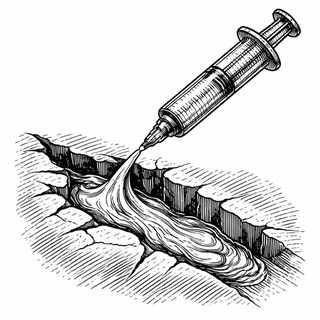
The syringe slides into the jagged wound cavity - not a neat surgical incision, but the kind of messy, irregular gash you get from a car accident or a piece of industrial equipment that didn't care about your weekend plans. The gel flows in, conforms to every crevice and contour like it's mapping the terrain, and within seconds it's a cohesive, wound-sealing barrier. No heat. No burning. No secondary damage. Just a quiet, chemistry-driven handshake between the material and your tissue.
This is COG@TA hydrogel, and the numbers behind it are genuinely impressive.
The Problem With Current Hemostatic Materials (By the Numbers)
Here's what the numbers actually say about traumatic wound management: irregular wounds are the norm, not the exception. Battlefield injuries, accident trauma, and emergency surgical scenarios rarely produce tidy geometries. Yet most hemostatic materials are designed as if wounds come in standard sizes, like buying a one-size-fits-all hat for a population that includes both chihuahuas and Great Danes.
Traditional hemostatic hydrogels carry an additional problem that sounds almost comically counterproductive - they generate heat during formation. Free radical polymerization, the chemical reaction that crosslinks many conventional hydrogels, is exothermic. So you're essentially treating a wound by slightly cooking the surrounding tissue. The medical equivalent of putting out a fire with warm gasoline.
Tissue adhesion? Often mediocre. Adaptability to irregular wound shapes? Poor. Infection protection while the wound heals? Frequently an afterthought.
A research team set out to solve all of these problems simultaneously, and they did it with three ingredients you'd find surprisingly relatable: a modified version of the stuff in shrimp shells, a plant-based gum, and the same compound that makes tea astringent.
The Ingredients: Chitosan, Guar Gum, and Tea Chemistry
The COG@TA hydrogel is built from carboxymethyl chitosan, oxidized guar gum, and tannic acid. If that sounds like a recipe your health-conscious friend might try to sneak into a smoothie, bear with me - the chemistry is elegant.
Carboxymethyl chitosan is derived from chitosan, which itself comes from chitin - the structural polymer in crustacean shells. It brings amino groups to the party. Oxidized guar gum (a modified plant polysaccharide widely used in food science) contributes aldehyde groups. When these two meet, they undergo a Schiff base reaction - a well-characterized chemical bonding process that forms a dynamic crosslinked network.
The word "dynamic" is doing heavy lifting here. Unlike permanent chemical crosslinks that create rigid structures, Schiff base bonds can break and reform. This gives the hydrogel two properties that matter enormously in wound care: self-healing and injectability. Squeeze it through a syringe, and it temporarily breaks apart. Once deposited in the wound, it reassembles into a cohesive gel. It's like a jigsaw puzzle that puts itself back together after you dump it out of the box.
And because this is a Schiff base reaction - not free radical polymerization - the gelation process is mild. No exothermic heat spike. No thermal tissue damage. The wound gets sealed, not seared.
Tannic Acid: The Overachiever
Then there's tannic acid, and honestly, this compound deserves its own fan club.
Tannic acid is a polyphenol found abundantly in tea, wine, and various plant tissues. In the COG@TA system, it dramatically enhances adhesion strength to 8.88 ± 1.45 kPa. For context, that's strong enough to keep the hydrogel firmly attached to wet, bleeding tissue - which is notoriously difficult for adhesives. (Anyone who's ever tried to put a bandage on a wet finger understands the challenge at a very basic level.)
But tannic acid doesn't stop at adhesion. It also provides:
- Antibacterial activity - reducing the risk of wound infection, which is one of the leading complications in traumatic injury management
- Antioxidant properties - scavenging reactive oxygen species that can impair wound healing
- UV-shielding capacity - protecting healing tissue from ultraviolet radiation damage
One compound, four functions. Tannic acid is the Swiss Army knife of polyphenols, and the data backs it up across every metric the researchers tested.
Shape-Shifting and Self-Healing: The Adaptive Advantage
The adaptive filling capability is where COG@TA really separates itself from the pack. When injected into an irregular wound cavity, the hydrogel flows and conforms to the wound geometry - every pocket, every crevice, every awkward angle. Once in place, the dynamic Schiff base crosslinks reform, and the gel becomes a unified structure.
Think of it like injectable silly putty with a medical degree.
This self-healing behavior also means the hydrogel can recover from mechanical disruption. If the wound shifts or the patient moves, the gel doesn't crack and lose contact with the tissue. It reforms. The crosslinked network is constantly breaking and rebuilding at the molecular level, maintaining structural integrity without brittleness.
Biocompatibility: The Non-Negotiable Checkbox
Any material destined for wound contact needs to clear the biocompatibility bar, and COG@TA passes cytotoxicity testing with strong results. The components - chitosan derivatives, guar gum, tannic acid - all have established safety profiles in biomedical literature. This isn't some exotic synthetic polymer with unknown biological interactions. It's a system built from components that biological systems already know how to handle.
The biodegradability angle matters too. The hydrogel doesn't need to be surgically removed. It degrades naturally as the wound heals, which eliminates the secondary trauma of dressing changes in deep or irregular wounds.
What This Means Going Forward
This is still preclinical research, so temper your excitement with the appropriate statistical confidence interval. But the combination of properties in a single material - mild gelation, adaptive filling, strong tissue adhesion, self-healing, antibacterial protection, antioxidant activity, UV shielding, biocompatibility, and biodegradability - represents a genuinely multifunctional approach to traumatic hemostasis.
The clinical translation path will require animal studies, safety profiling, and eventually human trials. But the foundational data suggests COG@TA hydrogel addresses real, quantifiable gaps in current hemostatic technology. It's not solving a problem that doesn't exist. It's solving several problems that emergency medicine deals with every single day.
And it does it without cooking your tissue. Which, as selling points go, is a pretty good one.
This blog post discusses research findings and should not be taken as medical advice. If you have concerns about wound care or hemostatic treatments, please consult a healthcare provider. Research discussed here represents ongoing scientific investigation and clinical validation is still in progress.
All images used in this post are decorative illustrations only and do not represent or reflect the accuracy, reality, or correctness of the referenced research.
Primary Source: Schiff base-crosslinked carboxymethyl chitosan/oxidized guar gum@tannic acid hemostatic hydrogel with mild gelation, adaptive filling, and infection protection. PubMed. 2026. PMID: 41861890